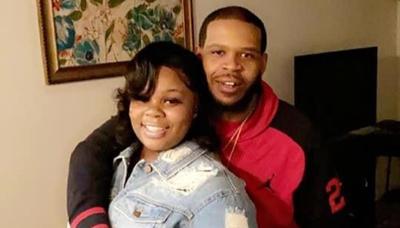
LOUISVILLE, Ky. (WDRB) -- When Louisville Metro Police Sgt. Amanda Seelye met with Kenneth Walker hours after the raid in which police killed his girlfriend, Breonna Taylor, she encouraged him to give up his right to remain silent and talk with her.
As a member of the department’s Public Integrity Unit, Seelye told Walker that she and her colleague, Sgt. Chad Tinnell, investigated “officer-involved” shootings, according to audio of the interview provided by Walker’s attorney.
“This is like the internal affairs unit,” Tinnell added. “So we’re just kind of figuring stuff out at this point, and you’ve got a pretty good perspective, and we’d always like to hear that if that would be all right with you.”
Walker told the officers he was “scared” but waived his Miranda rights and agreed to speak without an attorney for more than an hour with Seelye and Tinnell about what he said happened when officers served a "no-knock" search warrant at Taylor’s apartment early on March 13.
Just six days later, on March 19, it was Seelye who testified for prosecutors seeking to indict Walker in front of a Louisville grand jury, providing a two-minute recount of what police say happened.
She did not mention that police shot Taylor five times or that Walker said he feared for his life when he fired his weapon because he didn’t know who was breaking into the home.
Walker was quickly indicted on a charge of attempted murder of a police officer, which was later dismissed by Commonwealth’s Attorney Tom Wine, who, in part, said the case needed more investigation.
“If the public integrity unit was investigating the officers involved in the shooting, I don’t see how, at the same time, they can present the (criminal) case against Kenneth Walker,” said Rob Eggert, Walker’s defense attorney. “It raises questions about the purpose of the internal investigation. Was it to investigate what happened or pin the case on Walker?”
And even Wine said in a statement Thursday that a better practice would be "for an officer outside of PIU to investigate the underlying allegations against a suspect" in a police shooting.
A few years ago, Wine said, he "expressed concern" to then-Chief Steve Conrad about the practice of "one officer handling both investigations."
And he said Conrad agreed "there were potential issues with the current practice" but because of the shortage of resources and personnel, "the chief advised it would not be feasible to conduct separate investigations" in every case.
Wine also said there is no state law prohibiting a public integrity unit officer from testifying in a grand jury hearing of a defendant.
Wine has said that police do not legally have to present exculpatory evidence to a grand jury. He has said if the case is brought up again, however, Walker will be asked to testify.
Christopher Slobogin, director of Vanderbilt Law School’s Criminal Justice Program, concurred with Wine that prosecutors have no legal duty to present Walker’s side of the case to a grand jury.
He said it is likely that prosecutors simply needed someone with the police department who had evidence needed for an indictment, and Seelye would have had that information, given she interviewed Walker.
“She may have been the best person to deliver an anti-Walker story,” he said. “I don’t think that person would testify at trial.”
And Slobogin added that while it is “unusual” to have the internal investigator testify, there would be nothing illegal about this on the part of the prosecution.
He did say, however, that information collected in police internal investigations typically is not allowed to be released until the findings are complete, as part of confidentially rules with the union representing police.
Ryan Nichols, president of the River City Fraternal Order of Police Lodge 614, did not immediately return a phone message.
The public integrity unit turned over most of its internal investigation to the office of Attorney General Daniel Cameron on May 20.
LMPD did not comment Thursday on whether it was proper for an internal investigator in a police shooting to also present testimony against the defendant to a grand jury instead of just focusing on police conduct.
In less than two minutes, Seelye told grand jurors that Walker admitted "to being the only person to shoot from inside the apartment at police as they were making entry into the apartment."
Eggert asked a judge to dismiss the case based on the testimony, claiming Seelye misled jurors.
"The picture presented to the Grand Jury completely mischaracterizes the events that took place at Ms. Taylor’s apartment that resulted in Ms. Taylor’s death – in fact, they completely omit the existence of Ms. Taylor at all," Eggert wrote in the motion.
In his interview with Seelye and Tinnell, Walker said he and Taylor heard a “loud boom” at the door and repeatedly asked who it was but didn’t receive a response.
“So then I grab my gun, which is legal; I’m licensed to carry,” Walker told police. “I’ve never even fired my gun outside of a range. I’m scared to death.”
When the couple got out of bed and walked toward the door, it came “off the hinges” as police burst in and “I just left off one shot and then all of a sudden there’s a whole lot of shots,” Walker said. “We both just drop to the ground, like, fell.”
Sgt. Jonathan Mattingly was shot in the leg and underwent surgery for what police said were severe injuries.
While police obtained a no-knock warrant from Jefferson Circuit Court Judge Mary Shaw, Mattingly told police investigators that officers announced their presence repeatedly. A no-knock warrant gives police judicial approval to burst into a home, day or night, without giving the homeowner any notice. Police have said there is no body camera video of the raid.
Walker also said in the interview that after the shooting, an officer told him police “had a misunderstanding or something like that. To me, it seemed like they realized they were at the wrong place.”
Seelye responded: “That’s some new information for us, as well. That’s what we’re trying to learn.”
Walker asked the officers: “What are you going to do? If you’re home with your family and somebody’s beating on your door and you don’t know who it is after you’ve asked who it is?
“True,” Tinnell said.
Eggert argued in a court motion that “had the police presented the actual facts of the events … the Grand Jury presentation would have lasted longer than two minutes, and Mr. Walker would not have been indicted.”
He also argued that “had Breonna Taylor been killed by anyone except police, the person or persons responsible for her death would have been charged with a homicide.”
Copyright 2020 WDRB Media. All Rights Reserved.


