LOUISVILLE, Ky. (WDRB) – Cooking dog treats and fashioning bandanas for adoptable canines typically aren’t focal points for reading and math lessons.
But that sort of outside-the-box teaching is exactly why Klondike Elementary School teachers Rebecca Reynolds and Terri Griffin are eager to begin the second Summer Backpack League at Jefferson County Public Schools.
The program is designed to prevent the phenomenon known in education circles as the "summer slide" and to help bring struggling students entering third through sixth grades up to speed.
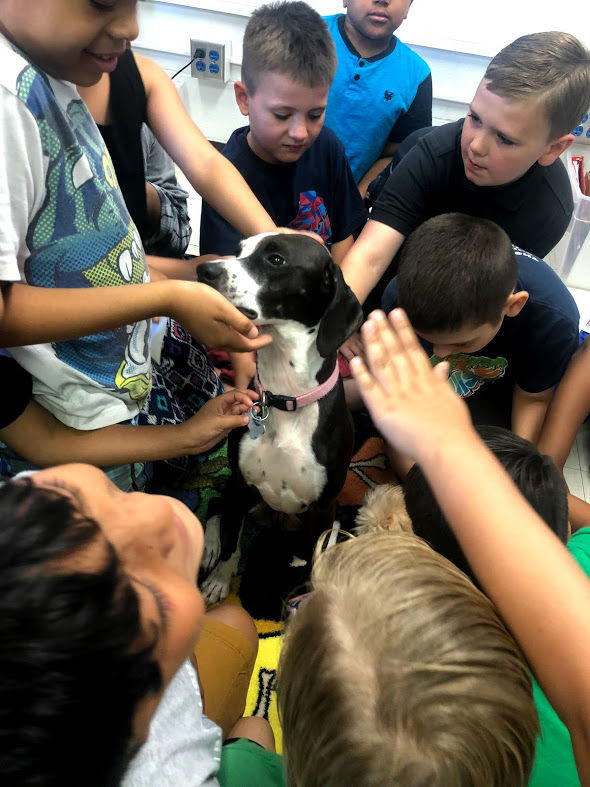
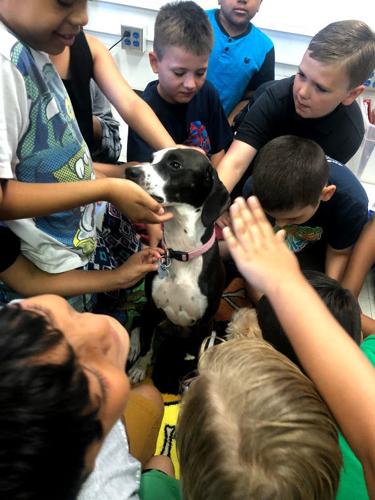
Students pet a dog during their "WILD for Animals" adventure at Summer Backpack League. (Photo provided by JCPS)
The two Klondike Elementary teachers paired up last year to lead the "WILD for Animals" adventure, which allowed students to work with the Kentucky Humane Society on projects like baking dog treats and making bandanas.
For Reynolds, the unique lessons and opportunities to step in when students need extra help were her favorite part of the program’s inaugural year. While students were busy reading directions, measuring materials and working on their crafts, Reynolds and Griffin were also busy making sure that every kid in their class understood the concepts they were teaching.
"We were able to have access to their (test) scores before we had them, so we were able to group them and be able to understand who needs help with what," Reynolds said. "They do have that fun experience of measuring, but we were right there with them. Having two teachers in the classroom was really beneficial."
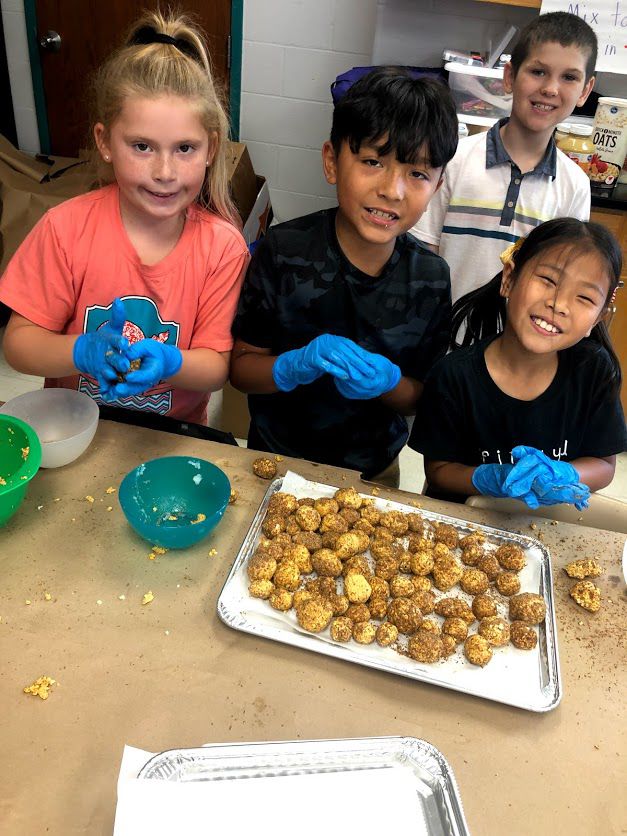
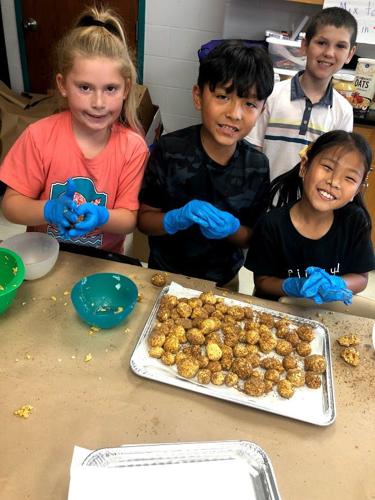
Students in the "WILD for Animals" adventure making dog treats during the Summer Backpack League. (Photo provided by JCPS)
JCPS administrators are looking to double the size of the Summer Backpack League in its second year, pushing the total cost to more than $2 million for the free, four-week program.
However, data obtained by WDRB News show that student attendance hovered just above 50% and that more than a quarter students enrolled, 262 out of 955, never stepped foot inside Male High School, the Summer Backpack League’s central hub, despite the district providing bus transportation for everyone who signed up.
Overall attendance was 55%. When those who never attended a single session are factored out, that rate improves to 74%, according to JCPS.
The district, which is pushing schools to improve student attendance, had an overall attendance rate of 93.2% in the 2018-19 school year, district data show.
JCPS leaders didn’t have the results of the latest K-PREP exams and state accountability scores as they developed the first Summer Backpack League, but those results, based largely on standardized tests taken before the summer learning program began, shed some light on the makeup of the student population.
Numbers provided by JCPS in response to open records requests by WDRB News show that 33.6% of students who regularly attended came from some of Kentucky’s lowest-performing schools, which were identified for comprehensive support and improvement, or CSI, based on last year’s accountability results.
Combined, students who attended one- and two-star schools based on the most recent state accountability scores made up 60.3% of the students who came to Summer Backpack League at least once. Students from three-, four- and five-star schools comprised the remaining 39.7% of regular attendees.
Another consideration on the program's student population is that the state did not identify any new schools for less stringent targeted support and improvement, or TSI, under a deal reached with the U.S. Department of Education in September. All but 11 of the 418 TSI schools met the state's exit requirements based on their 2018-19 accountability results.
Schools could have landed on that list if any student subgroups performed the same or worse than students in the bottom 5% of schools based on test scores.
Norton Elementary, a five-star school based on 2018-19 results that tied for the second-most students who attended Summer Backpack League with 31, landed on the list of TSI schools last year because of low scores from students with special needs. While disabled students' scores improved in 2018-19 and the achievement gaps between them and students without disabilities shrunk slightly, students with special needs lagged others by 37.7 percentage points in reading and 38.6 percentage points in math.
Based on 2017-18 K-PREP results, 17.9% of students who came to at least one Summer Backpack League class attended CSI schools identified that year while 67% came from TSI schools.

Carmen Coleman, chief academic officer for JCPS who helped design and build the Summer Backpack League, said the district is doing more to specifically get students who need the extra summer help into the program.
Those efforts include working with Family Resource and Youth Services Centers, school counselors and academic coaches to identify students who truly need such academic interventions and directly reach out to their families about enrolling in the summer program, she said.
"Last spring, again, we were putting it together so quickly, just trying to get the program up and running was almost the goal," Coleman said, likening the $1.2 million program’s launch to opening a brand new school. "This year we’ve been able to think much more intentionally and strategically.
"I believe that we have to invest our resources in our students who need some additional support," she added.
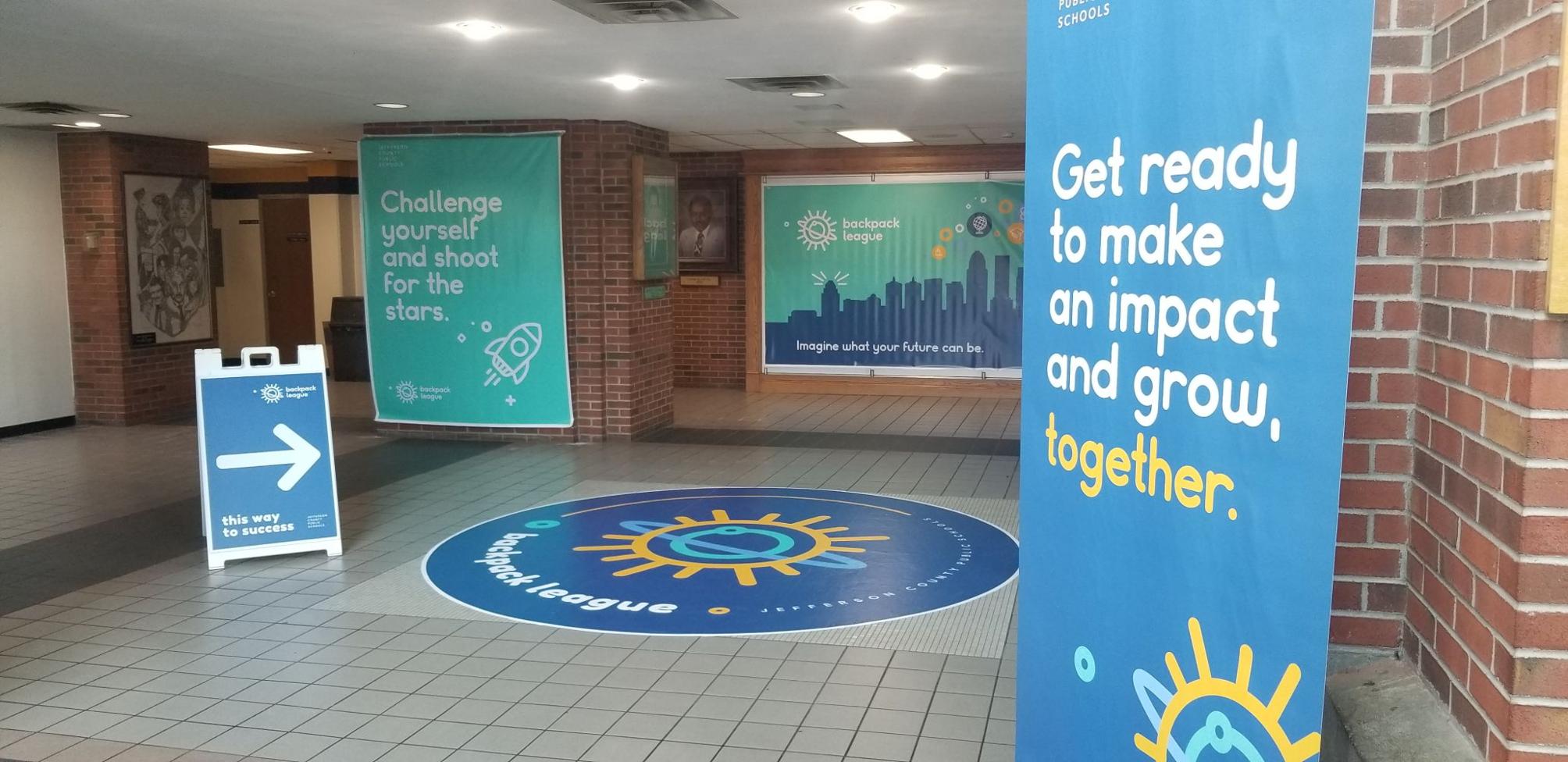
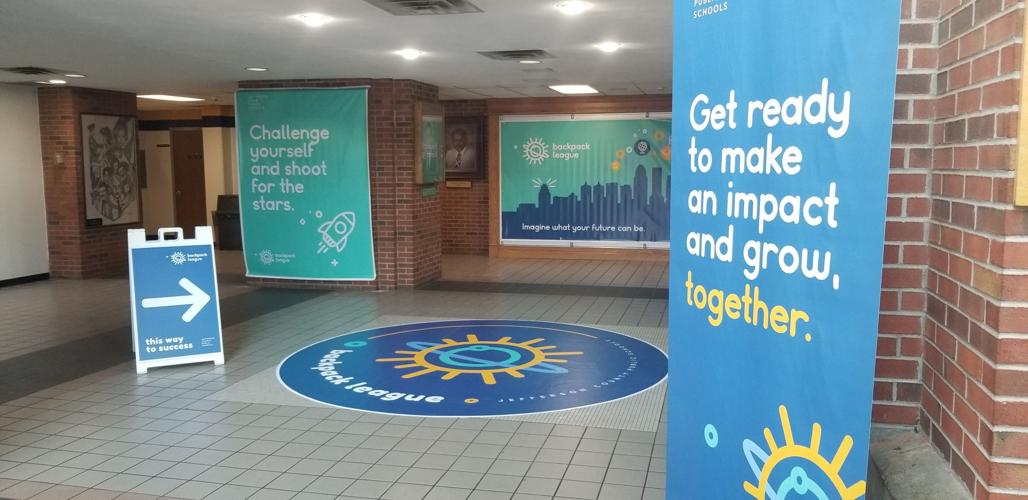
The front lobby of Male High School welcomes parents and students to the Summer Backpack League, a four-week summer learning program aimed at helping kids who struggle in reading and math.
Coleman also hopes to boost student attendance this year through incentives and outreach.
While the district tried to eliminate barriers by providing bus transportation, breakfast and lunch for students in the Summer Backpack League, Coleman conceded that attendance at summer programs "is a challenge" for various reasons, such as preplanned family vacations.
To that end, JCPS is reaching out to families to see whether any unforeseen barriers still stand in the way of their child’s attendance.
"That’s part of our planning right now," Coleman said. "We want to know why to see if that will help us. Were there barriers? What on our end could we do to control that?"
The district has divided the four-week program into two two-week periods from June 15-26 and July 6-17 to not only give families advanced notice and flexibility to plan their vacations, but also to boost interest from teachers who might not have been able to commit to lead Summer Backpack League adventures for the full four weeks last year. Teacher can choose to lead two-week classes instead of the full four weeks.
Coleman and other administrators – such as the Summer Backpack League’s project manager, Ray Yaksic – have already begun planning for this summer’s program, which will offer 40 adventures led by about 80 teachers.
That’s an increase from the 27 adventures led by 56 JCPS educators in last year’s offering, according to a teaching roster provided by the district. Educators and others involved in the initiative met Wednesday for orientation.

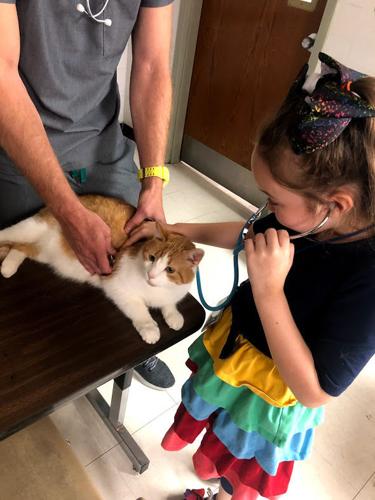
A girl checks a cat's vital signs at the Kentucky Humane Society during Summer Backpack League. (Photo provided by JCPS)
Data provided by JCPS show that of the 56 teachers who led adventures during Summer Backpack League last year, 14 came from schools currently identified as CSI. That’s a quarter of the teaching roster, all of whom got to keep their district-provided materials to implement in their instruction this school year.
Coleman said she wanted to find teachers who are passionate about education and ready to try new teaching strategies regardless of where they work.
"I want teachers who are willing to try new things that then we can all learn from to make learning experiences day-to-day more engaging for our kids," she said.
Coleman is cautiously optimistic that the Jefferson County Board of Education, which controls the district’s purse strings, will ultimately approve doubling the size of the Summer Backpack League.
Board members, she said, "want us to do everything we can to accelerate learning for our students who need it most."
"I can’t answer what ultimately they will do, but I can tell you that I know they want our students to be successful just as much as we do," Coleman said.
During a Nov. 26 work session, some school board members suggested that more time and academic data may be needed before the program’s expansion.
Demographic data presented at that meeting show that 52% of students enrolled in the Summer Backpack League were black, 67% qualified for free or reduced-price lunch, 15% had special needs and 5% were learning English.
Scores on Measures of Academic Progress, or MAP, tests indicate that fourth-, fifth- and sixth-graders who regularly attended the program either maintained or improved their reading and math scores from spring to fall.
The only notable decline was a one-point dip in fifth-grade reading MAP scores.

Board member Linda Duncan, who represents District 5, says she wants to know whether the Summer Backpack League helped students attain proficiency in reading and math and how the district plans to get more of those students in the program before she can endorse doubling its capacity.
And even then, her support for expansion comes with a caveat.
"Only if we double the size of the kids who are struggling and need it, not just doubling the size of the program," Duncan said. "… They’re the ones that I want us to target, so if we doubled their number and we got double of those kids to participate, that would be a positive for me."
Reynolds and Griffin say they saw students progress academically and socially throughout the four-week program. Students were able to add projects completed during the program as "artifacts" in their Backpack of Success Skills, a transition readiness initiative from the district on which the summer learning program was based.
Griffin said one young girl entered their Summer Backpack League adventure quiet and reserved. By the time her class showcased their work at the end, she was more than eager to show Coleman everything she learned and all of the artifacts she had uploaded into her digital backpack.
She and other students also had treats for Coleman to take home to her dog.

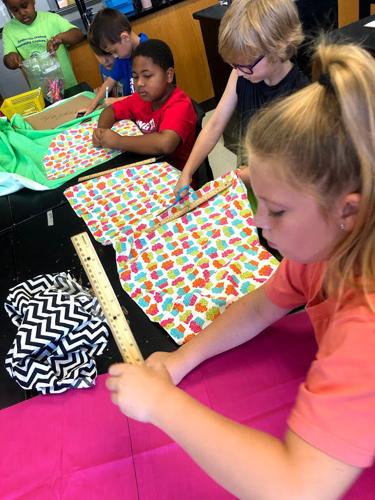
Students measure cloth to make bandanas for dogs during Summer Backpack League. (Photo provided by JCPS)
"I think it’s a worthwhile program," Griffin said, noting that students were also able to visit places like Henry's Ark during one of the class field trips last summer. "I think it’s so great for kids who don’t have an opportunity for other things."
While a lot of their supplies went to the Humane Society, Reynolds and Griffin said they brought iPads purchased for their Summer Backpack League class back to Klondike.
They’re already planning for this year’s offering, albeit in separate adventures this time.
Griffin, who is partnering with another educator to continue teaching the "WILD for Animals" adventure, has her eyes on either buying or borrowing a 3D printer so her students can design and build their own animal shelters.
Reynolds will be getting fifth- and sixth-grade students certified in G Suite, meaning they’ll be proficient in the various applications offered by Google.
Asked how many of her students last year needed to attend the Summer Backpack League, Reynolds didn’t hesitate with her answer.
"All of them," she said. "Even if scores were high when they came in, an increase in score, I would hope, would happen."
Copyright 2020 by WDRB Media. All rights reserved.


