

(WDRB/InvestigateTV) — It's a common complaint heard all the time: prices for just about everything are expensive.
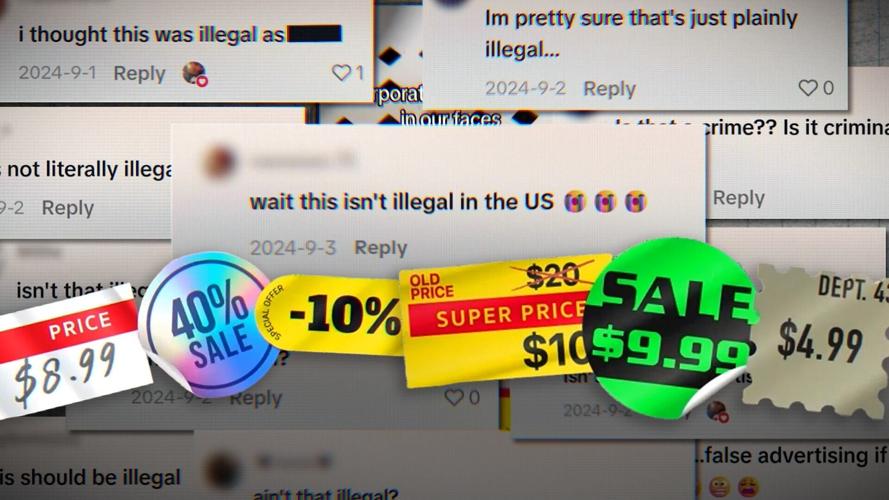
But what you're paying may not be fair, it could even be illegal. Many may not know that some retailers may be taking advantage of shoppers through deceptive pricing tactics.
A shirt found at Macy's, marked 40% off of $149, kicked off an examination into sales prices. Behind that sale sticker, the original price of the shirt appeared to be lower than what was listed on the discount tag. At 40% off and if the original MSRP tag was used ($109), the shirt should have cost $65 instead of what was listed: $89.
Macy's did not specifically address the pricing discrepancy when asked for comment, but noted that stores "often offer different limited-time sales events."
"Our pricing cadence varies, based on the nature and seasonality of the merchandise," the company said.
Researchers tracked 25 retailers over six months
A former Dollar General employee in Alabama, Ashtyn Kennedy, said she was instructed by corporate to place "sale" stickers on items that were not actually discounted.
"So they actually marked it up and then made it look like it was on sale," Kennedy said. "And I was like, that's wrong."
Kennedy said the practice was routine during her time at the store.
"That one day alone, I did that at least five or six times to other products," she said. She added that she estimated "a solid 40% of the stickers I put out were manipulative price descriptions."
Dollar General, in a statement, said: "The company denies that it engages in any pricing activity designed to mislead its customers, including raising prices in connection with promotional activities."
But allegations like this are not unique to one company and they are not new.
Kevin Brasler, executive editor of Consumers' Checkbook, a nonprofit consumer advocacy group, said his organization has studied the issue for more than a decade.
"The problem just gets worse and worse, especially when it comes to these fake sales," Brasler said.
He said altering the original price isn't the only problem.
His group tracked 25 major retailers for six months beginning in February 2025 and found that discounts at most stores were continuous — meaning retailers rarely, if ever, intended to sell items at the listed "regular" price.
"When you say something's the list or regular price, it should be your list or regular price, the price you usually charge for the item," Brasler said. "In most stores, they rarely have ever charged that list price."
Among the most frequent offenders cited in Brassler's report for running constant sales: Gap, JCPenney, Bass Pro Shop, Wayfair, and Dick's Sporting Goods.
None of those companies responded to multiple requests for comment.
"Week after week, we found that retailers are constantly pushing these fake discounts, so there is no rush," Brasler said. "But the environment makes it seem like I'd better get moving now before the special deal goes away."
Both inflating an original price before a sale and advertising a fake list price violate the FTC Act, according to Monica Vaca, a former deputy director of the FTC's Bureau of Consumer Protection.
FTC enforcement limited
Brasler said a part of the problem is that the Federal Trade Commission "hasn't enforced its own rules" on deceptive pricing in more than 40 years.
"They've been unwilling to go on the record with me about why," Brasler told us.
We reached out to the commission as well and did not receive a response either.
Vaca said the FTC's ability to hold retailers accountable is limited. In 2021, the agency lost its authority to recover money for consumers in cases involving unfair or deceptive acts or practices in commerce.
"The FTC can go into court and get an injunction. They can try to get a court to stop that conduct. What they can't do is get money back," Vaca said.
State and local action leads to settlements
While federal enforcement may not often go after deceptive pricing in retail stores, state and local authorities have pursued cases to hold companies accountable.
Vaca said that alerting your state attorney general's office or a local consumer protection authority could lead potential action against a company. And in many cases, they have.
District attorneys in California reached a settlement of more than $5 million against Walmart for scanner price overcharges and false advertising.
A class action lawsuit accused Ann Taylor Factory and Loft Outlet of false discounts and reached a settlement.
Missouri's attorney general filed suit against Dollar General, alleging the company charged customers higher prices at the register than what was posted on shelves.
Vaca said those cases only happen when consumers report questionable pricing.
"I don't think most people really know that it is against the law," Vaca said. "We may all have a gut feeling that, hey, this price isn't right … and most of us just sort of roll our eyes and decide that we're not going to buy that product that day."
How to report potentially deceptive pricing
The next time you're in a store and the price seems wrong, consumers can take a photo and contact their state attorney general or local consumer protection office.
Reports can also be filed with the FTC at reportfraud.ftc.gov. Even if the FTC does not investigate, reports create a record that could assist investigators in future cases.
The National Retail Federation, the world's largest retail trade association, did not comment on Consumers' Checkbook's report and did not respond to questions about whether it communicates FTC pricing guidelines to its members.
Copyright 2026 Gray Media Group, Inc. All Rights Reserved.