

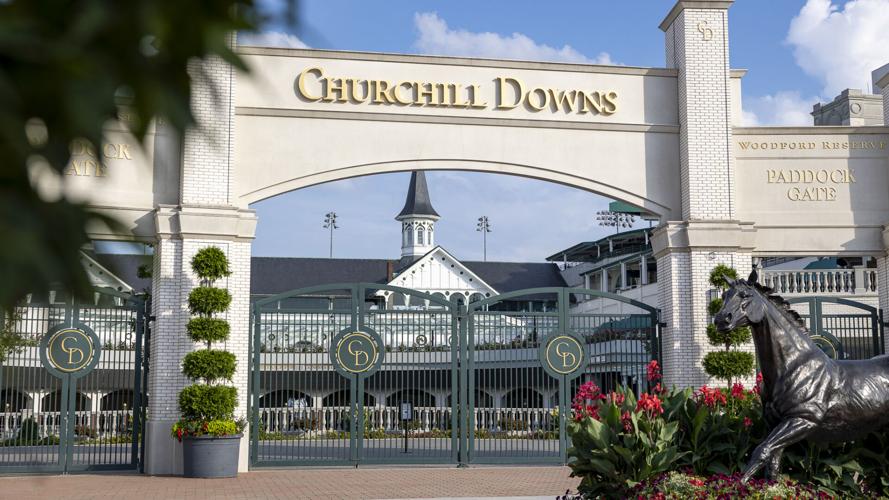
LOUISVILLE, Ky. (WDRB) -- Louisville Metro Council passed a resolution Thursday extending tax breaks for Churchill Downs for another 30 years.
Metro government has held title to the racetrack and surrounding parcels since the early 2000s as part of a plan to help Churchill finance a series of improvements to the Central Avenue track.
Under that arrangement, the city technically owns the land and leases it back to Churchill until 2032. The Louisville-based racetrack and gambling company gets a reprieve on property taxes, although it does pay Jefferson County Public Schools an amount meant to equal the taxes it otherwise would get.
City approval of an Industrial Revenue Bond was once again needed for Churchill's four-year, $920 million expansion plan announced in February.
The work includes rebuilding the Skye Terrance and adding a new five-story entertainment complex, along with permanent infield seating.
The measure is needed for Churchill to receive up to $1.2 billion in bond proceeds for new development projects planned for the iconic racetrack home to the Kentucky Derby. The city must approve the industrial revenue bonds (IRB), although it isn't responsible for paying off the debt.
Council members Kevin Kramer, R-11, and Markus Winkler, D-17, sponsored the legislation and said the Churchill project would "result in economic development and the creation of new job opportunities" in Louisville. At the time of its introduction, Winkler said the new deal sought to help Churchill Downs at a time when other homegrown companies like KFC and Papa John's have migrated their headquarters from Louisville.
When the resolution was introduced in April, Metro leaders said they wanted to make two major changes. First, the city would retain ownership of the land for 30 more years, or until roughly 2055. The version passed Thursday allows the city to maintain ownership and extends the IRB. The IRB, Winkler said, allows the city to 'give' its preferential borrowing status to a private entity, which gets to issue bonds "at lower rates as well as a forbearance on the property tax." Winkler said Metro government "does not have any obligation under the bonds (they are not on our books) but does lose the potential property taxes."
The IRB would not use the city's credit and the city would not be required to support the bond if Churchill Downs failed to make a payment. Councilmembers said the IRB would instead help lead the way towards $200 million to up to $1 billion in capital investment."
The second change would have sent Churchill's "payment in lieu of taxes," also known as a PILOT, to Metro government coffers and not JCPS, as it has since 2002. But councilmembers reversed course on that change during a Metro Budget Committee on Tuesday, deciding leave the money with the school district.
JCPS said at the time it was caught off guard by the new compact and said its 2002 deal "remains in force." The legal agreement between Churchill and JCPS, which WDRB News obtained in April through a public records request, said it remains in effect as long as the racetrack property stays tax exempt.
Kramer said JCPS' attorneys told councilmembers that they did not have the authority to change the PILOT language, adding that whether Council has the authority or not, Mayor Craig Greenberg felt it wasn't something worth challenging and wanted to work with the district to reach an agreement, which they did. The agreement says that any additional revenue they receive as a result of the PILOT will be used to fund workforce development so it isn't put on the chopping block as the district looks at making cuts to address a multimillion-dollar budget deficit.
The "payments in lieu of taxes" to JCPS have increased in recent years after WDRB News found that the track had not been reassessed for tax purposes despite new additions and construction.
Winkler said in a statement Friday there was "much debate" about the issue during Thursday night's Metro Council meeting, primarily over concerns about giving a large entity a tax break.
"While I think these concerns are fair, I reminded my colleagues that all public dollars begin in the private sector. We are dependent on companies being in Louisville to employ our residents. We have too often been a city of 'no' - and that has, at least in part, led to the departure of several large companies," Winkler's statement continued. "For us to compete for jobs, I think it is very important that we are a city of 'yes' - one that is open for business and easy to work with. For me, the vote to support the IRB was less about the direct benefit the track expansion provides to Louisville and more about the message we send to the broader business community about how we are to work with."
Councilwoman Jennifer Chappell, D-15, whose district includes Churchill Downs, spoke against the legislation Thursday night and said it is not a relationship she takes lightly. However, she could not support the extension of the IRB, citing Churchill Downs' annual revenue of $2.734 billion in 2024.
"That's $370 million in net income for the first nine months of 2025 — not revenue. They have paid their bills and still have well over a quarter of a billion dollars for 9 months' profits, and we just finished the fall meet, which will surely inflate that dollar amount by the time we're ringing in the new year," Chappell said.
Chappell said with those numbers in mind, she would recommend Churchill Downs "save and budget their money in a more judicious manner over the next three decades instead of relying on government handouts."
Ultimately, the legislation passed 18-7, with one person voting "present."
Since 2019, the more realistic tax treatment of the racetrack has generated nearly $4 million of additional funding for Jefferson County Public Schools, according to school district records obtained by WDRB.
This story may be updated.
Related Stories:
Louisville ordinance proposes 30-year tax break for Churchill Downs
In a reversal, Louisville's mayor backs Churchill Downs payment that aids JCPS
'Victory Run' | Churchill Downs announces another multimillion-dollar project
Citing 'tariff and trade disputes,' Churchill Downs hits pause on $920 million construction plan
Churchill Downs crews finishing $80 million courtyard, pavilion project ahead of Derby 151
Churchill Downs plans 4-year, $920 million project to transform infield, grandstand seating
After historic Kentucky Derby 150, Churchill Downs lays out major renovation plan
Copyright 2025 WDRB Media. All Rights Reserved.


