FRANKFORT, Ky. (WDRB) – Educators from across the state are helping the Kentucky Department of Education re-evaluate a new accountability standard that tracks students’ academic growth and is among factors that identify Kentucky’s lowest-performing schools.
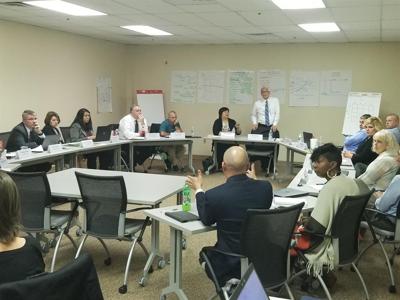
The 15-member Growth Indicator Work Group met for the first time Wednesday, laying out their concerns with the new standard and brainstorming possible changes ahead of next fall’s test data release.
The current growth indicator, which is in its first year, determines whether elementary- and middle-school students are on pace toward proficiency in reading and math based on at least two years of their testing data, their current results and how other students who scored similarly fared in later tests.
Schools are scored based on those projections, and students earn points for their schools as they demonstrate potential improvement. Students expected to remain in the same novice or apprentice categories for two years get no points, and students who test proficient or distinguished in math and reading and are expected to remain there earn 0.25 points.
But those projected to slip lose points for their schools. Dropping from proficient to apprentice low, for example, will cost schools 0.5 points.
A number of educators on the panel said such methodology is confusing and focuses on projected growth rather than actual year-to-year growth.
Teresa Nicholas, an assessment coordinator at Pulaski County Public Schools, said one of the biggest complaints she had heard even before the new accountability standards came into place was that schools weren’t given credit for students’ academic growth.
“Even if the kids weren’t on track to reach proficiency or not reaching proficiency, we were still growing, and if we’re given growth points, then give growth points when we grow kids,” she said during Wednesday’s meeting.
Nyree Clayton-Taylor, a teacher at Wheatley Elementary and the state’s elementary school teacher of the year, said the new growth indicator was unclear to her colleagues after it was rolled out.
“They really don’t understand,” she said after the meeting. “It’s just something that came out and we were told what it meant, and so we’re just following procedure. This was eye-opening to me just so I can understand what it all means and how I can explain it and why our scores are the way that they are.”
Academic growth was one of the accountability standards used to determine whether schools need comprehensive or targeted support and improvement. Fifty-one schools across the state were identified for comprehensive support while 418 were identified for targeted support.
Teachers and district leaders shouldn’t expect the growth indicator to be scrapped. Rhonda Sims, associate commissioner of assessment and accountability, said the new standards have been two to three years in the making and that growth was something that stakeholders wanted to see calculated.
“Really what we heard from parents and others is, ‘We think growth is important,’” Sims told WDRB News. “Not just where kids are currently performing, but am I getting better even if I start lower.”
However, it seems less likely that projections will be part of the equation in the work group's recommendation to the Kentucky Board of Education.
The work group was split between growth methods that looked at achievement based on student percentiles and achievement based on levels attained, and KDE staff reconfigured the current growth model without projecting student performance and penalizing schools for students who drop in proficiency.
Education Commissioner Wayne Lewis called growth an “essential” piece of the state’s school accountability standards but said KDE has fielded more concerns about the growth calculation “than any other aspect of the accountability system.”
Many of those concerns are shared by the state, he said, though he saw positive examples of schools that demonstrated academic growth in testing data released last month.
“When you take a look at our schools’ performance, there are schools who by proficiency rates in this last cycle have proficiency rates far from where we want it to be, but their growth was really impressive,” he told the work group. “And it was their growth and their level of growth that kept them from being identified as CSI schools, and I think that is worthy of consideration in the accountability system.”
Reach reporter Kevin Wheatley at 502-585-0838 and kwheatley@wdrb.com. Follow him on Twitter @KevinWheatleyKY.
Copyright 2018 WDRB Media. All Rights Reserved.


