



LOUISVILLE, Ky. (WDRB) -- Literacy rates in Indiana have been declining for more than a decade as now nearly one out of every five third graders didn't pass reading tests last year.
Since 2012, the number of Indiana students who can't read at the end of third grade has more than doubled, according to literacy rate date released on Tuesday. As reading scores have decreased, retention rates also decreased, which means thousands of students enter fourth grade unable to read.
Gov. Eric Holcomb said he supports holding back third graders who don't pass the reading test, IREAD-3.
"We must improve policies around third grade reading to make sure that every child masters this essential skill," Holcomb said.
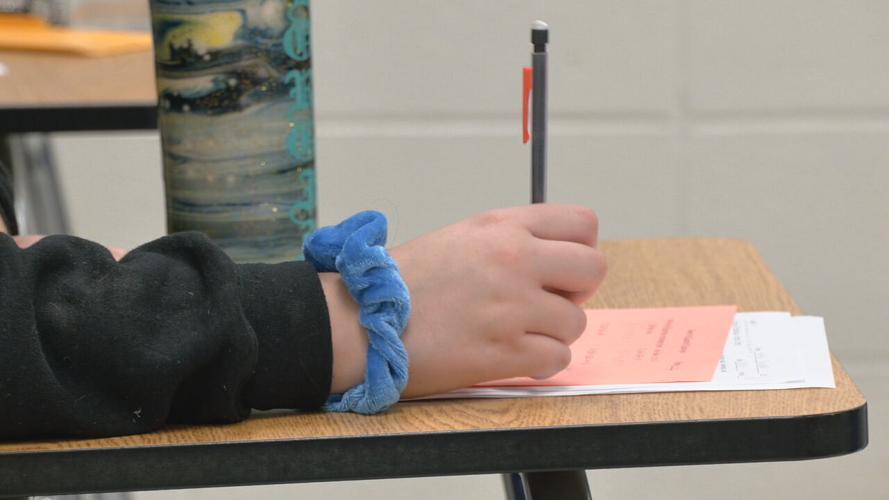
IREAD-3, which is an online, timed, multiple-choice assessment consisting of three separate test segments. The test taken annually in March measures foundational reading skills like phonics and vocabulary.
The state's current policy is to keep students from moving to the fourth grade, but many students are promoted anyway.
"Retention is not the answer," said Kimberly Hartlage, deputy superintendent of Greater Clark County Schools.
Holcomb plans to tight up the pre-existing policies on retention, requiring third grade students who fail IREAD to be held back for at least one school year.
Donna Reed has two children, Jackson and Sophie, in Greater Clark County Schools.

Brother and sister Jackson and Sophie Reed are students at Greater Clark County Schools.
"I worry about taking the teacher's opinion out of those choices, whether to promote a child or not," Reed said.
While Reed's children are now in fifth and sixth grade, she still remembers their testing anxiety surrounding the IREAD test.
"They did have some stress because they understood that it was a barometer of their success," Reed said.
Jackson and Sophie Reed both passed the test, but their mother knows not every student is a good test taker.
"Kids are kids, and we need to allow them to be children," Reed said. "Because learning looks different for each person."
If her children would have failed IREAD, Reed said she would have wanted her kids to have extra resources. She believes that choice shouldn't come from lawmakers and instead be up to the teachers who interact with children the most.
"And then the teacher could make the decision on whether they're ready for the programming in the fourth grade after those interventions have taken place," Reed said.
According to last year's IREAD results, Greater Clark County Schools has an 83.1% reading proficiency level.
"In this day and age, we have many students who are transient they move from one building to another building or district to district," Hartlage said.
If more students are held back, classes sizes could become too large and schools might not have enough staff or resources to keep up, according to Hartlage. She said the best solution for her district is a strong intervention program.
"Even though they're retained, that's not going to be the surefire way to get them to build a better foundation to be successful in and reading," Hartlage said.
According to the Indiana Department of Education, 81.9% of third grade students in Indiana demonstrated proficient reading skills. That's a minimal 0.3% improvement from the 2021-22 school year. Overall, reading proficiency slightly improved for Black students, students in special education and English learners. Reading rates declined for Hispanic students.
Of about 14,000 students who did not pass the test, about 72% were eligible for free or reduced-price lunch.
With the goal of having 95% of third graders reading proficiently by 2027, Indiana has invested more than $170 million to improve the state's literacy rates. Programs like Indiana Literacy Cadre and Indiana Learns offer support for students.
People can view the percentage of students able to read by the end of the third grade, number of students not able to read by the end of the third grade and the number of students who are proficient in math, among other benchmarks with this new tool. To view the visualization tool, click here.
Other stories about education:
- Number of Indiana students unable to read doubled since 2012
- Kentucky Board of Education releases survey on state's educational needs
- Southern Indiana school district expected to use grant money to help their employees with child care
- Deadline looms for Louisville families navigating JCPS school choice
Copyright 2024 WDRB Media. All Rights Reserved.