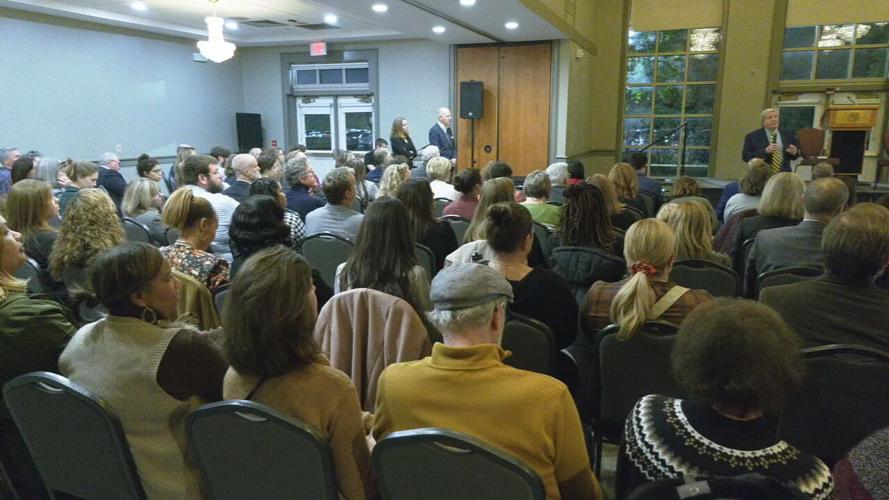


LOUISVILLE, Ky. (WDRB) -- The debate of school choice for students in Kentucky continued at a panel discussion hosted the University of Louisville on Monday evening.
When Kentucky lawmakers meet next month for the 2024 Regular Session of the General Assembly, school choice, and what that could look like is expected to be brought up.
Kentucky Youth Advocates hosted a panel discussion with varying opinions on what vouchers would mean for the state and its students. Vouchers allow qualifying families to receive a credit to attend alternative schools, like private schools, but opponents say it would take away from public school funding.
Bills promoting charter schools and private school-related tax credits were among the most contentious faced by Kentucky lawmakers in recent years, splintering Republican supermajorities. Gov. Andy Beshear vetoed those school-choice measures, but enough GOP lawmakers voted to override his action.
Last December, Kentucky's Supreme Court struck down a state law, House Bill 563, that allowed donors to receive tax credits for supporting private school tuition. The high court said the 2021 measure violated the state's constitution as the justices upheld a lower court ruling.
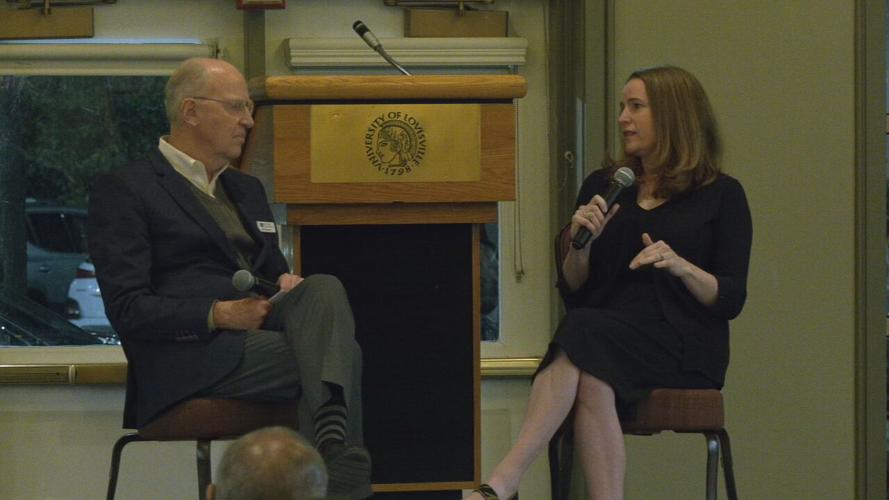
The event started with an interview with Cara Fitzpatrick, a Pulitzer Prize winning journalist who wrote "The Death of Public School: How Conservatives won the war over education in America." The book examines the history of school choice, government funding for private schools and political strategies for educational equity.

Cara Fitzpatrick speaks at the University of Louisville on Dec. 4, 2023.
"Our country arrived at the definition of public education in the 1800s which was basically the idea that school is free to students, it's secular and in theory it's open to all," Fitzpatrick said.
Fitzpatrick used the state of Florida as an example, saying state funding goes to public schools, charter schools, private schools via vouchers, along with home schooling. She said it pushes the idea that public education can be anything that is paid for by state dollars.
"It's been a conservative led issue in a lot of ways, and some of the successes, there moments of bipartisanship in key places," Fitzpatrick said. "Even the bipartisanship that developed around charter schools now there has been a backlash by the Democrats in the last few years. It's one of the issues that people tend to feel strongly one way or the other."
When asked about the possibility of Kentucky lawmakers putting an amendment for vouchers on statewide ballots, Fitzpatrick sided with local control of schools.
"If you want to make everyone in the local district mad, that's the way to go," Fitzpatrick said. "The hallmark of American education has been local control. There are good things about that and there are bad things about that. One of the good things about that is that whatever the local community is doing with their schools generally reflects the values of the local community."
The panel discussion followed and included Kentucky state Rep. Tina Bojanowski, who is also a JCPS teacher, Kentucky state Sen. Lindsey Tichenor, Andrew McNeil, president of KY Forum for Rights, Economics, & Education (KY FREE), Corrie Shull, member of the JCPS Board of Education, Jerry Stephenson, minister of Midwest Church of Christ and Al Cornish, CEO of Closing The Gap Consulting.
The panelist all agreed education should be an equalizer for children. Tichenor said every child should be looked at individually for their educational path.
"It should be the great equalizer, it depends on where people start and where they finish, and the journey in between has everything to do with it can be that equalizer," Tichenor said.
Stephenson believes parents should have a choice, saying what's currently offered isn't working for children. He posed the question, "what's wrong with a little competition?"
"We know that 75% of our low-income and African American children are not receiving an adequate education," Stephenson said. "I believe in public education, I'm a product of it. But public education is not what it was when I was a child."
He said charter schools are one of the answers to improve education.
Shull said Louisville families already have a variety of educational options offered by JCPS.
"JCPS is a district that encompasses an enormous amount of choice, we have options," Shull said. "The challenge is finding that which that your child needs, and selecting a school that will be responsive to their learning styles."
McNeil countered Shull's meaning of the definition and said school choice means resources follow the student wherever they choose to attend.
Tichenor advocated for educational diversity. She said expanded offerings could help the state, but charter schools still haven't been operational in Kentucky. School choice advocates are pledging to mount an effort next year to put a school choice constitutional amendment on the statewide ballot for voters to decide.
"Vouchers was the buzz word in the last election in the governor's race," Tichenor said. "We can't move to a discussion on vouchers unless we have an amendment that has passed that allows the General Assembly to act in that manner."
Opponents of the tax credits said they would have cost the state up to $25 million a year — money they said could go to public education. Cornish and Shull agreed taking away state funding would hurt JCPS and local school districts.
"Would taking dollars away from that education system make it better? Ask yourself that question. I don't personally believe that it will," Cornish said.
"It's entirely a direct target at JCPS," Shull said. "I think the state would do well and would benefit by first fully funding public schools."
The General Assembly is scheduled to convene on Jan. 2, 2024 for 60 legislative days.
Indiana has a school voucher program and expanded its income-requirements this past year, meaning more families are eligible for vouchers than before.
Related Stories:
- Kentucky Supreme Court decision to strike down school choice law brings mixed reactions
- Judge finds Kentucky school choice program unconstitutional
Copyright 2023 WDRB Media. The Associated Press contributed to this report. All Rights Reserved.