


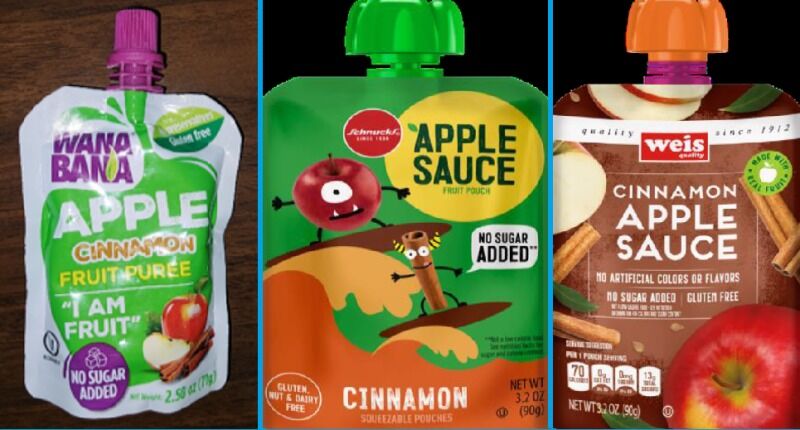
LOUISVILLE, Ky. (WDRB) -- The U.S. Food and Drug Administration has reported three illnesses in Kentucky tied to recently recalled fruit pouches tainted with lead.
The FDA is conducting an ongoing multistate investigation into children getting sick from apple cinnamon fruit puree pouches.
The agency recalled the pouches in November over dangerous lead contamination after reports of children who had been exposed to certain brands of the pouches having elevated blood lead levels.
Friday, the Louisville Metro Department of Public Health & Wellness said the FDA had reported three cases in Kentucky as of Nov. 28.
The agency said there have been 57 reported cases of "adverse events potentially linked to" the recalled products in multiple states as of Nov. 30. Confirmed cases are in children who are less than 1 to 5 years old, the FDA said.
The pouches were marketed to parents and children under three brands: WanaBana apple cinnamon fruit puree and Schnucks and Weis cinnamon applesauce pouches, the Associated Press reported. They were sold by national grocery chains, including Dollar Tree, and online retailers such as Amazon.
Parents should dispose of the pouches by emptying the contents into the trash and discarding the packaging, the agency said.
The FDA said it is still investigating the source of the contamination in cooperation with the U.S. Centers for Disease Control and Prevention. The agency previously said cinnamon imported from a manufacturer in Ecuador was the “likely source” of the lead contamination.
The FDA's latest update, posted Nov. 30, said the distributor of WanaBana products confirmed through an investigation that the cinnamon used to manufacture the recalled pouches was supplied by a third-party distribution company located in Ecuador.
"The FDA is continuing to work with Ecuadorian authorities to investigate the source of the contamination and to determine if the cinnamon in the recalled products was used in other products or distributed as a raw ingredient to other countries," the update read.
Lead exposure can lead to serious learning and behavior problems. Heavy metals like lead can get into food products from soil, air, water or industrial processes, according to the American Academy of Pediatrics.
There’s no safe level of lead exposure, but the CDC uses a marker of 3.5 micrograms per deciliter to identify children with higher levels than most. The affected children’s blood lead levels ranged from 4 to 29 micrograms per deciliter.
Copyright 2023 WDRB Media. All Rights Reserved. The Associated Press also contributed to this report.


