


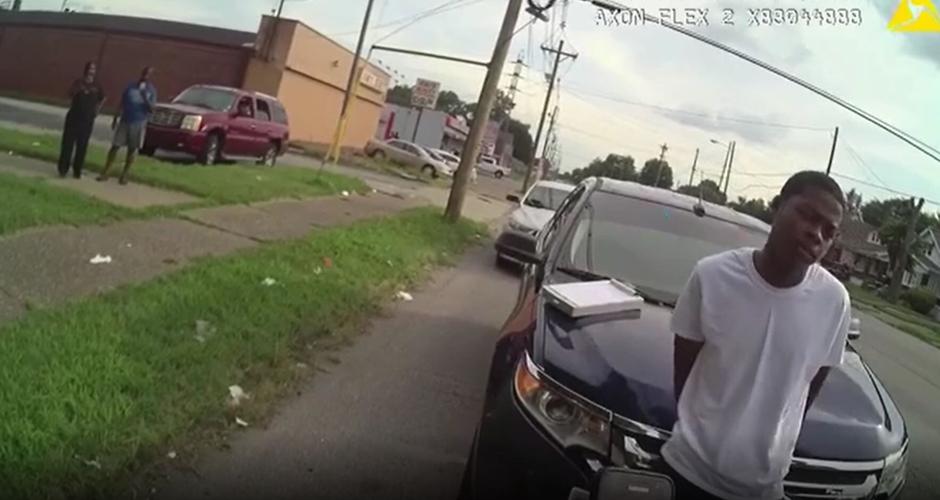
LOUISVILLE, Ky. (WDRB) — The Louisville Metro Office of Inspector General called for immediate action Monday after internal records obtained by WDRB showed Louisville Metro Police Department officers searched Black drivers more than twice as often as white drivers last year and were less likely to find anything illegal when they did.
Louisville Inspector General Edward Harness's office said in a statement the data is alarming.
"These findings are not merely statistical," the OIG said in a news release Monday. "Each traffic stop and discretionary search represents a direct exercise of governmental authority against an individual. When one racial group accounts for a larger share of stops and is searched substantially more often, while those searches were less likely to uncover evidence supporting further enforcement action, LMPD must determine whether officer discretion, supervisory practices, enforcement strategies, or departmental policies are contributing to the disparities."
The data, drawn from a report produced by Sigma Squared — a data firm LMPD hired for $350,000 — found Black drivers were searched 133% more often than white drivers overall. When controlling for similar factors such as age and location, the disparity narrowed but persisted: Black drivers were still searched 66% more often than white drivers in comparable situations.
The report also found discretionary searches of Black drivers produced an 11% lower hit rate — meaning officers found illegal items less often — compared to searches of white drivers in similar circumstances. The report's own language described the pattern as reflecting "inefficient and potentially biased discretionary search decisions."
The gap in traffic stops has grown over more than a decade. In 2014, Black drivers made up 28% of traffic stops in Louisville — a city where Black residents represent roughly one-fifth of the population. By 2019, that figure climbed to 34%. Last year, it reached 48%.
That trend is consistent with findings from earlier reviews. A 2013–14 analysis of vehicle stops found 13.7% of stops involving Black drivers resulted in a search, compared to 7.6% of stops involving white drivers. A 2021 independent assessment by the consulting firm Hillard Heintze, commissioned by the city after the death of Breonna Taylor, found "strong evidence exists indicating Black individuals are treated disproportionately in every category — electronic stop data, paper stop data, field contacts, arrests and citations."
In March 2023, a U.S. Department of Justice investigation concluded LMPD engaged in a "pattern or practice" of unlawful discrimination against Black people in its enforcement activities, including through racially disparate traffic and pedestrian stops.
The OIG is calling upon LMPD to:
- Officially release the complete report, underlying methodology, and supporting data, subject to lawful privacy protections
- Identify the officers, units, stop categories, and divisions exhibiting the largest disparities
- Conduct documented supervisory reviews of discretionary search activity
- Examine whether reasonable suspicion, probable-cause, and consent-search standards are constitutional
- Determine whether deployment strategies, enforcement priorities, or supervisory practices contribute to the disparities
- Establish measurable corrective actions and implementation deadlines, and
- Publish periodic data on stops, searches, search results, and evidence recovery so that the public can evaluate whether conditions improve.
"True reform begins with acknowledging what the evidence demonstrates," the OIG said in a news release. "LMPD's own analysis identifies a racial disparity in traffic-stop composition and substantial, widespread racial disparities in discretionary searches, and concludes that officers are conducting more searches of Black subjects without better results. Minimizing those findings will not correct them."
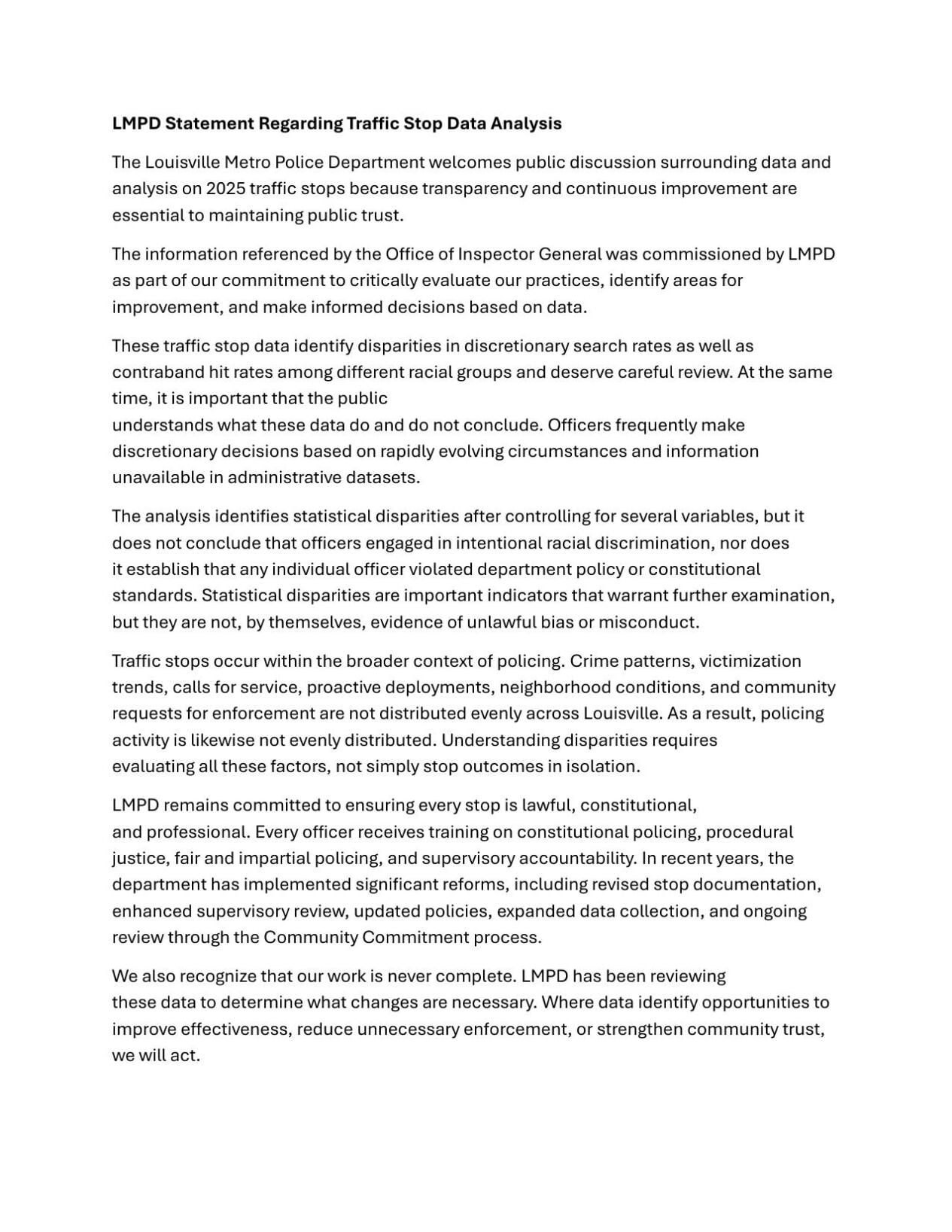
LMPD released a statement Monday night regarding the data, saying, it "welcomes public discussion surrounding data and analysis on 2025 traffic stops because transparency and continuous improvement are essential to maintaining public trust."
LMPD said the data "identifies statistical disparities after controlling for several variables, but it does not conclude that officers engaged in intentional racial discrimination, nor does it establish that any individual officer violated department policy or constitutional standards. Statistical disparities are important indicators that warrant further examination, but they are not, by themselves, evidence of unlawful bias or misconduct."
The full statement can be read below:
Copyright 2026 WDRB Media. All Rights Reserved.


