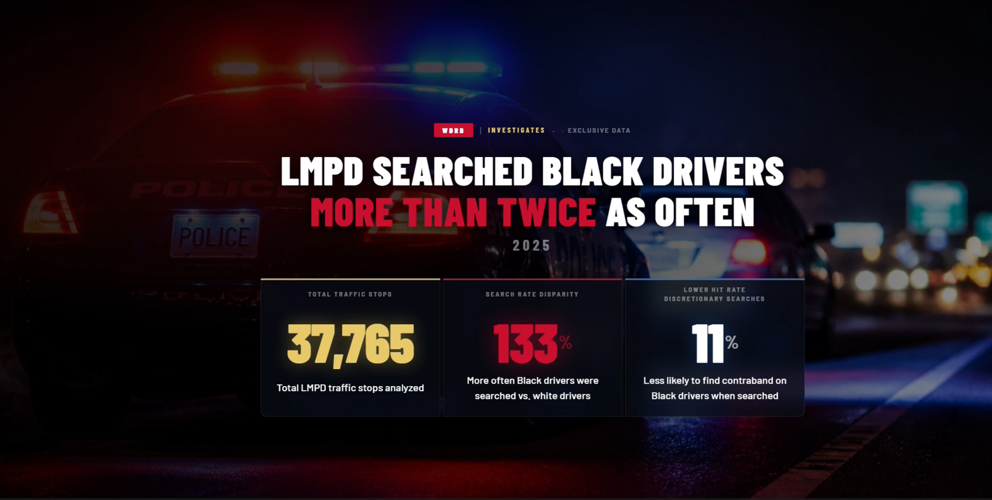

LOUISVILLE, Ky. (WDRB) — Louisville Metro Police Department officers searched Black drivers more than twice as often as white drivers last year and were less likely to find anything illegal when they did, according to internal records obtained by WDRB.
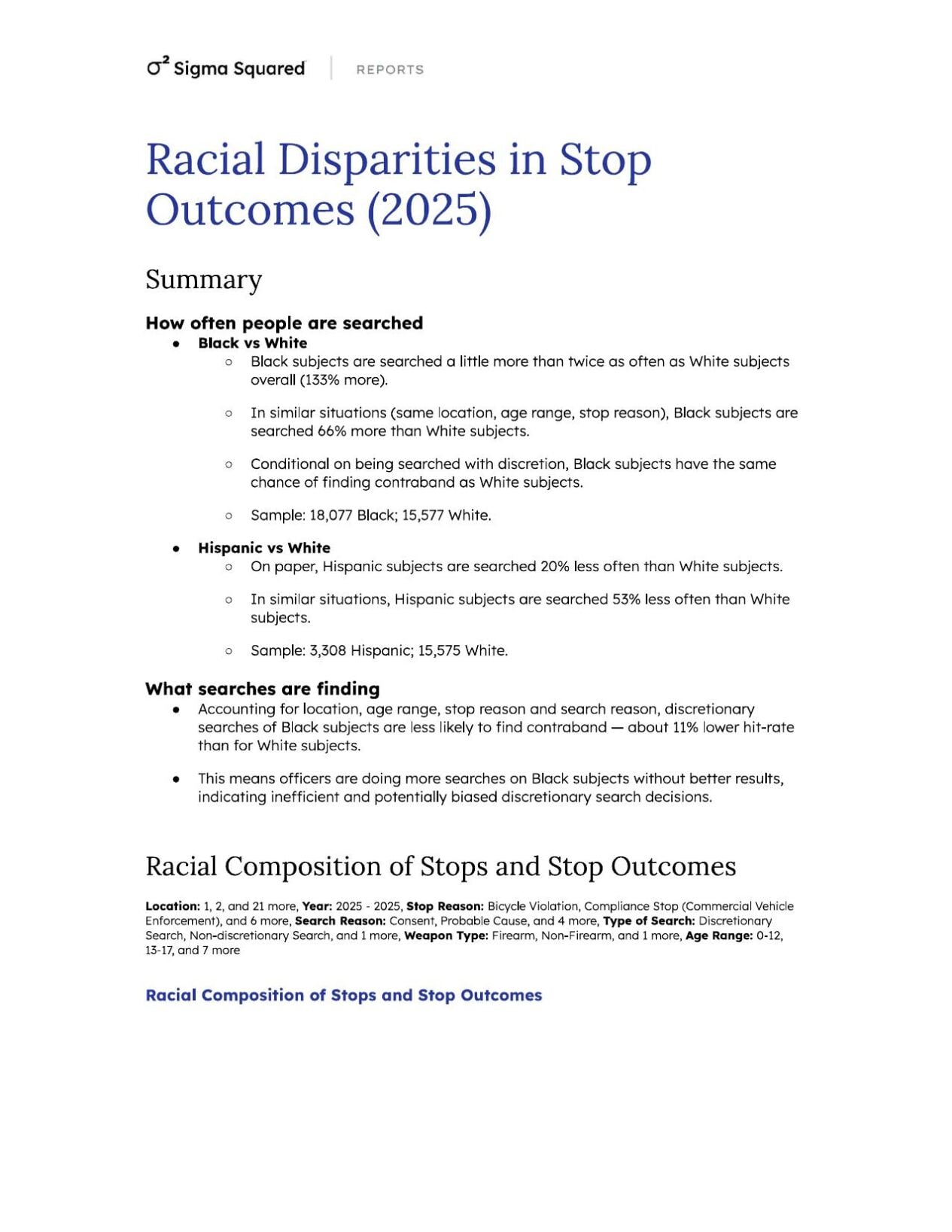
The data, drawn from a report produced by Sigma Squared — a data firm LMPD hired for $350,000 — found Black drivers were searched 133% more often than white drivers overall. When controlling for similar factors such as age and location, the disparity narrowed but persisted: Black drivers were still searched 66% more often than white drivers in comparable situations.
The report also found discretionary searches of Black drivers produced an 11% lower hit rate — meaning officers found illegal items less often — compared to searches of white drivers in similar circumstances. The report's own language described the pattern as reflecting "inefficient and potentially biased discretionary search decisions."
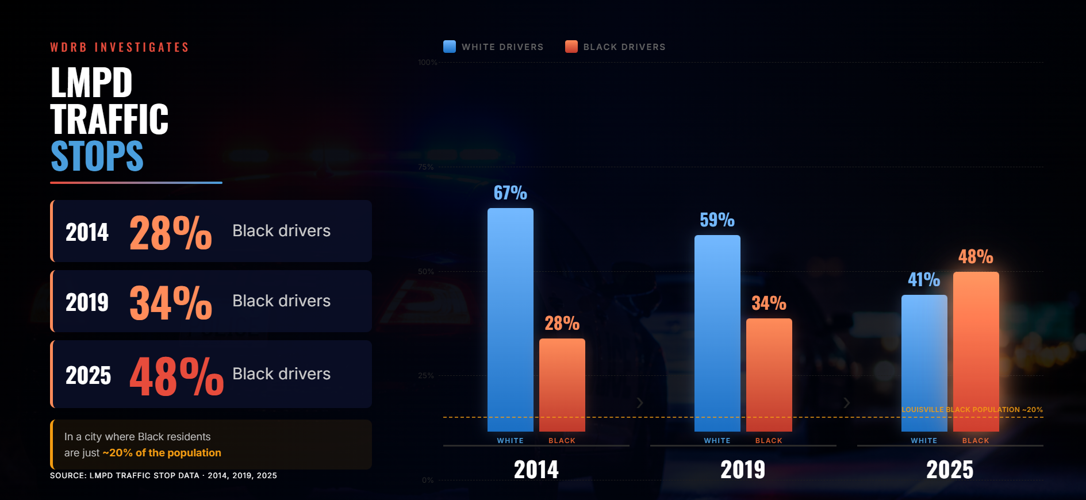
The gap in traffic stops has grown over more than a decade. In 2014, Black drivers made up 28% of traffic stops in Louisville — a city where Black residents represent roughly one-fifth of the population. By 2019, that figure climbed to 34%. Last year, it reached 48%.
That trend is consistent with findings from earlier reviews. A 2013–14 analysis of vehicle stops found 13.7% of stops involving Black drivers resulted in a search, compared to 7.6% of stops involving white drivers. A 2021 independent assessment by the consulting firm Hillard Heintze, commissioned by the city after the death of Breonna Taylor, found "strong evidence exists indicating Black individuals are treated disproportionately in every category — electronic stop data, paper stop data, field contacts, arrests and citations."
In March 2023, a U.S. Department of Justice investigation concluded LMPD engaged in a "pattern or practice" of unlawful discrimination against Black people in its enforcement activities, including through racially disparate traffic and pedestrian stops.

The data, drawn from a report produced by Sigma Squared — a data firm LMPD hired for $350,000 — found Black drivers were searched 133% more often than white drivers overall. (WDRB Graphic)
'I wouldn't have pulled you over'
Steve Clark, 82, said he was driving home along Southwestern Parkway near Shawnee Park in Louisville's west end last year when an LMPD officer stopped him. Clark said he was traveling 5 miles per hour under the speed limit in his Mercedes SUV with tinted windows.
Audio of the stop released by LMPD captured the officer identifying himself as Officer Buckner and telling Clark his registration had been expired for more than two years. Clark's plates weren't expired.
When Clark showed his current registration, the officer attributed the error to his computer system. The stop lasted about one minute.
"He said 'If I could have seen you, who you were in the car, I wouldn't have pulled you over,'" Clark said.
Buckner's recorded words were: "I couldn't see who was in here with the dark tinted window, but ya'll take care. I'm sorry for the inconvenience."
When asked whether he interpreted the comment to mean the officer wouldn't have stopped him if he had seen he was an older white man, Clark said "That's exactly right."
"It didn't seem fair," he added.
Clark filed a complaint with Louisville Metro's Independent Office of the Inspector General, which works in concert with the Civilian Review and Accountability Board. The complaint triggered an internal Professional Standards Unit investigation by LMPD. Chief Paul Humphrey cleared the officer following the PSU investigation, but the inspector general's office found the department's review incomplete.
According to the IG's findings, Sgt. Shay Rausch and Detective Jeff Artman interviewed the officer, a session that lasted 9 minutes and 34 seconds. The IG found neither investigator asked the officer any probative questions related to the stop. Specifically, the officer wasn't asked why he ran the plate in the first place, whether he runs everyone's plate if they have valid tags or what his reasonable suspicion or probable cause was.
The IG's office said to make a determination related to LMPD's standard operating procedure on biased law enforcement practices, investigators must first determine why the officer ran the complainant's license plate. The IG also found no investigation into the officer's stop history to determine whether there was any pattern of stop violations.
"OIG Staff found the PSU Investigation to be incomplete and lacked crucial information to make a final determination," the IG's findings state.
The IG's office also flagged a broader concern: The system LMPD uses to run license plates (NCIC) doesn't provide accurate or reliable information, and officers making stops based on incorrect system data are put in unnecessary danger.
Humphrey disputed the IG's conclusion in an interview with WDRB.
"There was no reason to extend that investigation to past stops to see how racist this officer is if we don't have indication that he's being racist now," Humphrey said, adding the stop was legitimate and he didn't believe the officer acted with bias or malice.
The city said it needed more than one month to redact the body camera video of the stop.

In 2014, Black drivers made up 28% of traffic stops in Louisville — a city where Black residents represent roughly one-fifth of the population. By 2019, that figure climbed to 34%. Last year, it reached 48%. (WDRB Graphic)
Chief defends stop, acknowledges bias exists within LMPD
When asked directly whether he believes there is bias within LMPD, Humphrey said yes.
"There's always bias. There is," Humphrey said. "What we have to make sure is systemically, one, we root that out from the individual level ... (and) our strategies are focusing on the data and doing things the right way. ... Policing as a profession, and as an individual agency, reflects society. There is bias in society. I know that there's probably officers here that are biased. We all have our biases. What we have to make sure is that those biases don't contribute to that disproportionate outcome."
Humphrey said he accepts the Sigma Squared data as accurate and described the report as a baseline for future training and goals for improvement. He said the department is conducting targeted reviews but hasn't begun examining the track records of individual officers with the widest disparities in their stops.
"We're not there," Humphrey said, when asked whether the department would review individual officers. Asked whether it would get there, he said "Maybe."
When asked whether the 48% stop figure — roughly half of all stops coming from a group that makes up one-fifth of the population — was wide enough to constitute bias, Humphrey said no.
"I completely follow the data and say that the data is accurate," he said. "What it gives us is a starting point to look at it and say 'Hey, where are we? Are we having any actual issues with these stops? Is it part of our strategy? Is it effective?'"
On the broader question of whether driving while Black amounts to a crime in Louisville, Humphrey said he understood the sentiment.
"The feeling is valid. I would not dispute your feelings," Humphrey said. "... I went to Canada last week on vacation, and they pulled me over and searched me, went all through my vehicle. And you can give me every piece of data in the world that says that was completely valid, completely legal. There was no bias. It still feels kind of crappy. And I get that."
Humphrey said the disparity in stops and searches reflects the disparity in violent crime, noting that Black residents account for about 70% of homicide victims in Louisville.
"We're focused on keeping Black people alive and protecting constitutional rights," he said.
City cuts Sigma Squared contract; new vendor to take over
The city has since ended its contract with Sigma Squared — the same firm the administration lobbied Metro Council to approve in 2024, calling it the best available option for the work.
Metro Council approved the, $350,000, one-year contract after the administration presented Sigma Squared as a leader in this type of analysis. Humphrey said in an interview with WDRB that LMPD was the first law enforcement agency to contact Sigma Squared about doing this kind of work, which the firm had previously done in the private sector to review hiring practices.
Humphrey said the contract wasn't renewed because a company LMPD already had under contract for crime data analysis — Peregrine — offered to provide comparable analysis at a lower cost.
"They gave us a demonstration and we said 'It looks like you do have the capability to do this level of math and analysis without costing $350,000,'" Humphrey said.
He said Peregrine is expected to provide a comparable data set and that LMPD also hired additional data analysts internally.
The transition means the department currently lacks the ability to drill down to the individual officer level on disparity data — something Humphrey acknowledged the Sigma Squared dashboard had been building toward.
"We don't have the ability to narrow down that data right now," he said. "And that's where we're going."
Prior stops, federal findings, and stalled reform
The current data came years after a series of high-profile stops drew public backlash. Among the most prominent was the stop of Tae Ahn Lea, then 18, who was handcuffed on the side of the road for more than 20 minutes and subjected to a K-9 drug search after making a wide right turn. A federal judge ruled the stop unconstitutional, and the city settled for more than $300,000.
"I was always told if you don't do nothing wrong, you ain't got nothing to worry about," Lea said. "But that's not true."
The city retrained every officer on the force following that case. Eight years later, the new Sigma Squared data has renewed questions about what has changed.
"There is little to almost no trust in the Black community with LMPD, given the history that we're talking about, that we keep showing these disparities for decades," said Kungu Njuguna, a policy strategist with the American Civil Liberties Union of Kentucky.
The findings increased calls to pass the Community Commitment, Louisville's version of police reform legislation crafted after federal consent decree negotiations were dropped by President Donald Trump's administration. The measure has stalled in Metro Council.
Clark said he isn't just speaking out for himself. His experience left him with questions he believes the department still needs to answer.
"I kind of think they need to take a hard look at the whole pulling people over and stopping them, the reasons that they think are valid for that," Clark said. "Maybe they've crossed the line or maybe it's one officer or two officer problem, or maybe it's the department."
Copyright 2026 WDRB Media. All Rights Reserved.


