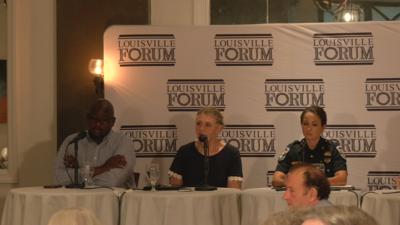


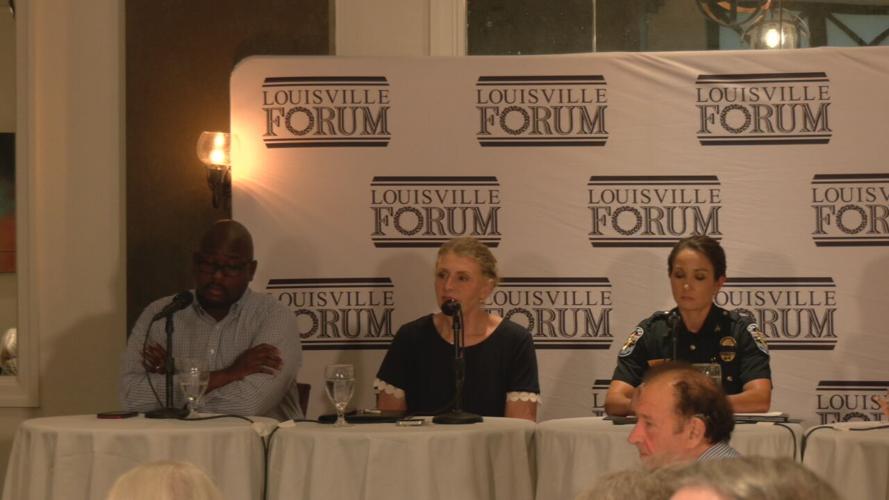
LOUISVILLE, Ky. (WDRB) — Louisville leaders, law enforcement and mental health professionals gathered Wednesday to discuss how police can better respond to people experiencing mental health crises following two recent fatal shootings involving Louisville Metro Police officers.
The discussion, hosted by the Louisville Forum, comes weeks after former LMPD officer Nathan Stotts was fired and indicted in the fatal shooting of 27-year-old Martin Nitzken Jr. It also comes months after two officers fatally shot 28-year-old Katelyn Hall during a behavioral health crisis.
At the end of May, police responded to the 3000 block of Cromarty Way after multiple calls reporting an assault. Officers were told the suspect was running down the road without clothes on.
Police said Stotts found Nitzken, who was naked and unarmed, sitting in the street. After repeated commands to show his hands and stop walking toward the officer, Stotts fired, killing Nitzken.
LMPD Chief Paul Humphrey later said the shooting "did not meet our training" or the department's standards and began the process to fire Stotts.
Stotts resigned days later, and a Jefferson County grand jury later indicted him on charges of manslaughter and reckless homicide. He pleaded not guilty.
And earlier this year, Officers Robert Baker and Robert Gabbard responded to an apartment near Jeffersontown after Hall's cousin called 911 reporting Hall had locked herself in a bathroom and was harming herself.
LMPD said Hall was "highly agitated, incoherent and making suicidal statements." Officers attempted to de-escalate the situation while waiting for additional resources. After firefighters forced open the bathroom door, Hall "exits rapidly" holding what police described as a jagged, 1-foot piece of broken porcelain from a toilet. Baker and Gabbard opened fire, killing Hall.
Deputy Chief Emily McKinley previously said Hall was not eligible for a deflection response because she was actively trying to kill herself, had slit her wrists, ingested cleaning products and was armed. Neither officer was charged.
"We are a couple of months removed from two of our neighbors who are now no longer here whose family called because they were in crisis," said Louisville Urban League President Lyndon Pryor during Wednesday's panel. "We sent officers, and those people are not here."
Louisville's Crisis Call Diversion Program was not involved in either incident because of safety concerns, Nitzken's call came in as an assault, while Hall was actively attempting to harm herself. Under the current system, calls reporting a mental health crisis are transferred to a diversion team unless the person is believed to pose a danger to themselves or others, in which case police respond instead.
Pryor criticized the belief that only armed officers can safely respond to mental health emergencies.
"I think we have to rid this argument that somehow safety can only be performed by someone in a uniform with a gun," Pryor said. "And it's not to diminish the value that officers bring, but we can do things differently."
He said responses should center around protecting the person experiencing the crisis. McKinley, who also served on the panel, agreed police should not be the only response.
"Lyndon, I agree with you that police officers should not be the only solution for safety," McKinley said. "It is all of us finding solutions to reduce the number of times that there needs to be police involved in these incidents."
McKinley said LMPD provides annual de-escalation training that focuses on teaching officers how to slow situations down and connect individuals with the right resources.
Following Hall's shooting, Mayor Craig Greenberg also said the city began exploring whether a co-responder model with both an officer and a mental health professional could help in these types of situations. He brought that up again after Stotts' indictment.
"We are moving as rapidly as we can and my hope is to have a final plan in place that can be implemented as soon as possible," Greenberg said at the time.
Dr. Elizabeth McKune, chief operating officer of Seven Counties Services, said its agencies are also exploring ways to get behavioral health professionals involved sooner.
Deflection connects people experiencing behavioral health crises with mental health professionals instead of law enforcement when there are no immediate safety concerns.
According to Louisville Metro Emergency Services, deflection services were called almost 5,000 times in 2025, while the Mobile Crisis Response Team was dispatched nearly 950 times.
Both McKinley and McKune said they're already seeing improvement with how often deflection services are called. They also said Seven Counties and LMPD will continue exploring the co-responder model, but nothing has been officially rolled out yet.
Seven Counties plans to open a new crisis center in Louisville within the next few weeks.
Copyright 2026 WDRB Media. All Rights Reserved.


