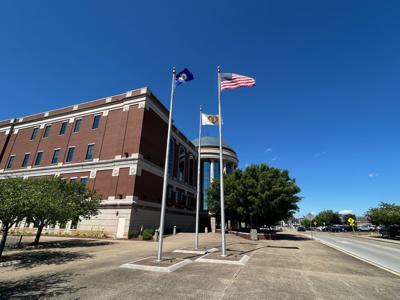
LOUISVILLE, Ky. (WDRB) -- Five Louisville media outlets, including WDRB, asked Nelson Circuit Court Judge Charles Simms III on Friday to allow a camera in the courtroom for the first trial in the murder of Crystal Rogers, which begins Tuesday morning in Bowling Green.
Simms ruled earlier this month that no cameras, cellphones or any recording devices will be allowed in the courtroom, which is unusually restrictive for trials in Kentucky, arguing he must "impose limitations" on the media and public. While the media and public will be able to watch the trial from the courtroom, no one will be able to have a phone or disseminate "to the public any information it ascertains" as the trial is ongoing, according to the order.
"Unfortunately, this case has generated tremendous interest among the news media and the general public which has resulted in a 'circuslike atmosphere,'" Simms wrote.
An attorney representing WDRB, WAVE, WHAS, WLKY and the Courier Journal said in an emergency motion filed Friday that the media "has a unique right to intervene in civil and criminal cases to assert the public's right to access court proceedings." The motion argues the benefits of allowing the public to see the video of the trial outweighs the downside mentioned by Simms.
The emergency motion filed Friday asked for the following guidelines to be set for media coverage:
- A single "pool" camera will be allowed in the courtroom, which will share video and audio recordings with all Media Petitioners (and other media outlets who elect to participate in the pool) at no charge
- The camera will be located at a place within the courtroom to be designated by the Court
- The pool camera may record the proceedings but they may not be live-streamed
- The camera will not produce any distracting sounds or employ any artificial lights, and any cables used to operate the camera will be securely taped to the floor
- The camera and its operator must be in place no less than 15 minutes before the beginning of each day's scheduled Court session
- No member of the jury may be shown or otherwise identified at any time prior to the jury's dismissal, and thereafter only if the juror consents to being identified
- The pool camera may not record any audio of off-the-record conferences between the Court and counsel, or between counsel and co-counsel, or between counsel and their clients or any witnesses
- The pool camera may not record any proceedings held in chambers or otherwise closed to the public pursuant to standards set forth in WPSD TV vs. Jameson, 552 S.W.3d 93 (Ky. App. 2018)
All other aspects of Simms' prior rules should remain in effect, the emergency petition says.
"Simply put, the benefits of allowing the public access to contemporaneous reporting on an already public, high-profile trial, in a controlled manner, outweighs otherwise speculative risks that may be addressed through other means," the petition says. "The Media Petitioners respectfully request, therefore, that this Court modify its May 13 Order to allow a single Pool Camera subject to the conditions set out above and in the attached propose order."
Simms said it was the first time in his more than two decades on the bench that he has not allowed a camera in the courtroom. The ruling means that recordings of the trial will only be available through the courts. Typically, it can takes days to obtain these recordings.
In hearings leading up to the trial, Simms said he has allowed reporters to have phones, but some have violated his rules and livestreamed the proceedings. With this order, Simms said he hopes to avoid sequestering the jury during the trial, which has already been moved to Bowling Green because of the publicity since Rogers disappeared in 2015.
"This Court finds that the trial proceeding must be conducted in a dignified manner without the distraction of anyone recording this proceeding" with any electronic device, Simms said in his order.
There will also be no media room for reporters. The media will be able to sit in the courtroom and report on the trial during breaks, the judge ruled.
"Unfortunately, this Court believes that it must impose limitations herein to assure a fair trial," Simms ruled.
Rogers was last seen with her boyfriend, Brooks Houck, during the Fourth of July weekend in 2015. Her car was left running on the side of Bluegrass Parkway with her purse still inside. She's presumed dead, but her body was never found.
Steve Lawson is scheduled to stand trial in Warren County next month with Houck and Joseph Lawson scheduled later in June. Both trials were moved out of Nelson County because of the massive amount of publicity surrounding the case.
Steve Lawson, according to a Dec. 6, 2023, Nelson County indictment, agreed to "aid one or more persons in the planning or commission" of the death of another and then "destroyed, mutilated, concealed, removed" or altered physical evidence on July 3 or July 4, 2015, when Rogers disappeared.
Houck's indictment accused him of "acting alone or in complicity with another" committing the offense of murder of Rogers. He's also charged with tampering when he "destroyed, mutilated, concealed, removed or altered" physical evidence, according to the indictment.
Joseph Lawson pleaded not guilty in September 2023 to criminal conspiracy to commit murder and tampering with physical evidence in the Rogers case. He isn't charged with Rogers' murder but is charged with conspiracy, meaning they believe he was involved in some way with Rogers' killer.
Related Stories:
Crystal Rogers murder case will bring 'circus-like atmosphere' to Kentucky community
Nelson County judge puts strict limits on media coverage of Crystal Rogers' murder trial
Judge declines to delay Crystal Rogers murder trial over new DNA testing
Copyright 2025 WDRB Media. All Rights Reserved.


