LOUISVILLE, Ky. (WDRB) -- University of Louisville faculty and staff salaries “lag those at the benchmark schools” – an issue the university hopes to address beginning next academic year, U of L President James Ramsey told employees in an email Friday.
A pair of “comprehensive studies” conducted by U of L show faculty and staff salaries are 8 to 9 percent below their benchmark peers, and the university will need an additional $11.8 million annually to bring salaries up to or near the benchmark median, Ramsey said in the email.
“This will not be an easy task, as flat or declining state funding has become the norm, and we cannot rely on tuition increases to achieve the goal,” Ramsey said in the email, a copy of which was obtained by WDRB News. “But standing still simply won’t do. Competitive and fair compensation has been and will continue to be a major budget priority.”
U of L found that professors in its School of Dentistry are the lowest paid, in the aggregate, compared to a group of 19 benchmark universities, according to a copy of the faculty study obtained by WDRB News.
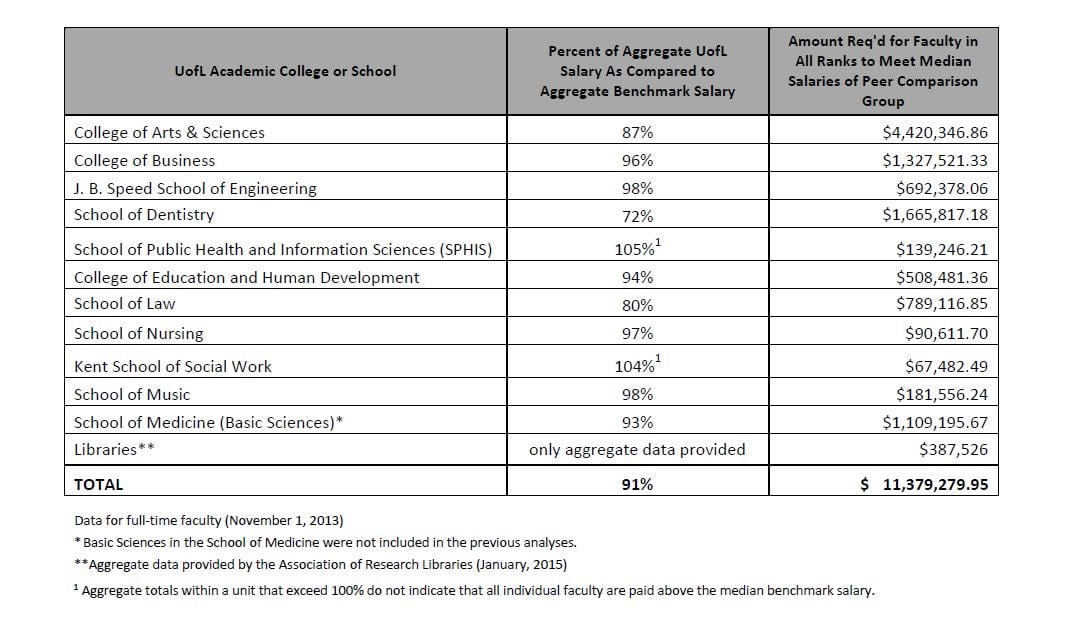
The next-lowest paid faculty group was the Brandeis School of Law. Meanwhile, professors in the Kent School of Social Work and the School of Public Health and Information Sciences were paid higher, in the aggregate, than the benchmark.
The results don't mean "all individual faculty" in the public health and social work schools are paid more than the median benchmark salary, according to a note included in the study.
The faculty and staff salary issue comes at a time of increased scrutiny over the multi-million-dollar compensation of Ramsey and other high-ranking administrators by university’s nonprofit foundation.
A university-funded study released in July said U of L’s top five administrators are “generally (paid) at or above the market” and pegged Ramsey’s 2014 total pay as $2.5 million – nearly all of it from the foundation.
Here is Ramsey’s message on compensation in its entirety:
Colleagues,
I hope the semester is off to a great start.
In Wednesday’s State of the University address, I said: “We must address the market inequities which you, our faculty and staff, face as a result of years of budget cuts. The time is NOW!”
Competitive and fair compensation for faculty and staff is vital as we move toward our state-mandated goal to become a premier, metropolitan research university. In fact, our University Scorecard includes the goal that by 2020, the average compensation of UofL faculty and staff will match the median of UofL’s benchmark institutions. Despite cuts in state support, we have succeeded in funding faculty and staff salary increases in each of the past three years – a total of more than 9 percent. We managed this by developing new funding sources, such as our Nucleus and Shelbyhurst developments, and also by drawing on funds made available by the Voluntary Separation Incentive Program. But more is needed to ensure competitiveness.
In 2013 and 2014, the university conducted two comprehensive studies comparing the salaries of UofL faculty and staff with those of institutions we define as our benchmarks – a strong group of universities, including several in the Atlantic Coast Conference. The good news is that more than a fourth of faculty and many staff are very near or above the median of our benchmarks. Overall, however, UofL faculty and staff salaries lag those at the benchmark schools. Faculty salaries are 91 percent of benchmark institution salaries. The cost to raise the salary of each surveyed faculty member who was below the benchmark to the benchmark median exceeds $11 million. Results for staff are less definitive. According to the study, staff salaries as a whole are at 92.2 percent of benchmark, and about $800,000 in additional funding is needed to ensure all staff salaries reach at least 80 percent of the median for the respective position. These are ongoing costs in addition to annual salary increases. The details of the survey results are available online at http://louisville.edu/provost/what-we-do/salary-reports.
Our leadership team -- Dr. Pinto, Dr. Dunn, Dr. Pierce, Mr. Sands and I -- is committed to achieving the scorecard goal on compensation. This will not be an easy task, as flat or declining state funding has become the norm, and we cannot rely on tuition increases to achieve the goal. But standing still simply won’t do. Competitive and fair compensation has been and will continue to be a major budget priority. To improve our competitiveness and to ensure fairness, we will charge a work group comprising key administrators, faculty and staff to work on compensation. The charge of the group will be the following:
• Review the university budget, develop a multi-year plan and recommend specific action steps to raise our relative standing with benchmark institutions;
• Explore the performance review process and recommend changes to ensure fairness and appropriate reward and recognition for both faculty and staff;
• Study salary compression and salary inversion, and make creative recommendations to address this issue where it exists; and
• Design and conduct new salary surveys of staff and faculty. The most recent surveys are outdated and do not reflect the full effects of the Voluntary Separation Incentive Program, faculty and staff turnover, or recent salary increases.
The work group will report to the leadership team regularly and will complete its charge this academic year. Salary surveys and preliminary plans should be ready in time to influence next year’s budget cycle.
You, our faculty and staff, are at the core of the amazing trajectory we have achieved in recent years. You are our most valued asset. Fair and equitable compensation is critical in continuing our progress, and we are committed to improving our relative standing among our benchmark institutions.
Thank you for all you do for the university.
Jim Ramsey
President


