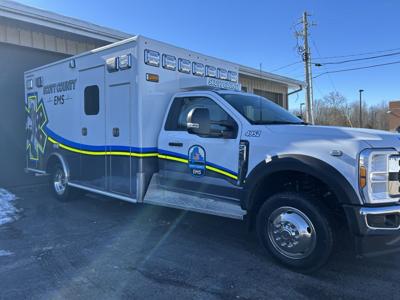


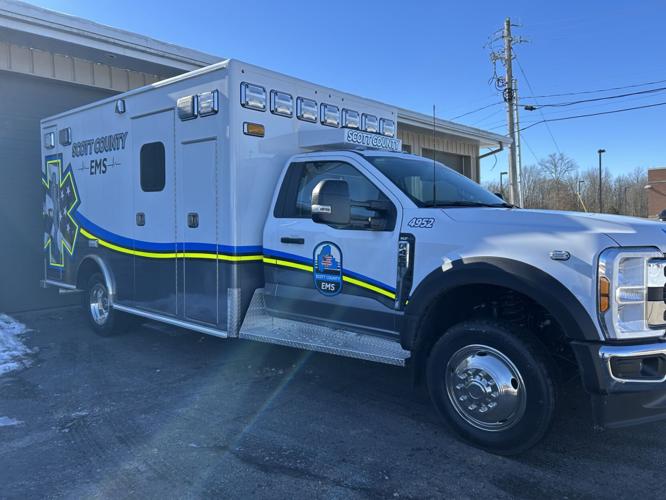
SCOTTSBURG, Ind. (WDRB) — In a move that many believe could save lives during critical emergencies, Scott County Emergency Management Services is now able to provide blood and plasma transfusions directly to patients on emergency scenes before they are transported to a hospital.
The program, launched with the assistance of the American Red Cross, officially became available in Scott County this January. EMS Chief Nick Oleck said until now, patients had to wait for a medical helicopter or hospital arrival to receive these types of transfusions.
"The unfortunate thing is, just like in our profession, if we had had it a week sooner, we had three runs we definitely could've used it on," Oleck said. "It's one of those timing things."
The availability of on-scene blood transfusions helps address the challenge posed by Scott County's distance from the nearest Level 1 trauma center across the Ohio River in Louisville. While there are other hospitals much closer to the area, Oleck said for Level 1 trauma care, the closest hospital is UofL.
"If we have the ability to implement this in the field, that can change the outcome for a lot of our patients," Oleck said.
Scott County is now the fifth county in Indiana to adopt a program like this, according to Dr. Eric Yazel, Indiana's EMS medical director and Clark County Health Officer. He called this a "major undertaking" and said it involves specialized equipment, staff training, and paperwork. But he believes it can save lives.
"This can be the absolute difference between life or death," Yazel said.
Yazel encouraged others to donate blood, saying that's a necessary part of making programs like this possible, and one of the major reasons it's not more common to have blood products readily available in settings like an ambulance.
"As we build these programs, we also need to increase our blood donation pool," he said.
Scott County EMS will receive a fresh supply of blood every 21 days, with replacements available within hours if needed.
"My goal is to have a very progressive and advanced EMS service, and I think this is moving in the right direction," Oleck said.
Oleck said Scott County EMS is not funded by tax dollars. He also said the program will cost around $30,000 annually and supported by some county councilmembers.
"It's been something that's been in the works for almost a year, and I'm glad we finally have it," Oleck said.
Yazel said programs like this are likely to grow across the state, with other providers showing interest.
"Typically, in the past, they've given IV fluids and things like that which may get a blood pressure back up, but it doesn't stop bleeding or refill the tank of blood that's been lost. So, it's a really exciting development, and we're just now seeing that in the ground-based EMS side of things," Yazel said.
He also said early studies are showing improvements in mortality, where this type of blood product access is available.
Related Coverage:
- Critical blood shortage sparks urgent call for donations at the Kentucky Blood Center
- Kentucky Blood Center celebrating Baptist Health's 100th anniversary with blood drives
- Kentucky Blood Center opens new Middletown location
Copyright 2025 WDRB Media. All Rights Reserved.


