LOUISVILLE, Ky. (WDRB) -- Cases of COVID-19 are on the rise in Louisville, and health officials are sounding the alarm.
"Cases continue to skyrocket, and that is worrisome," said Dr. Sarah Moyer, director of Louisville Metro Public Health and Wellness. "We're not trying to instill fear, but I do want people to be realistic."
At a Tuesday morning news conference, Moyer pointed to data indicating that the number of COVID-19 cases in Louisville more than doubled last week, with 10,153 new confirmed cases.
"To put this in perspective, just over a year ago, we were deeply troubled when we reported just over 4,000 cases of the virus in the week," Louisville Mayor Greg Fischer said. "Well, today, we're looking at 10,000 cases in a week."
Louisville's previously weekly high of confirmed cases was more than 4,000, set in January 2021.
Moyer said last week's sharp rise in confirmed cases is expected to continue, and that will eventually work itself out into increased hospitalization.
"At this rate, it's very likely that our hospitals are going to be in crisis mode -- so, beyond capacity -- very soon, meaning critical and elective surgeries may have to be postponed," she said. "And if you have COVID or a non-COVID emergency, it might result in delayed care."

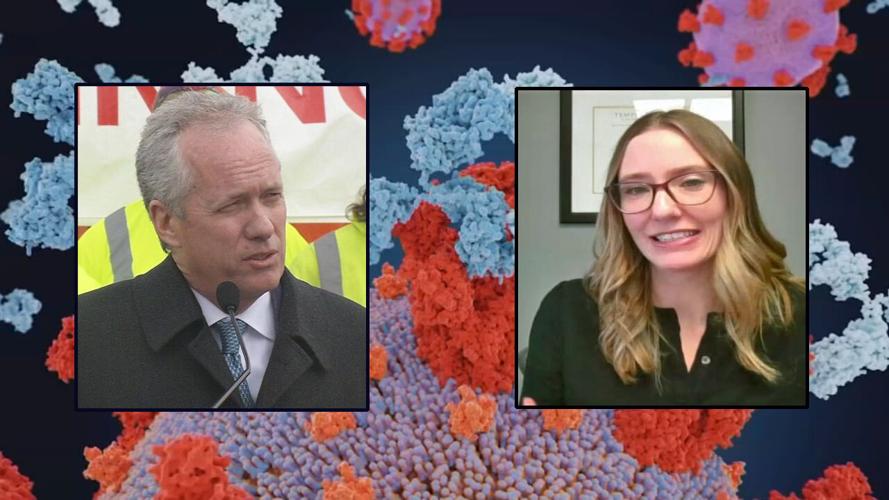
Louisville Mayor Greg Fischer, Dr. Sarah Moyer
As of Tuesday, Moyer said Louisville is seeing an average of 2,000 new cases each day, and there were 147,449 total confirmed cases. As of Monday, she said there were a total of 323 hospitalizations due to COVID-19, with 63 people in ICU and 36 on a ventilator.
Last week, 16 people died from COVID-19 complications, Moyer said. It brings Louisville's death total to 1,827 since the start of the pandemic.
Despite some break-through COVID-19 cases, Moyer said the vast majority of COVID-19 deaths and hospitalizations are patients who were unvaccinated.
She said health officials are also seeing an increase in the number of young people hospitalized. On Monday, she said 16 young people had been admitted to Norton Children's Hospital. All of them were unvaccinated, and most were in their teens.
"So it's especially important for all of our kids to get vaccinated, especially our teenagers," Moyer said.
Fischer cautioned those who might be letting their guard down because the current variant -- omicron -- is less severe.
"The variants are different. That's true," he said. "And the early science indicates that omicron generally causes less severe illness than over versions of COVID-19, but it's still early. We do not understand the long-term impact. So I don't want people to kind of diminish the dangers that come with the omicron virus. Because we're still filling up our hospitals. People are significantly ill. This is a pandemic amongst the unvaccinated. And the best way to protect yourself, obviously, is to get vaccinated, and/or get the booster."
The omicron variant was confirmed in Jefferson County in December. Dr. Steven Stack, the state's public health commissioner, previously called the omicron variant "one of the most transmissible and contagious diseases we've had in the last century."
Moyer admitted that many of the new cases confirmed recently were people who were fully-vaccinated and received the booster, and she attributed that to the new variant.
"We are seeing more breakthrough cases with omicron, and it is much more contagious than previous strands," she said. "And as FDA and CDC -- as you see -- they're changing and really recommending that booster. So even those people who are fully-vaccinated are at risk unless they've had the booster.
"We are occasionally seeing those booster breakthrough cases, but people tend to be milder, being able to stay home with those symptoms."

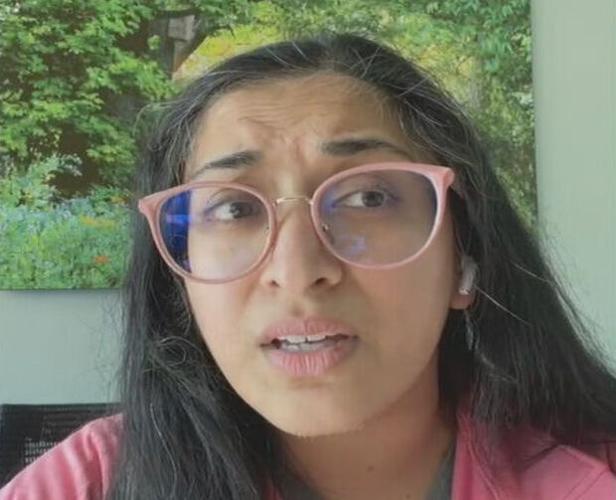
Dr. Monalisa Tailor, Norton Healthcare
So if a patient who is fully-vaccinated and received the booster still gets sick, what's the point of getting vaccinated? Dr. Monalisa Tailor of Norton Hospital said several of her patients are asking this question. She said it's important to know that the vaccine actually gives the patient's body the blueprint to fight off the virus, even if it mutates.
"You may still get sick, because this virus is slightly modifying itself," she said. "It's changing. It's smart. And so it's trying to get smarter. And that means that our body is going to recognize it and going to try to fight it off too. But in some cases, we may still get sick because of the way the virus has changed.
"Now, if you're vaccinated, you're going to be more likely to have milder symptoms: more upper respiratory, more sinus issues. Those are the type of symptoms you’re going to have if you're vaccinated. You're less likely to have the breathing issues, and most importantly, you're less likely to have these prolonged COVID symptoms."
When it came to those prolonged symptoms, Tailor gave examples of what she is currently seeing in the hospital.
"I can't tell you the number of people that I've seen -- especially in the recent weeks -- who have continued difficulty with their breathing," she said. "I have one lady who is still on oxygen right now from an infection that she had in September and October. I have another gentleman who unfortunately had to go to the hospital from COVID and still has the pneumonia in his lungs. It's still hanging out. And that is something that your body can help you fight off, if you've gotten the vaccine, so that you don't have these prolonged symptoms."
Copyright 2022 WDRB Media. All Rights Reserved.


