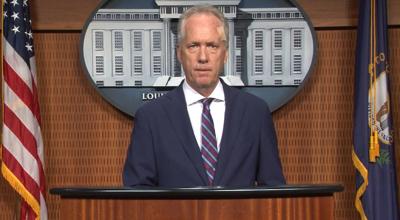

LOUISVILLE, Ky. (WDRB) -- Mayor Greg Fischer says the Louisville Metro Police Department should no longer investigate itself after officer-involved shootings where someone is either killed or injured.
Fischer announced he's seeking that change and others in a nearly 20-minute address, which the mayor posted to YouTube and social media Thursday night.
"As the great John Lewis said, 'When you see something that is not right, not just, not fair, you have a moral obligation to say something — to do something,'" Fischer said.
The mayor said he is "incredibly frustrated" with waiting for the results of state and federal investigations into the March 13 LMPD raid that killed Breonna Taylor. However, he said that he won't wait "to pursue the cause of racial justice in Louisville and particularly the need for public safety reform."
Fischer's leadership, as well as certain city policies and practices, have been scrutinized by protesters and others in the months after the shooting that killed Taylor, a 26-year-old Black woman. In his address Thursday, Fischer acknowledged that frustration as he pushed for the new measures.
"Black lives matter," Fischer said. "We have to do more than say it. We have to prove it through actions."
Fischer said he wants state lawmakers to allow cities like Louisville to share more info during police investigations of officer-involved shootings.
"State law KRS 67(C) imposes, essentially, a gag order on what I can say publicly about matters related to any kind of investigation being conducted by LMPD's Public Integrity Unit such as an officer-involved shooting," Fischer said. "And while we don’t want to jeopardize an ongoing investigation and compromise the rights officers or civilians, we have to be able to address the public’s right to know what’s happening. Being unable to answer basic questions to the public contributes to distrust of the investigative process, and suspicion of secrecy and cover-up.
The mayor also wants a stronger state law to allow more civilian oversight of those investigations. A group of Louisville leaders is working on an ordinance creating a new civilian review board, which will be tasked with investigating LMPD.
"For accountability and transparency, there must be informed, independent civilian involvement from the beginning of investigation," Fischer said.
Most notably, the mayor said LMPD should no longer investigate itself after certain incidents.
"In the event of an officer-involved shooting where a person is killed or injured, we will contact the Kentucky State Police to do an independent investigation, rather than LMPD investigating themselves," Fischer said.
Metro Council President David James, D-6, says they're welcome changes.
"I'm just sorry that we had to have the death of Breonna Taylor in order to do that though," James said.
A transcript of Fischer's remarks appears below:
"Hello everybody. I want to share a few thoughts and updates with you. This is certainly a challenging and in many ways a painful time for our city and our country.
We are simultaneously dealing with the COVID-19 health crisis, an economic downturn and protests and demonstrations in our streets where people have gathered for almost two months to call for racial justice and justice for Breonna Taylor.
Breonna’s tragic death is an open wound for Breonna’s family, for protesters and their families, for me and my family, for our entire city and for all of us as human beings. And it’s especially painful for our Black community as I’ve heard, seen and felt up-close in talking with protesters individually and in groups who feel the impact of Breonna’s death in a raw and visceral way.
I will always be grateful for the honesty and directness of these heartbreaking conversations.
I am listening and learning from these conversations and from the many questions I am hearing from people throughout our city.
A lot of the questions are about the status of Breonna Taylor’s case. I also hear questions about how we got here and where do we go from here. And there are strong emotions in those questions too: frustration, pain, anxiety, grief, along with determination, compassion and hope. I share all of those feelings and I feel like I go through that cycle every single day. Because that’s what happens when the people in the city you love are going through a time of hurt and uncertainty.
That’s the situation we’re in. So let’s talk about it.
I, along with so many others in our country and our community, am incredibly frustrated at the slow pace of justice in Breonna’s case. On May 20, LMPD turned over its Public Integrity Unit file from its investigation to Attorney General Daniel Cameron’s Office, and has since complied with all of his requests for additional information and material.
People need to know what happened in this tragedy. And we need to know soon.
So now we’re all waiting for him to announce his findings. I’m waiting the same as you. I have no control or influence over that process or the additional independent investigations being conducted by the Department of Justice and the FBI, and I’m as frustrated as you are by how long it’s all taking. Yes, the process needs to be thorough, but like you, I want a resolution. Breonna Taylor’s family and our community deserve that.
But while we are waiting for these investigative outcomes, I’m not waiting to pursue the cause of racial justice in Louisville and particularly the need for public safety reform. People are demanding action, and we are acting, like signing Breonna’s Law, which bans no-knock warrants, and mandates the use of body cameras for police officers serving search warrants, installing new leadership at LMPD and conducting a national search for a permanent chief with major public involvement, hiring an independent outside firm to conduct a top-to-bottom review of LMPD to help us understand strengths as well as weaknesses, and implement changes necessary to improve public safety, working to create an independent civilian police review board with subpoena power to bring greater accountability and transparency and strengthening the rules governing an officer’s duty to intervene.
These are substantial changes, but we know they are enough – not nearly enough – to sooth or heal the anger people feel about what happened to Breonna Taylor. Because tragedies involving Black Americans dying at the hands of law enforcement have been happening for centuries. And to begin to really address structural and systemic racism, you have to reform the structures and the systems.
Our citizens deserve more transparency and accountability with the investigative process of officer-involved shootings. Period. That requires changes, both within and beyond our city, and I will fight for this change, wherever the fight takes me.
For example, changes in state law must occur. State law KRS 67(C) imposes, essentially, a gag order on what I can say publicly about matters related to any kind of investigation being conducted by LMPDs Public Integrity Unit such as an officer-involved shooting. And while we don’t want to jeopardize an ongoing investigation and compromise the rights officers or civilians, we have to be able to address the public’s right to know what’s happening. Being unable to answer basic questions to the public contributes to distrust of the investigative process, and suspicion of secrecy and cover-up.
That is not just. And it must be corrected.
Changing this law is just one of the many steps we needed to take to restore people’s trust in government in general, and law enforcement in particular.
We also need to change state law to strengthen civilian oversight of police investigations. As I said, we’re working to establish a strong independent civilian review police board made up of people from all across our community. The working group, created jointly with the Metro Council, and charged with recommending our civilian board model includes representatives ranging from the ACLU to the Fraternal Order of Police. For accountability and transparency, there must be informed, independent civilian involvement from the beginning of the investigation. And we want the civilian review board to have subpoena power so they can get answers to questions from the people of our city.
I will be working with the legislature to change state law in order to do that, and I will need your help to make that happen too.
An Office of Inspector General is being established. Created by local ordinance, this office will support the Civilian Review Board by investigating individual complaints against LMPD officers for serious infractions, as well as any troublesome patterns and practices.
In addition, in the event of an officer-involved shooting when a person is killed or injured, we will contact the Kentucky State Police to do an independent investigation, rather than LMPD investigating themselves.
Beyond these changes, we’ll also be working with the FOP, through the collective bargaining process, to find ways to strike the right balance between protecting an officer’s right to due process and providing the public with greater transparency and accountability, which are essential to police community legitimacy and public safety. And good police officers know that they have to have trust of the public in order to do their jobs effectively, and they will support these changes we are pursuing.
LMPD employs about 1,100 police officers who are sworn to serve and protect about 770,000 people. That’s more than 600 people for every one police officer. So you can see, public safety is only possible when police and the public work together.
Let’s talk a bit about our police structure. There are serious long-standing challenges in policing that must be addressed. We must ensure all our police officers see themselves as guardians and peacemakers – not warriors.
We must also acknowledge that we as a society and nation bear the responsibility for not making the necessary investments to address poverty, mental health, domestic violence, substance use and much more. And instead, we ask our police officers to deal with these systemic failures. And while good police officers do their best to meet these challenges – and many do incredible work – it’s not fair, it’s not smart, it’s not just to ask them to address all of society’s problems. To realize true racial justice, equity and peace, we have to take on all of these challenges. All of us.
How did we get to this state where our country is so imbalanced with racial justice? While we may have ended the explicit legal mechanisms of racism, fueled segregation and slavery, Black Americans still contend with policies and practices that result in disenfranchisement, including assaults on civil and voting rights, gentrification, overincarceration, and a lack of access to quality education, healthcare and employment opportunities.
I could cite 1 million stats to demonstrate this, but I’ll pick just one: family wealth. The average white family has 10 times the wealth of the average Black family in America. Ten times. That’s not a coincidence. That’s not an accident. That’s the product of racist institutionalized systems that need to be not just replaced, but transformed.
This is the work my team has been doing at Metro government for almost a decade. And while we’ve worked with community partners to attract a billion dollars in unprecedented investment to west Louisville, it hasn’t been nearly enough. We’ve created the Office for Safe and Healthy Neighborhoods, which focuses on Black male achievement, and has brought in millions of dollars in competitive grants, and that hasn’t been enough. We’ve established programs to help people get jobs and job training – SummerWorks, Code Louisville and Tech Louisville – and that hasn’t been enough.
I know, quite simply, these actions in total have not been enough. But right now, we have a rare opportunity and a choice, both as a city and a country, to do more.
So the question is, what do we do with this moment? Do we sit tight and see if things cool down so we can go back to the old normal? Even though that normal has been unjust an unfair to so many Americans? Even though that normal just means waiting until the next tragedy? Or do we take advantage of this moment and come together to create something better: Something more than improvement. Something more than progress. Do we work together in this moment of pain to create transformation – transformation like we should have seen long before now to create racial equity in our country.
We must recognize that America has faced moments like this before, when the country has essentially stood on the doorstep of transforming our country for the better, but lacked the courage, will or unity to walk through.
In 1967, President Johnson created the National Advisory Commission on Civil Disorders – known as the Kerner Commission – to study the causes of the race riots that year. That report blamed the unrest on poor neighborhood conditions and limited economic opportunities available to Black Americans caused by rampant discrimination in housing and employment. The report warned that – without intervention – “our nation is moving toward two societies, one Black, one white, separate and unequal.”
Tragically that intervention never came.
But now, it’s our turn to intervene. It’s time for us to assume responsibility for altering the course our city and our country have traveled for far too long. To do this requires cooperation, compassion and tenacity because we have to work for change at not only the local and state level, but the national level as well.
On July 1, I was inaugurated as the president of the United States Conference of Mayors and my first act as president was to propose a resolution in support of Congress creating a commission to study and develop proposals for reparations for African Americans. I did this to address the unconscionable wealth gap that I mentioned between white and Black families -- to use the national platform that I have now to act, as the great John Lewis said, “when you see something that is not right, not just, not fair, you have a moral obligation to say something, to do something.”
It is well past time America accepted the need for reparations so that Black Americans are given their due and have the funds to start a business or buy a home once denied by redlining. It’s hard to get ahead when you’re always fighting from behind. I am proud to say that my fellow mayors passed this resolution.
We mayors are creating a mayor’s vision for a new America addressing the systemic and institutional failures that have, for too long, denied equal rights, access and opportunity to too many people. Mayors across America are right now working on bipartisan recommendations on critical issues like eliminating poverty, COVID-19 and health equity, economic recovery, dismantling systemic racism and police reform. And in my conversation with other mayors, I am making sure that the experience and perspectives of the people of Louisville are represented. The conference will provide our recommendations to lawmakers and candidates for office because these issue and the proposed solutions must be part of our national conversation heading into the crucial November elections.
As the Conference of Mayors president, I’ll also be calling on the federal government to raise the grossly inadequate minimum wage to a family-supporting wage. Because we have to address this issue of poverty which leads to so many other challenges for our cities and our country. Imagine the difference it would make if everyone had a living wage – the struggle that would end for so many.
And yes, I’m talking about changing laws. Laws that have been on the books for a long time. But they were written and passed by people and they can be re-written so that the laws of the land in America more closely represent the laws of humanity, so that we create a country that is set up expressly to make it possible for every American, regardless of color, to have an equal chance to thrive.
To make that happen, we either have to persuade current lawmakers to make these changes, or we have to work to elect people that will.
Of course that’s only possible if we create a broad coalition of people from across the demographic and political spectrum. The good news is, that’s already happening. More than 2,000 cities and towns have hosted marches for racial justice in the last couple of months. And the crowds here and elsewhere have been beautifully diverse. And that’s what this will take: Democrats and Republicans, young black men and women working with older white Louisvillians. Immigrants. People from small towns and rural communities from suburbs and cities. All of us united in fighting for recognition in the fundamental truth that black lives matter.
We have to do more than say it. We have to prove that we mean it through actions. That includes taking this fight into the voting booth where meaningful change happens.
But there’s work that we can do every day of the year, and I want to say something now to the compassionate women and men of our city who have watched these protests in solidarity from their homes and are ready to do something -- particularly from the white community. It’s time for you – for us – to speak up and take greater action. It’s no longer enough to say you’re not a racist. It’s not enough to post supportive messages on social media, or put a sign in your yard. Those are great. Keep doing that. But it’s time to do more.
It’s time to channel the spirit of one of our city’s great civil rights heroes, Anne Braden, who said, “In every age, no matter how cruel the oppression carried on by those in power, there have been those who struggled for a different world. I believe this is the genius of humankind – the thing that makes us half-divine – the fact that some human beings can envision a world that has never existed.”
We can bring Anne’s vision of equity and justice into existence and it’s time we all committed ourselves more deeply than ever to that cause. That means it’s time to tell all your elected representatives, as you have said to me, that your support is contingent on our support for equity and racial justice. That means it’s time to support organizations fighting for equity with your time, your money, your energy and your connections.
I mention the questions I’ve been hearing from the people of our city, and one question I get asked all the time is, ‘What can I do to help?’ Well, there are dozens of opportunities for people to support the cause of equity. I’ll list a few: join a Build Back Better Together Workgroup so we can rebuild a more equitable and dynamic economy. Support minority owned businesses like those listed at the BlackBusinessApp.com. Become a mentor for a young person through the Office for Safe and Healthy Neighborhoods. Donate to organizations working to close the education gap like Evolve502 or Simmons College of Kentucky. Invest in west Louisville by donating to important projects and organizations like The Russell A Place of Promise, Black CDC, OneWest and Rebound. Donating to non-profits with Black leadership and serving the Black community, like Play Cousins Collective, AMPED, Bates Community Development Corporation, Sowing Seeds With Faith and Change Today, Change Tomorrow. Reviewing your own policies, practices and leadership structures to make necessary changes to support racial equity in your own organization or house of worship. Attend or host a virtual race-based trauma training through the Trauma Resilient Community Initiative. Give young people job opportunities through SummerWorks.
Explore your family’s history: If you’re white, how has your privilege impacted your life and others? Research how racism has shaped you, your city and your nation.
This is a critical moment for our city, as well as our country. Because of the national interest in justice for Breonna Taylor, America’s eyes are on Louisville. Let’s demonstrate what we already know: that in our city, that we have the combination of civic pride, wisdom, courage and compassion to be that American city that takes itself from courage to compassion.
I know there are people in our community who are upset at me for decisions I’ve made or decisions they wish I’d make. I understand that, and I hear you. What I ask of you now is to acknowledge that what we’re facing is a choice. It’s not about Black vs. white or protesters vs. police. It’s about the past vs. the future. One we can’t change, and one we can. If we work together.
And while there will always be disagreements, the fundamental fact in this city is that we are all on the side of Louisville. When you share a city, you share a future. That means we don’t have to look hard for common ground because this city we love is our common ground.
In closing, I want to leave you with the words of the Greatest – our own Muhammad Ali. His wife Lonnie has said that, if he were still alive, he would be joining those calling for racial justice. But Muhammad wouldn’t be tearing things down, because he believed in lifting people and communities up. And he believed in taking on big fights, even if the odds were long. Even if people said that victory was impossible.
In moments of doubt, remember what Ali told us about the impossible. He said impossible is just a word thrown around by small men who find it easier to live in the world they’ve been given than to explore the power they have to change it. Impossible is not a fact. It is opinion. Impossible is potential. Impossible is temporary. Impossible is nothing.
Well, history tells us that moments of transformation are rare. So let’s seize this moment and make that the story of Louisville – how our city responded to tragedy, with a fierce determination to create together a future for our city and our country that offers compassion, equity, innovation, justice and opportunity to those for whom it has been denied for far too long.
Let’s make this happen.
Thank you."
Transcript ends.
Copyright 2020 WDRB Media. All Rights Reserved.


