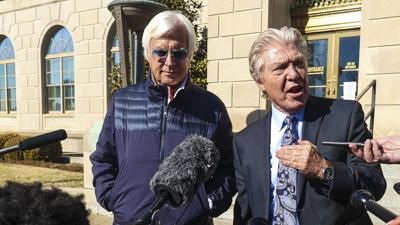

LOUISVILLE, Ky. (WDRB) -- Clark Brewster, attorney for Bob Baffert in his federal case against Churchill Downs and its top executives, filed a motion to have Judge Rebecca Grady Jennings disqualified from the case.
In a motion to disqualify filed Friday, Baffert's attorney argues that Jennings failed to disclose that her husband works for a lobbying firm that represents The Jockey Club, of which co-defendant Churchill Downs chairman Alex Rankin is a steward. The Jockey Club, as well, filed an amicus brief against Baffert's position as he sought to overturn a ban imposed by the New York Racing Authority last year.
The motion — which represents only one side of the story — comes days after Jennings warned Brewster, in part, "any future conduct implicitly threatening the Court, attempting to create or fabricate a situation suggesting recusal ... will not be tolerated and may result in a show cause hearing and disciplinary action."
Jennings' husband, Friday's motion argues, is managing partner of Commonwealth Alliances, which the motion says represents The Jockey Club.
"The Jockey Club has intervened publicly and litigiously in the litigation surrounding the Bob Baffert/Medina Spirit matter sine the beginning ... " the motion argues. "Judge Jennings has failed to disclose that she receives marital income from the lobbying efforts of her husband, Patrick Jennings, a lobbyist for The Jockey Club. Such facts ... would clearly cause a reasonable person to believe the judge has a personal bias against the moving party."
Baffert is seeking an injunction against the ban issued by Churchill Downs last year that would effectively bar any horses trained by him from accumulating points to qualify for this year's Kentucky Derby. Brewster has argued that Churchill is acting in concert with the state of Kentucky, and therefore owed Baffert more due process than he was afforded.
The Court has not replied to the 106-page filing by Baffert's attorneys, which included a affidavit from Brewster revisiting the events that led to the judge's rebuke earlier in the week, a Tuesday after an email exchange between the sides was shared with Jennings, including some talk that Baffert's attorney was "considering notifying the marshal's office for an inquiry."
Brewster said he had not been alleging improper communication between the judge and defense when he first sent an email to Churchill attorney Orin Snyder on Feb. 3, saying instead he only wished to ask how the defense seemed to know that it would be allowed to question Baffert on the stand before the plaintiffs had presented witnesses.
Brewster said he was "bewildered by the (subsequent) announcement of Judge Jennings and the 'warning' to counsel not to suggest recusal, given that counsel had made no effort to impugn the Court or to seek recusal."
Curious as to why the judge would bring up the topic of recusal, Brewster said he took to the internet for a simple search, which quickly turned up that the judge's husband was a lobbyist for a firm he says represents The Jockey Club. The affidavit alleges that Patrick Jennings made just over $34,000 personally and that his firm made $50,750 from The Jockey Club from April to December of last year, and that the firm also represents The Stronach Group, which owns Santa Anita Park.
Brewster, made his case for the temporary injunction last Thursday and Friday in U.S. District Court in Louisville, with Baffert taking the stand Friday. Jennings gave no timeframe for her decision after the hearing, saying only that she would issue a ruling in "a period of time." Baffert needs to be cleared to train horses for the Kentucky Derby before Feb. 28, the date by which the Triple Crown is mandating that horses under the care of suspended trainers be moved if they wish to run in the Classic races.
Before the second day of testimony, Jennings told the parties she only wanted to consider Churchill's actions in suspending Baffert, whether it was legally entitled to do so, if so, was there a process to do so, and did the track's leadership follow it. She repeatedly expressed frustration when Brewster seemed to take the discussion in other directions.
"Throughout the proceedings, Plaintiff and his counsel were treated disparately by Judge Jennings," Brewster said in the affidavit. "Judge Jennings interrupted questioning, terminated counsel's argument, denied cross-examination on points raised on direct, and permitted defense counsel to commence the defense witness presentation by calling Mr. Baffert for cross before his lawyer was permitted to provide a direct exam and ultimately assisting defense counsel in raising objections.
"At no time did Judge Jennings disclose or invite dialogue regarding her husband's lobbyist contracts and income to their family from The Jockey Club or The Stronach Group."
Churchill banned Baffert in the aftermath of Medina Spirit testing positive for betamethasone after crossing the finish line first in the 2021 Kentucky Derby. Baffert also is suing to have a Kentucky Racing Commission decision to disqualify Medina Spirit overturned. In a memo to Jennings sent Monday, Brewster argued that because the federal Horseracing Integrity and Safety Authority is adopting an allowable amount of betamethasone that would have made Medina Spirit's test negative after the Kentucky Derby, his case is more likely to be successful in the long term and therefore more worthy of injunctive relief.
Attorneys for Churchill Downs argued last week that Baffert had not suffered irreparable harm from Churchill's ban, noting that he'd won more than $10 million in purses around the world since it went into effect, and more than $1 million in Kentucky, and that the ban was justified, given the damage that Baffert's comments after the public disclosure of Medina Spirit's positive test had done to the Kentucky Derby and to the sport and the track.
Copyright 2023 WDRB Media. All Rights Reserved.


