
LOUISVILLE, Ky. (WDRB) — Geoffrey Kirwa spent years running through obstacles before anybody bothered to put them on a track.
The NCAA steeplechase has 35 barriers and seven water jumps.
Kirwa has had more than that.
Long before he became an NCAA champion for the University of Louisville, Kirwa was a kid in Kenya trying to get to school.
Every morning, he ran three kilometers to class. At lunch, he ran three kilometers home. Then three kilometers back to school. Then three kilometers home again when the day was done.
Louisville | Kentucky | Indiana | Eric Crawford
Twelve kilometers a day. About seven and a half miles.
Every day.
Not because he was training. Because he was going to school.
"I could run in the morning and run back in the afternoon for lunch, run back to school after lunch and run back home in the evening," Kirwa said. "That's where I started building my mileage."
In Kenya, that part of the story isn't unusual.
The destination is.
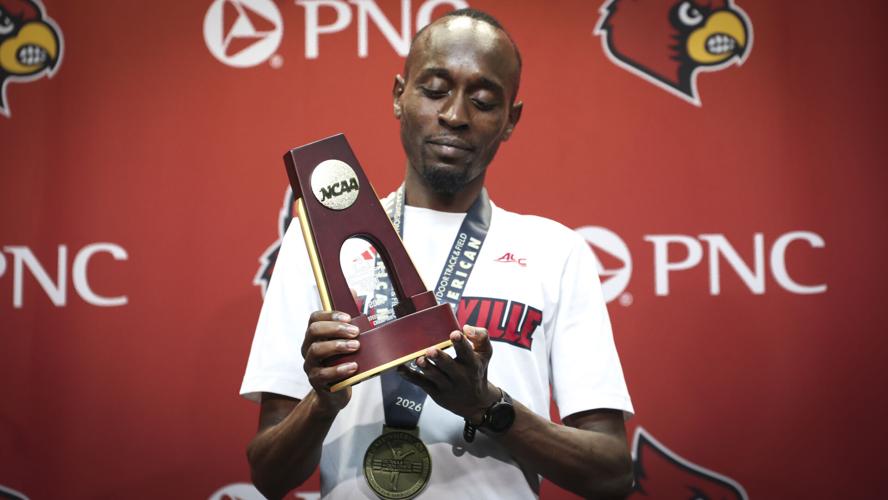
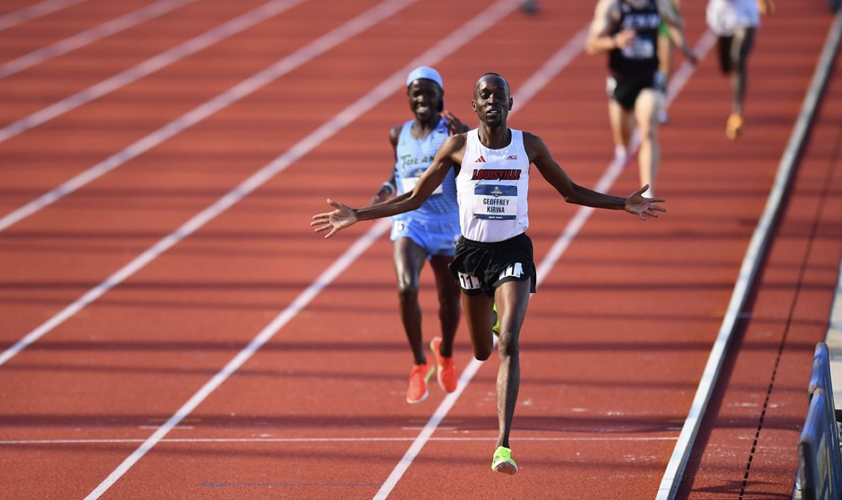
Last week in Eugene, Oregon, Kirwa became Louisville's latest NCAA champion, winning the 3,000-meter steeplechase and delivering one of the finest individual performances in program history.

Louisville's Geoffrey Kirwa wins the NCAA Steeplechase Championships at the outdoor nationals in Eugene, Oregon, on June 13, 2026.
The race lasted a little more than eight minutes.
The journey took years.
And it nearly didn't happen at all.
Before Kirwa ever set foot on a Louisville track, he had to get into the country. That meant the U.S. embassy. Multiple attempts. Two or three trips before a visa finally came through. Louisville director of track and field Joe Franklin called navigating that process a challenge even under the best circumstances, and these weren't the best circumstances.
When the visa finally arrived, Kirwa came with a backpack.
That was about it.
English was his second language. American food was unfamiliar. American classrooms were unfamiliar.
The technology was unfamiliar.
"First time using a laptop," he said. ". . . Everything changed."
Imagine trying to become one of the best runners in America while simultaneously learning how America works.
The barriers on the track may have been the easiest obstacles he faced.
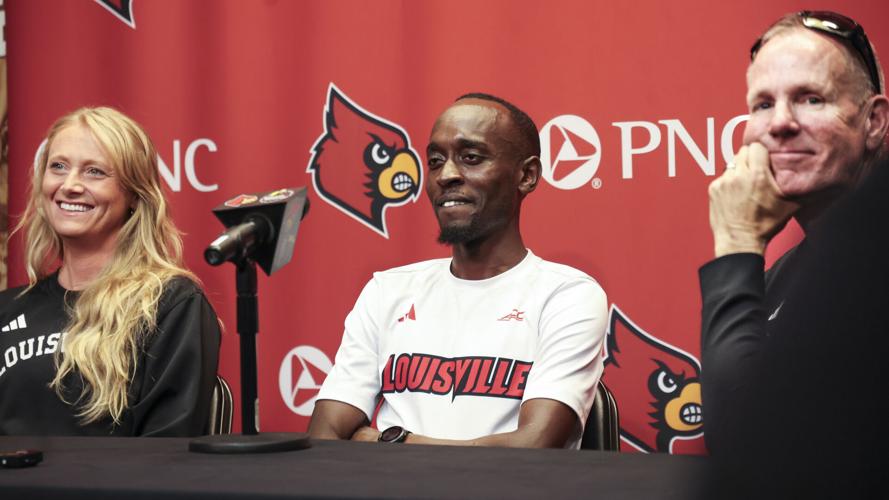
Assistant distance coach Baylee Mires has watched all of it up close. At a press conference this week, someone asked him what it had been like when Kirwa first arrived. Mires started to answer and then stopped.
"It makes me cry, almost," she said. "Sorry."
She wasn't embarrassed. She meant it.
Kirwa chose Louisville deliberately. Alabama offered a scholarship first. He turned it down after Franklin made his case — a coaching history that included world-class distance runners, a vision for where the program was going. Kirwa listened and made a bet.
"I was given a good story, a history of who he had been coaching," Kirwa said. ". . . All those great athletes."
He came here with a personal record of 8:22 in the steeplechase and got to work.
What separates great athletes isn't always talent. Sometimes it's what they do with disappointment.
Kirwa finished second at the NCAA Championships a year ago. Most athletes would rather forget that race. Kirwa studied it. After Kirwa won the title, Mires asked him how many times he'd watched the race. A handful. But when asked how many times he'd watched his runner-up finish the season prior, he said thousands of times.

Louisville assistant track and field coach for distance Baylee Mires, steeplechase runner Geoffrey Kirwa and track and field coach Joe Franklin on Louisville's campus in June of 2026.
Not the victory. The defeat. Over and over. The race became homework. The disappointment became preparation.
By this season, Kirwa had already run 8:08, a personal best. He wasn't simply hoping to win a national title. He expected to.
Then came the NCAA semifinal.
One thing to know about the steeplechase: the barriers don't move. They're fixed. They don't give way like hurdles do. Franklin mentioned this at the press conference almost as an aside. Mires finished the thought.
"He moved," Mires said. "That's for sure."
The first water jump nearly ended everything. Another athlete clipped Kirwa and he slammed into the barrier. Mires said the sound his knee made on impact was so loud it stopped the pole vaulters on the other side of the stadium. Kirwa looked at the barrier as if he couldn't believe what had just happened. Then he climbed over it — not cleared it, climbed it — and found himself 200 meters behind the field.
He chased them down anyway.
He qualified for the final.
Then he spent the next day with a swollen knee and a championship looming.
"I was so mad," Kirwa said with a smile. "I am the best in the country now."
Anger, then certainty.
There's a difference. Champions usually know it.
He had the second-ranked steeplechaser in the country by ten seconds on paper. He controlled the pace from the front. He held it. He crossed first.
Then he went back to his room and didn't sleep.
His phone ran all night. Congratulations messages, people reaching out from Kenya and Louisville and everywhere between. He answered them. He watched the race several more times. He got maybe an hour of sleep.
That was his celebration.
When Kirwa talks about the future, he doesn't sound like a man who has reached the summit. He sounds like a man looking at a higher mountain.
He talks about world championships. He talks about the 2028 Olympics in Los Angeles.
He talks about restoring Kenya's place atop an event his country once dominated, before Ethiopia and Morocco moved in.
"I'm ready to reclaim it back," he said.
Franklin did the math out loud at the press conference. If Kirwa improves three seconds a year over the next three years, he's on the podium in LA. Franklin noted it's a race run over two miles. He asked people to think about how long it takes to drive two miles through Louisville traffic.
Three seconds. That's the margin. Kirwa is already running toward it. Which shouldn't surprise anyone.
After all, Geoffrey Kirwa has been running toward something for most of his life.
First it was school.
Then it was a visa.
Then it was a scholarship.
Then it was a national championship.
The finish line keeps changing.
The stride never has.
Copyright 2026 WDRB Media. All Rights Reserved.


