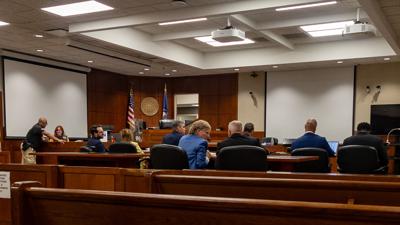

LOUISVILLE, Ky. (WDRB + WAVE) — On the Monday when college football coaches around the country were holding their first full game-week news conferences of the season, another piece of game-week business was taking place in a Louisville courtroom.
Former Kentucky linebacker Alex Afari Jr. was there in person, trying to become eligible in time to play Saturday. Louisville basketball transfer Seth Trimble was among 25 athletes waiting to learn whether they would receive the same temporary protection already granted to 13 players. And attorneys for the NCAA were arguing that what began as one dispute over fifth-year eligibility has become far more complicated than that.
An appropriate start to the first full game week of college football in 2026.
Jefferson Circuit Judge Brian Edwards took three motions under submission after a special hearing Monday: Afari's request to intervene in the existing lawsuit; a request to amend the complaint to add 25 athletes, including Trimble; and a request to extend Edwards' Aug. 21 temporary restraining order to those additional athletes.
Edwards said he would rule as quickly as possible.
Whatever he decides will be preliminary. It will determine who may join the case, and who gets protected while their claims proceed, not a final ruling on anyone's eligibility. What began with 13 athletes from the high school Class of 2022 now threatens to become a much larger test of how far one court's preliminary ruling can reach, and whether athletes with significantly different circumstances can all receive the same protection.
The NCAA argued Monday that the answer cannot be determined simply by establishing that all of the athletes were members of that class and have exhausted four seasons of eligibility. Some, it said, have hired agents. Some have entered professional drafts. Some have signed with or competed for professional teams. Others have transfer issues. And many of the athletes now seeking relief live and compete far outside Kentucky.
"What does a preliminary injunction hearing look like with 40 or nearly 40 plaintiffs, all of whom have individualized issues?" NCAA attorney Charles Stopher asked, accusing the athletes of flocking to Jefferson Circuit Court because Edwards issued a ruling they liked. Athletes without sufficient Kentucky connections, he argued, should pursue their claims elsewhere.
Attorneys for the athletes countered that the proposed plaintiffs have connections to Kentucky and that their common circumstances outweigh their differences at this preliminary stage.
When Stopher argued that handling nearly 40 individualized claims could become unmanageable, Edwards asked how the situation differed from a complex products-liability case involving numerous claims and differently situated parties. Stopher said the crucial difference is time: a civil case can proceed for years, but college athletic careers cannot. If temporary orders remain in effect while seasons are played, he argued, the practical result could become permanent before the NCAA ever gets a full hearing on the merits.
That urgency cuts both ways, according to Louisville attorney Hans Poppe, who represents the athletes. Every day without relief, he said, can cost an athlete a roster spot, scholarship, practice time or a chance to find another school, and the harm isn't limited to athletes whose seasons have already begun. Some need to enroll in classes and begin training now. Others need eligibility protection before schools will even consider adding them to a roster.
"The temporary injunction is exactly that," Poppe said. "It allows the players to talk to schools, which without an injunction they cannot do, and it allows them to at least make plans about maybe I can go here, maybe I can go there."
Afari's circumstances received considerably more attention Monday. He exhausted four seasons of college eligibility, entered the NFL draft, went undrafted and participated in a tryout with the Green Bay Packers. His attorneys submitted an email from Packers personnel stating Afari did not sign an NFL contract, along with the medical waiver under which he took part in the team's 48-hour tryout.
Afari attended Monday's hearing but declined to comment afterward through his attorneys. His attorneys argue he belongs in essentially the same Class of 2022 that Edwards protected in his Aug. 21 order and needs immediate relief to have a chance at returning to Kentucky for Saturday's opener against Youngstown State.
The NCAA says his situation illustrates why the cases aren't necessarily the same. Athletes seeking to take advantage of 2026-27 NCAA rules that could provide a fifth season, its attorneys argued, cannot selectively embrace those rules while asking the court to disregard other provisions involving professional competition, agents and eligibility requirements.
Plaintiffs' attorneys say that puts events in the wrong order: some athletes pursued professional opportunities only after the NCAA told them their college eligibility was exhausted.
"I really didn't understand that issue about the kids having agents," Poppe said. "You've got NIL agents, you've got professional agents, and Judge Edwards has already addressed that in his prior order." More fundamentally, he said, athletes shouldn't be penalized for moving on after being told there was nothing to return to.
"These kids didn't choose to go away and become professional athletes," he said. "They were told by the NCAA, 'Bye, you're done.'"
The NCAA also disputes the venue. Afari played all four seasons at Kentucky in Lexington and wants to return there; Stopher argued that any alleged violation involving him would have occurred in Lexington, where he played, or Indianapolis, where the NCAA made its eligibility decisions, not Jefferson County.
Trimble presents another variation. He completed four seasons at North Carolina but entered the transfer portal before committing to Louisville. Afari did not enter the portal after his fourth season.
"Seth did enter the portal. Afari did not enter the portal," Poppe said. "They got different advice from different people. Seth's advice turned out to be the right advice. I wish Mr. Afari had gotten that advice."
For all their differences, Poppe said, the two are now asking Edwards for essentially the same thing: "They're both seeking to get their own injunctive relief so that they can play. Seth is important to the University of Louisville. Alex is important to the University of Kentucky. They're both asking for the same thing. Just let us play."
The NCAA argued Edwards has more time to sort through Trimble and other basketball players. At least 10 of the proposed new plaintiffs, whose seasons don't begin until November. Poppe said that ignores the practical realities of assembling a roster: an athlete who doesn't compete until later may still need to enroll, practice and secure a spot now.
Nor, Poppe said, does Edwards need to resolve every athlete's circumstances at once. Some cases could require relatively brief consideration; others might need testimony about professional activity, Kentucky connections or where an athlete intends to compete.
A separate fight is unfolding alongside the eligibility questions, one over how far Edwards' order can reach beyond the NCAA itself. Attorneys for the athletes have asked Edwards to order the NCAA to show why it should not be held in contempt over Southeastern Conference rules they contend undermine his Aug. 21 order. Edwards noted at the outset Monday that the SEC is not a party to the case.
The plaintiffs argue the SEC acted "in concert" with the NCAA and therefore falls within language in Edwards' order applying to those acting with the association. The NCAA counters that the SEC is a separate organization, not an extension of the NCAA.
Edwards did not take the show-cause motion itself under submission, only the NCAA's objection to proceeding on it. If he overrules that objection, he said, he would give the NCAA a chance to respond before going further.
His Aug. 21 ruling temporarily protected 13 athletes from NCAA eligibility restrictions while their claims proceed. Monday, dozens more asked to join them, making clear how much has changed since that first order.
The athletes started in much the same place: members of the Class of 2022 who were told their college careers were finished after four seasons. What they did after being told that — sign with an agent, enter a draft, transfer, walk away entirely — is what Edwards must now sort through, one story at a time.
Copyright 2026 WDRB Media. All Rights Reserved.


