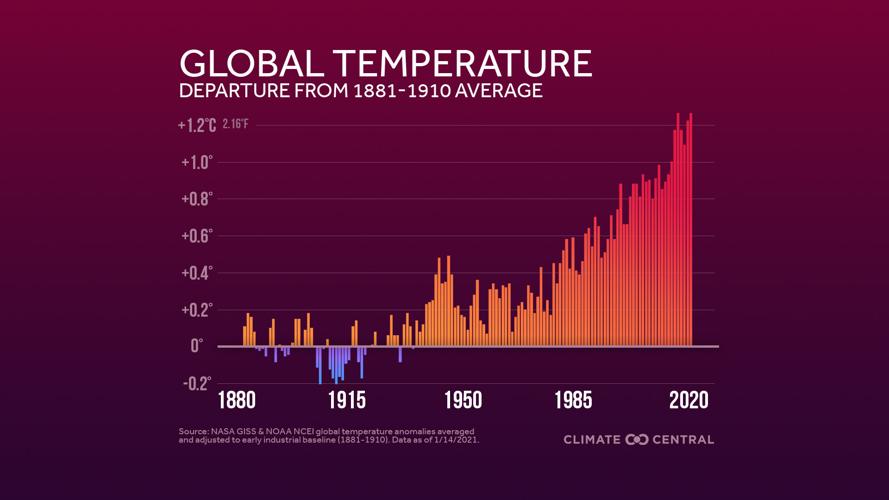
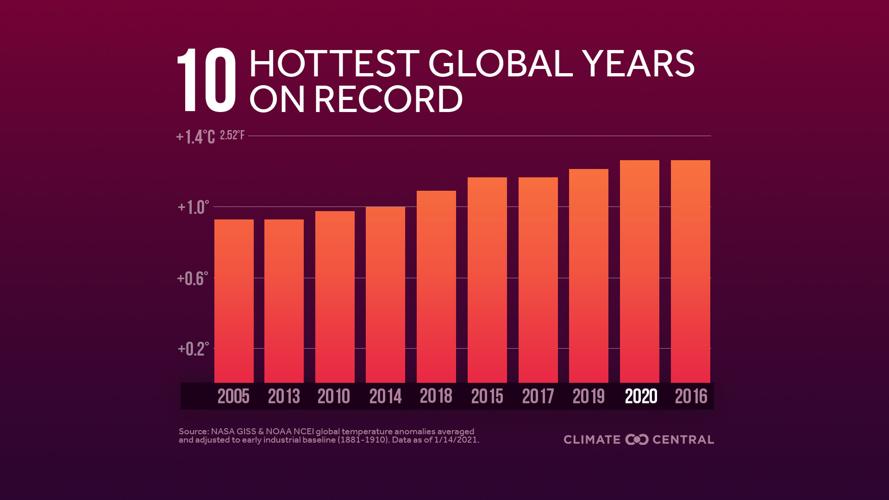
Depending who you ask, 2020 was either the warmest or second warmest year globally on record. NASA is ranking 2020 as the hottest year on record, tied with 2016. NOAA ranks 2020 as the second hottest, setting it just behind 2016. Regardless of which side you fall on (and we will look below at why they are different), the seven warmest years on record for planet Earth have all occurred since 2014. Since 2005 we have experienced all of the top 10 warmest years on record.

Why the difference?
We don't have enough observations in polar regions. NASA infers temperatures in those regions to fill in the gaps, but NOAA does not. According to NASA their "analysis incorporates surface temperature measurements from more than 26,000 weather stations and thousands of ship- and buoy-based observations of sea surface temperatures." The Arctic is warming faster than the rest of the globe, so the data in those polar regions are critical to determining the extent of that warming. Not all parts of the globe are warming as fast as the Arctic, but it does impact the rest of the planet. As the Arctic warms we are seeing greater melting of sea ice. When ice is in place it reflects the suns radiation back into the atmosphere, but when that ice is not present, the heat from the sun is absorbed by the land or ocean. That in turn heats the land or ocean more, which is already warmer than usual as evidenced by the lack of ice.
The fact that we had another "warmest year on record," or even second-warmest, is alarming. When you consider the elements that influence global temperature, that ranking becomes even more significant. Through 2020, especially the second half of the year, a La Niña was developing as we transitioned from an ENSO neutral phase. La Niña is a circulation pattern that shows up as temperature changes in the water in the central and equatorial Pacific Ocean. The ocean temperature changing influences the wind pattern which usually results in less heat being added to the atmosphere during a La Niña phase. For those keeping track at home, the La Niña should have added points to the column keeping the planet away from having a record warm year, but we still had a record warm year despite it. According to NOAA, "2020 marks the 44th consecutive year (since 1977) with global land and ocean temperatures, at least nominally, above the 20th century average."

January 2021
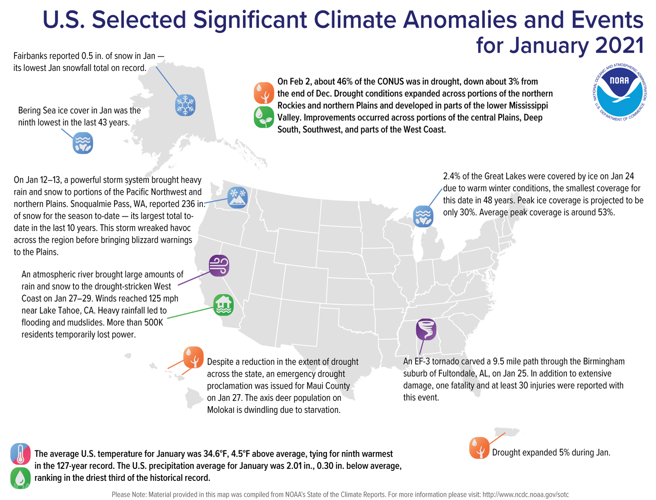
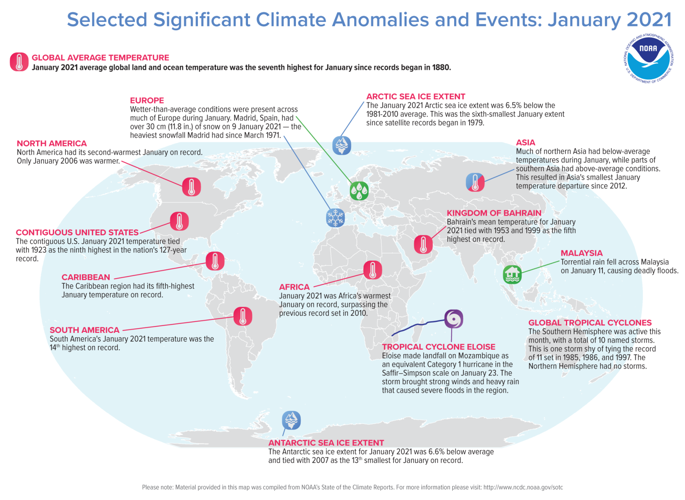
For the United States only, January 2021 was the 9th warmest January on record - tied with 1923. Globally this was the 7th warmest January with the average temperature 1.44 degrees Fahrenheit above the 20th-century average. For those keeping track at home, the average January 2021 temperature for the contiguous United States was 34.6 degrees Fahrenheit which is 4.5 degrees above the 20th-century average, according to NOAA. If you expand the view to the North American continent, the data from the National Centers for Environmental Information shows this to be the second-warmest January on record.

Image Credit: NOAA NCEI
One of the factors to consider in evaluating such a warm January is the ice cover on the Great Lakes, or lack thereof. According to the National Oceanic and Atmospheric Administration, "only 2.4% of the entire Great Lakes surface was covered by ice on January 24, the smallest amount of coverage on this date in the past 48 years." You can click here to see my earlier blog post about Great Lakes ice coverage this winter.

Image Credit: NOAA
During February the United States saw a massive swath of cold air cover the country and cover more than 70% of the land in snow. While the data hasn't been released yet by NOAA, it likely won't be another "warmest on record" sort of month. At least not for the U.S.


