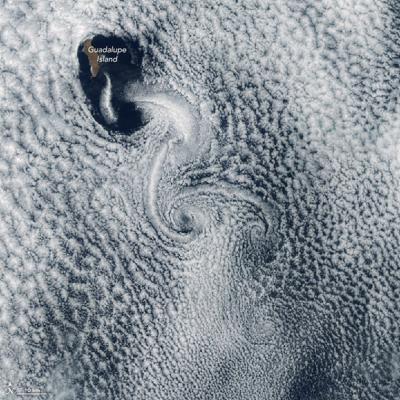

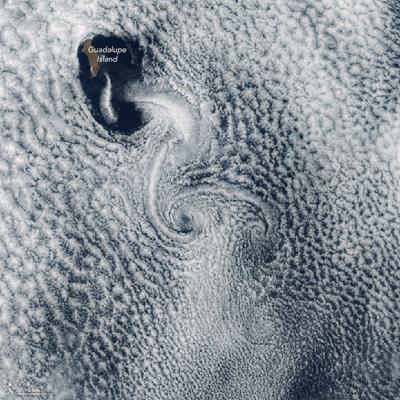
There's all types of cool looking clouds that form in our atmosphere, but some clouds that you won't be seeing around our area and aren't really often seen much at all are called Von Karman vortices.
There are few things in our atmosphere as elegant as von Karman vortices.Some beauties yesterday on Guadalupe Island. pic.twitter.com/OfW7jxW2IC
— Dakota Smith (@weatherdak) November 5, 2021
GIF courtesy: Dakota Smith/twitter
How cool is that? You may be wondering, why are they called that and how in the world do these clouds form?
Named after Theodore von Kármán, a co-founder of NASA’s Jet Propulsion Laboratory and one of the first scientists to describe this type of atmospheric phenomenon, these beautiful cloud formations typically occur when the prevailing wind is diverted by elevated land features such as islands, mountaintops, or volcanoes. These geological features can disrupt the flow of wind, causing the air, and its subsequent clouds, to rotate into a spiral shape. This is similar to the way large boulders create downstream eddies in rivers.
The pattern of the cloud swirls depends on the wind intensity. The vortices are driven by the prevailing winds, which can change seasonally and cause differences in the direction and structure of the vortices.

Image Courtesy: Nasa Earth Observatory
In addition to Guadalupe Island, the Cape Verde Islands and the Canary Islands off the coast of West Africa are common spots for von Kármán vortices to form. Satellites have also spied this atmospheric phenomenon over the Juan Fernandez Islands located off the coast of Chile, Tristan da Cunha, a remote volcanic island in the South Atlantic, Jeju Island, the largest island in South Korea, and the Kuril Islands, a volcanic archipelago in the Pacific Ocean that stretches approximately 810 miles from Japan to Russia.
Here's another video of some of these amazing formations from NOAA Satellites:


