
Happy Leap Day!
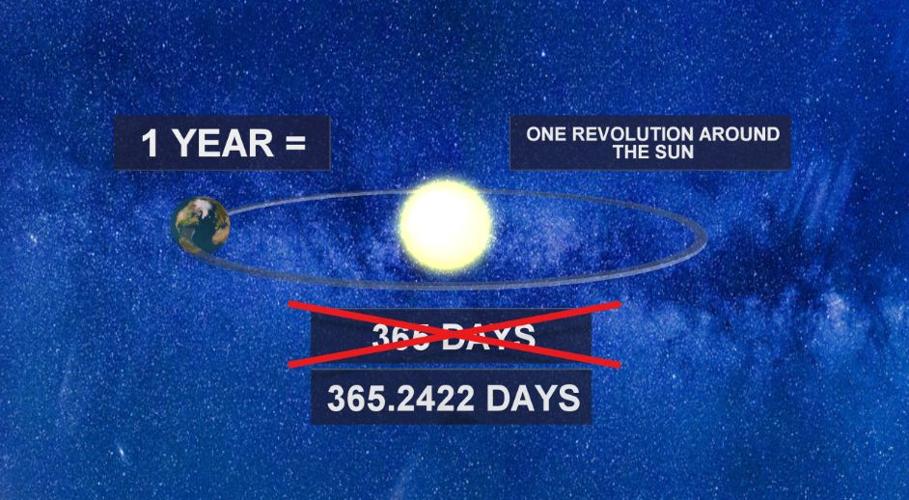
Seize today! It only happens once every 4 years ;) Earth's trip around the sun is 365.24 days, therefore an extra day is needed every fourth year, creating what we know as Leap Year.
Why do we have leap years?
A year is the amount of time it takes a planet to orbit its star one time. A day is the amount of time it takes a planet to finish one rotation on its axis.
It takes Earth approximately 365 days and 6 hours to orbit the Sun. It takes Earth approximately 24 hours — 1 day — to rotate on its axis. So, our year is not an exact number of days. Because of that, most years, we round the days in a year down to 365.

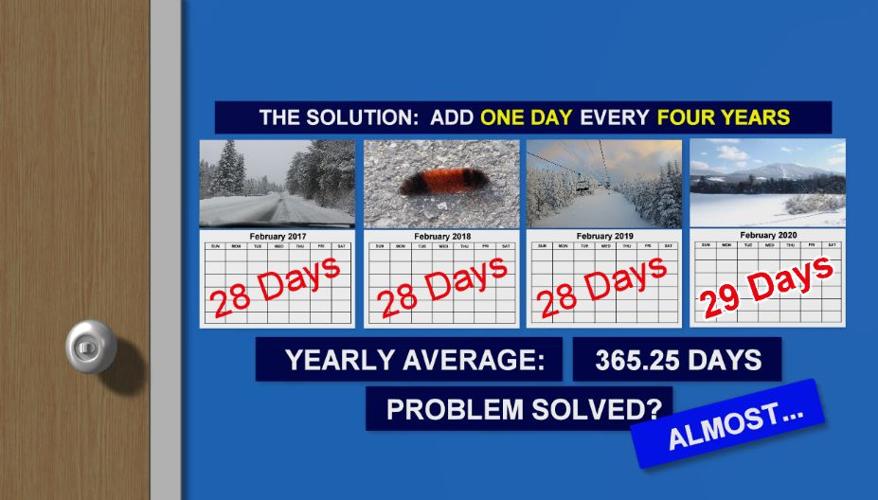
However, that leftover piece of a day doesn’t just disappear. To make sure we count that extra part of a day, we add one day to the calendar approximately every four years. Here’s a table to show how it works:
- 2017: 365 / No
- 2018: 365 / No
- 2019: 365 / No
- 2020: 366 / Yes
Because we’ve subtracted approximately 6 hours — or ¼ of a day — from 2017, 2018 and 2019, we have to make up that time in 2020. That’s why we have leap day!

Wait...There is More!
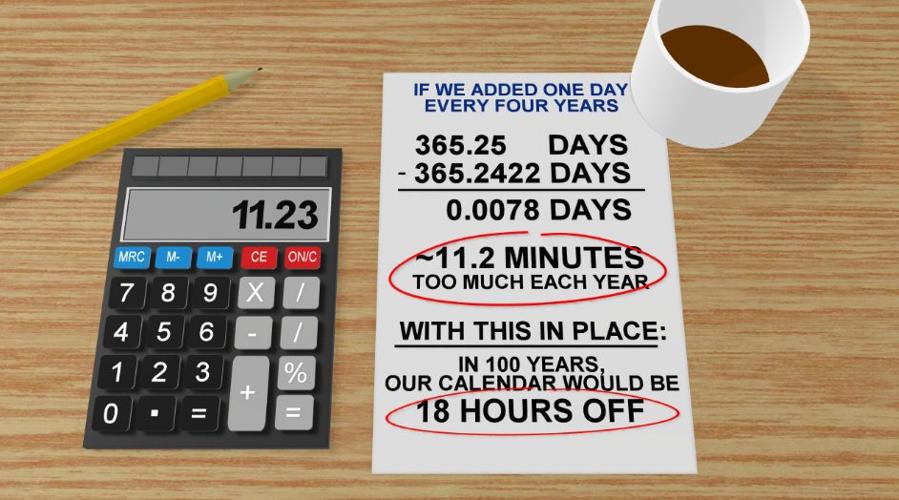
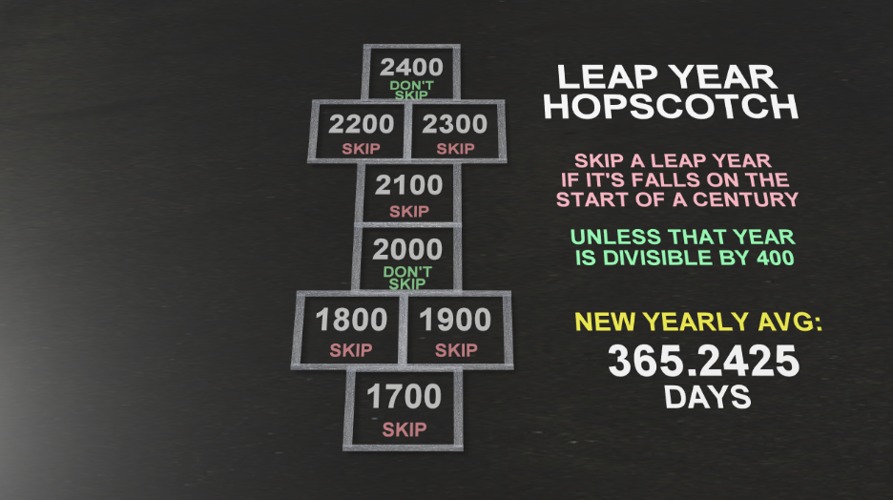
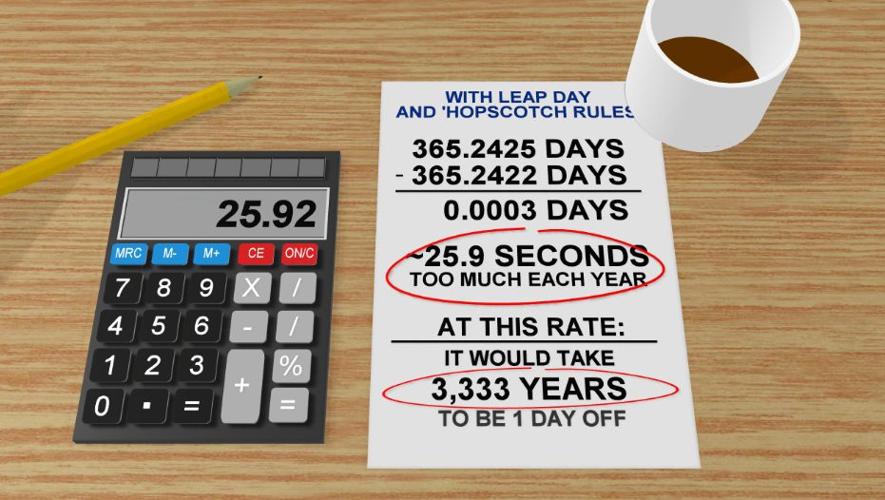
But the peculiar adjustments don't end there. If Earth revolved around the Sun in exactly 365 days and six hours, this system of adding a leap day every four years would need no exceptions. However, Earth takes a little less time than that to orbit the Sun. Rounding up and inserting a 24-hour leap day every four years adds about 45 extra minutes to every four-year leap cycle. That adds up to about three days every 400 years. To correct for that, years that are divisible by 100 don't have leap days unless they’re also divisible by 400. If you do the math, you'll see that the year 2000 was a leap year, but 2100, 2200 and 2300 will not be. For many of us reading this blog - we will likely never experience a skipped leap year. The last leap year that was skipped was the year 1900 and the next leap year to be skipped will be in 80 years! The images below break it down even more!


Are leap years really that important?
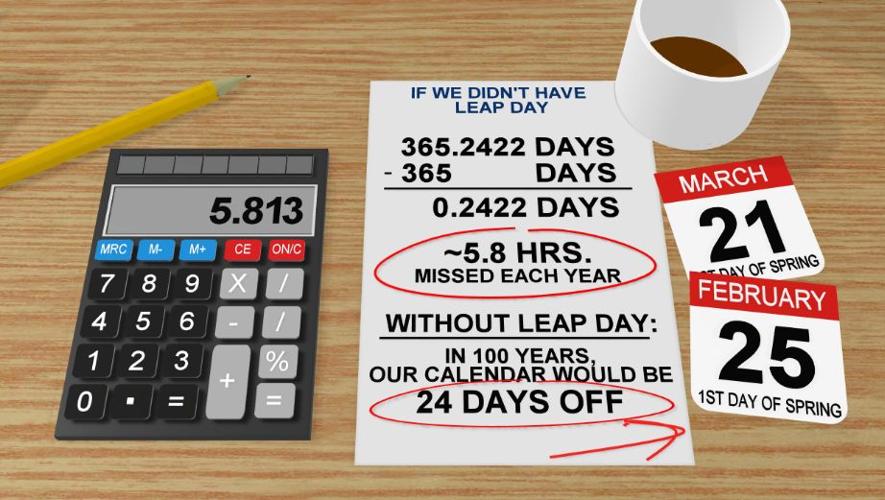
Leap years are important so that our calendar year matches the solar year — or the amount of time it takes for Earth to make a trip around the Sun. Subtracting 5 hours, 46 minutes and 48 seconds off of a year maybe doesn’t seem like a big deal. But, if you keep subtracting almost 6 hours every year for many years, things can really get messed up. Notice below, that if we didn't adjust, the calendar would be 24 days off in only 100 years!
For example, say that July is a warm, summer month where you live. If we never had leap years, all those missing hours would add up into days, weeks and even months. Eventually, in a few hundred years, July would actually take place in the cold winter months!

Do other planets have leap years?
Yes! Leap years happen because a planet’s orbit around the Sun (year) and rotation on its axis (day) are not perfectly in line. This is true of almost every other planet in our solar system.
Mars, for example, has more leap years than regular years! A year on Mars is 668 sols, or Martian days. However, it takes 668.6 sols for Mars to go around the Sun. So, you would sometimes have to add a sol to help the calendar catch up. In a 10 year period, four of the years would have 668 sols and six of the years would be leap years with 669 sols.


