The Hubble Telescope has helped us learn more about our universe than anyone could have expected and has sent back some of the most dazzling images ever seen, like the few clipped together at the top of this page. Now it's successor, the James Webb Space Telescope has completed its final functional tests before its planned launch in October. The European Space Agency and Canadian Space Agency are also working with NASA on this observatory.
The Webb is at Northrop Grumman in Redondo Beach, California, where all it's internal electronics were tested. Scientists also tested the scientific instruments on board using the same network they will be using in space to make sure they could send and receive data.
What is the James Webb Space Telescope?
The first thing to know is the Webb is more than just a telescope. There are other scientific instruments mounted on the platform of this observatory allowing scientists to study more than just the telescope's images. According to NASA's James Webb Space Telescope website, "Webb often gets called the replacement for Hubble, but we prefer to call it a successor. Hubble's science pushed us to look to longer wavelengths to 'go beyond' what Hubble has already done."
How is JWST different than Hubble?
The Hubble telescope was built to study mainly ultraviolet and visible light and only a small spectrum of infrared light. The Webb was built to study mainly infrared light. The images below are both from the Hubble telescope - visible imagery on the left and infrared imagery on the right. Infrared imagery helps cut through the dust and debris in space that can block our view of distant stars, and the Webb telescope is trying to look as far back into history as possible. The farther away a star is, the farther back we are looking in time because light takes so long to travel to us.
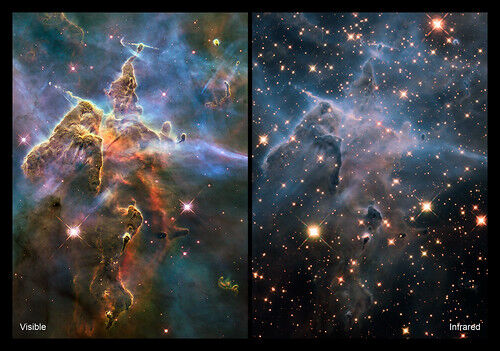
Credit: NASA/ESA/M. Livio & Hubble 20th Anniversary Team (STScI)
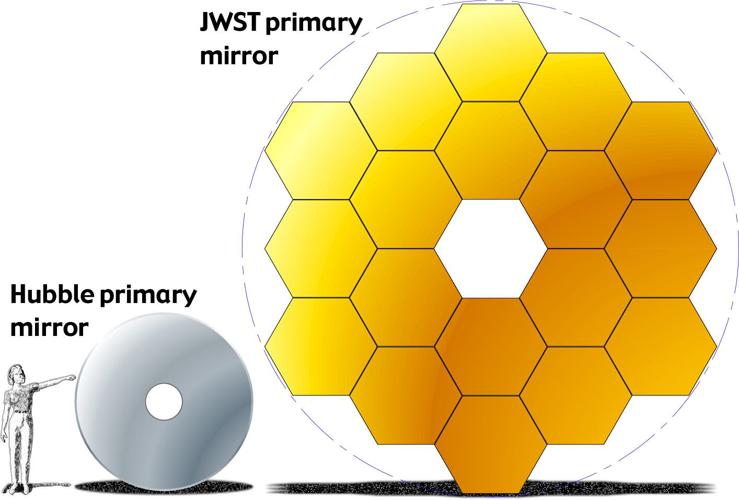
To get that kind of imagery, the Webb's mirrors are much larger than the Hubble's. The mirrors are the light capturing part of the telescope, so the larger the mirrors, the more light can be collected. Hubble's mirror is 2.4 meters in diameter, and Webb's is 6.5 meters.

Image Credit: NASA
Another difference between Hubble and Webb is where it will stay to study space. The Hubble was launched on board the space shuttle in 1990 and is in orbit about 570 km above the earth. Webb won't be orbitting the earth. It's headed to it's "home spot" 1.5 million km away at L2, so it has to be launched from a rocket instead of carried up by the space shuttle. At its "home point," Webb's solar shield will be able to block so much of the light from the Sun and other objects in our solar system. Blocking the sunlight helps the telescope stay as cool as possible, which is the whole ballgame for an infrared telescope. Light and heat cloud its field of view and don't allow it to see as far, so that solar shield is critically important,
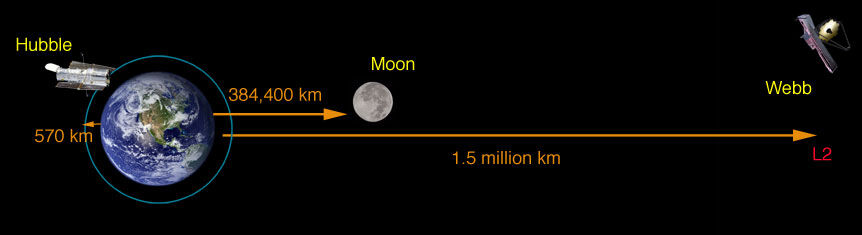
Image Credit: NASA
The next steps for the Webb will include "the final folding of the sunshield and deployment of the mirror" before it gets shipped to the launch site. Launch is tentatively scheduled for October 31 of this year.


