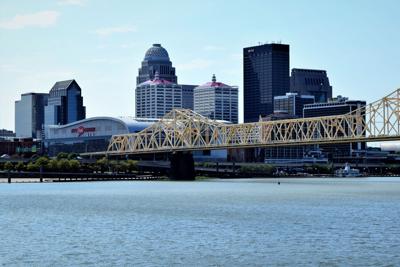


LOUISVILLE, Ky. (WDRB) – No detectable levels of chemicals from the East Palestine, Ohio, train derailment were observed in Ohio River samples from Louisville this week, Louisville Water officials told a Metro Council committee Thursday.
Louisville Water reported no measurable amounts of the main substance being monitored — butyl acrylate — in 32 samples taken at the intake station off Zorn Avenue through Tuesday, a day after the affected plume moved through. That means the levels of the chemical were less than 0.5 parts per billion, according to the water company.
Levels over 560 parts per billion represent a health concern, Chris Bobay, Louisville Water’s water quality manager, said in a presentation to the council’s parks and sustainability committee.
The data also show no detections of the contaminant or other chemicals of concern in Louisville or at other regional testing sites upriver, in Warsaw, Westport and Carrollton in Kentucky, and at Madison, Indiana.
The closest point on the river with a measurable amount of butyl acrylate — 1.44 parts per billion on Feb. 15 — was in Racine, Ohio, some 362 miles upriver from Louisville, according to data from the Ohio River Valley Water Sanitation Commission.
Bobay said there were “two blessings” in how the chemicals released from the Feb. 3 Norfolk Southern derailment affected the Ohio River, which is the source of drinking water for Louisville and other cities.
First, he said, it was uncharacteristically warm in the first week after the spill and the river was flowing slowly, allowing for the “natural biodegradation of these chemicals.” Then, he added, heavy rains churned more water into the river.
“A lot of that extra flow pushed this thing out quickly,” Bobay said.
Louisville Water officials said any chemicals from the spill already have passed through Louisville.
“Any water that could have contained any remnants from that derailment went by Louisville on Monday,” said Kelley Dearing Smith, a water company spokeswoman. “It's gone. It's downriver. That water is past Louisville.”
Parks committee chair Jecorey Arthur, D-District 4, said a concern he’s heard is about other chemicals besides butyl acrylate, a strong-smelling ingredient used in plastics, coatings and adhesives and other products.
Dearing Smith and Bobay said routine water monitoring continues for more than 30 chemicals that are associated with those known to be potential contaminants from the derailment, while other technology screens thousands of others.
In response to a question from council member Jeff Hudson, R-District 23, Bobay said Louisville officials could detect any chemicals from the train derailment that are released into the river as a result of future dredging operations.
“If there was a resulting release — a chemical that may have been embedded in the sediments, as you said — I think there's reassurance knowing that we have 17 monitoring stations continuously running to be able to detect anything that shouldn't be there,” Bobay said.
He also explained why Louisville Water didn’t shut down its intake system like Cincinnati did out of an abundance of caution as the chemicals moved past. Cincinnati has a storage system that handles several days’ worth of water, he said, but Louisville doesn’t and must “be able to treat everything.”
That led to monitoring and treating the water with carbon — a common method of removing impurities in water, Bobay said.
“We’re still feeding carbon just as out of an abundance of caution, even though we didn't see anything,” he said. “We just want to make sure that we have multiple barriers in place for protection and water quality.”
Copyright 2023 WDRB Media. All rights reserved.