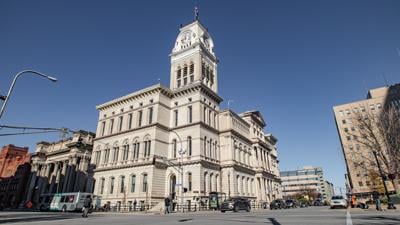
LOUISVILLE, Ky. (WDRB) – Vacant seats on Louisville’s Metro Council would primarily be filled through special elections rather than appointments under a bipartisan bill that cleared the Kentucky House on Tuesday.
House Bill 191, sponsored by Republican Rep. Jared Bauman of Louisville, passed 99-0 and now heads to the Senate.
The measure gives voters in Metro Council districts the power to cast ballots for their representatives weeks after vacancies, changing a process that now lets the council choose who will hold empty seats between scheduled elections.
“This appointment process has long been considered undemocratic and undesirable across the council, across the county and across this General Assembly,” Bauman said in a floor speech.
Bauman, a first-term House member who ousted longtime Democratic incumbent Charlie Miller last November, said “the right to have our voices heard and elect our leaders is one of the fundamental promises of government.”
HB 191 requires a special election 60 days after a seat becomes vacant. A special election would not occur if the vacancy happens less than three months before a scheduled November election for a term set to expire in January; in that case, the council president would appoint someone to finish the term.
If a vacancy happens within three months of an election and the term won’t expire in January, the winner of the November election would serve the remainder of the term.
Each special election would cost an estimated $50,000, according to a fiscal analysis of the bill.
As it stands now, the Metro Council appoints members to vacant seats until the date of the next regularly scheduled general election as called for in the Kentucky Constitution.
Markus Winkler, the council president, said in an interview Tuesday that no one objects to “people having a voice.”
But he said he has several concerns about the legislation and is working with Mayor Craig Greenberg’s administration and state Sen. David Yates, a Democrat and former Metro Council member, to make changes in the Senate.
Winkler, a Democrat, said someone leaving office slightly more than three months before a November election means that there could be two elections in short succession. He also said he’s concerned about council seats staying empty during the two-month period between when a vacancy occurs and a special election.
Former Metro Council members David James and Keisha Dorsey resigned on January 4 to take deputy mayor positions in the Greenberg administration. Their replacements – appointees Kumar Rashad in District 3 and Phillip Baker in District 6 – were selected on February 2.
“For the first month of this year I served as the district council person for District 3 and District 6,” Winkler said. “We answered their calls, but I would say they got a baseline level of representation.”
He argues that doing that for an extended period of time puts pressure on the council president’s office, which already is serving a council district. “You're not helping people in the real way they need to be helped.”
Another seat – the District 8 post currently held by Democrat Cassie Chambers Armstrong – also would become vacant if Chambers Armstrong wins Tuesday’s special election for the Kentucky State Senate.
HB 191 has nine co-sponsors, including Rep. Rachel Roarx, a Louisville Democrat who also is in her first term; Democratic Rep. Nina Kulkarni of Louisville; and Republican Rep. Ken Fleming, a former Metro Council member.
Roarx said on the House floor that her experience as a Metro Council legislative aide let her see firsthand how appointments aren’t fair to constituents.
“Voters in most cases chose someone different when it came time for the election,” she said. “And with that, council members also didn't like the process because it took up valuable time the Metro Council could be spending on other issues and made them appoint a member of a district that they did not represent.”
The bill only addresses vacancies on the Metro Council. A WDRB News investigation last fall found that government-by-appointment is common in Jefferson County’s small cities, where councils and commissions often struggle to attract enough candidates for office.
About 36 percent of those cities did not have a full complement of candidates running for the two-year legislative terms last November, according to a WDRB News analysis of Jefferson County Board of Elections data.
Those seats are then filled by appointments.
Copyright 2023 WDRB Media. All rights reserved.