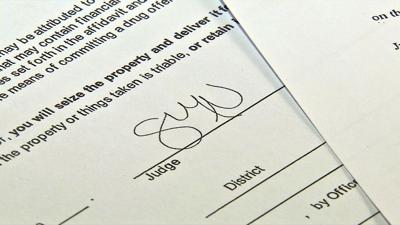


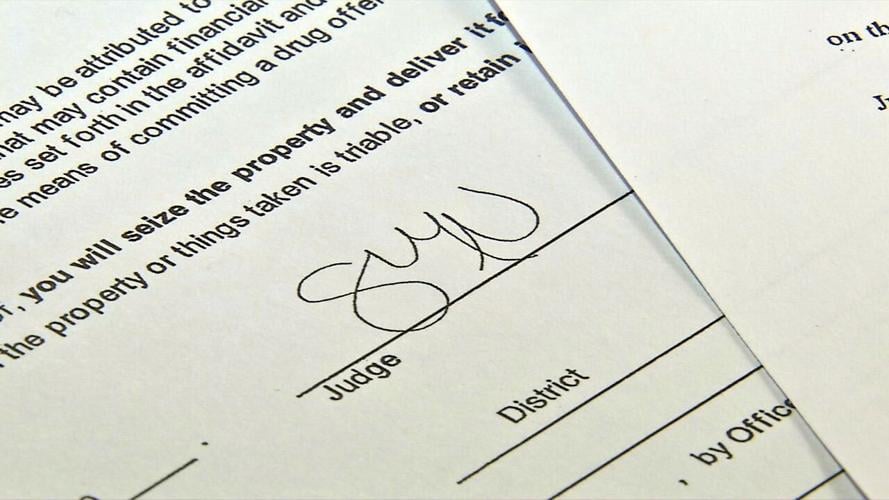
LOUISVILLE, Ky. (WDRB) -- Louisville police officers no longer can choose certain judges to review search warrant applications, a practice some call "judge shopping" that came under fire after the death of Breonna Taylor.
A majority of the 13-member elected group of circuit court judges voted last week to tell the Louisville Metro Police Department and other local law enforcement agencies that officers must now take warrant affidavits to the Jefferson Court Administrator, who will randomly select a judge to review each request.
And on Friday, the 17 member district court term voted the same way.
The changes comes after the U.S. Department of Justice released a report into Louisville police practices earlier this month that scrutinized how officers apply to have warrants approved. Investigators found that just six of 30 judges in circuit and district courts signed more than half of the warrants reviewed.
In addition, the report revealed that officers rarely sought approval from 19 of the 30 judges.
The DOJ recommended Louisville create a system "for seeking judicial approval of a search warrant without forum shopping," or being able to choose a specific judge.
The move by the circuit court judges is just the first of what is expected to be sweeping reforms by police and judges to strengthen rules governing how warrants are obtained. Chief Circuit Court Judge Mitch Perry informed interim LMPD Chief Jacquelyn Gwinn-Villaroel of the change last week, saying it took effect March 16, WDRB News has learned.
The chief then sent a memo to officers on March 17 telling the if they try to take a warrant affidavit to a specific circuit judge, "they will be redirected to the Court Administrator's Office."
Perry could not immediately be reached for comment. A call to a police spokesperson was not immediately returned.
Gwinn-Villaroel's memo to officers noted the current process in district court is unchanged.
Kelly Goodlett, one of the Louisville police detectives who drafted the flawed search warrant for Taylor's home, said she heard her partner, Joshua Jaynes, make the decision to bring the warrant affidavit to former Jefferson Circuit Court Judge Mary Shaw because he "believed that Judge Shaw would not closely scrutinize his warrants," according to court documents.
Among other misinformation in an affidavit presented to Shaw, Jaynes included fake validation from a postal inspector that drug suspect Jamarcus Glover was using Taylor's Springfield Drive apartment to receive parcels. But another Louisville police officer had already told Jaynes that "there's nothing there."
Shaw has said she did not know Jaynes or Goodlett.
In total, three officers have been charged after the "false affidavit set in motion events that led to Ms. Taylor's death when other LMPD officers executed that warrant," Assistant U.S. Attorney General Kristen Clarke has said.
LMPD has claimed that while Jaynes obtained a "no-knock" warrant, police repeatedly knocked on Taylor's door and announced themselves before knocking it in.
Kenneth Walker, Taylor's boyfriend, has said he never heard police announce themselves and believed the couple was being robbed. He fired a shot, hitting former Detective Jon Mattingly in the leg.
Police responded with 32 shots, hitting Taylor six times. The 26-year-old died at the scene.
No drugs were found in her home.
The circuit court judges' decision is "a step in the right direction," said attorney Sam Aguiar, a Taylor family attorney. "And it's nice to hear the circuit judges are taking action. Hopefully we'll see that warrants are electronically stored and that warrants are being unsealed."
Jeffersontown Police Chief Rick Sanders said his officers have no problem with the change.
"I certainly understand it, coming on the heels of the DOJ (Department of Justice) report," he said.
The Department of Justice recently released findings of a wide-ranging civil rights review in Louisville that began nearly two years ago in the wake of the 2020 police killing of Taylor.
The report pointed out how little information was presented to judges who signed off on warrants.
In one example, an officer obtained a search warrant for a man and his home without identifying any probable cause. Instead of identifying what the officer was seeking, he used a checkbox option for "other" and provided blank lines.
"He provided no other reason for probable cause," according to the report. "The court issued the search warrant anyway."
The name of the judge was not released.
It found that LMPD routinely seeks search warrants for residences without establishing legal justification for invading someone's home.
"Officers regularly seek warrants that are overly broad, sweeping in people who have at most a remote connection to the investigation, who have committed no crime, harbor no evidence and have a constitutional right to be not be subjected to unreasonable search and seizure," Clarke said on March 8.
Copyright 2023 WDRB Media. All Rights Reserved.


