

LOUISVILLE, Ky. (WDRB) -- The Jefferson County Board of Education’s vice chairman hopes to see a greater focus on student achievement, particularly among Black students at Jefferson County Public Schools, in the district’s proposed overhaul of its student assignment plan.
Corrie Shull, who represents District 6, said changes outlined in proposed changes to the JCPS student assignment plan are “moving in the right direction,” but he worried that the proposal as written could usher in “unintended consequences” for Kentucky’s largest public school district.
“This will affect kids for the next generation or more, possibly, and I think that we need to do a little bit more work to perfect this,” Shull said.
Another board member, James Craig, said he hoped to see enrollment boundaries created for the two traditional high schools at JCPS, Butler and Male, and for Kammerer and Crosby middle schools to maintain their funding if enrollments drop sharply based on the proposed student assignment strategy.
“I'm going to keep my eyes on the funding for those two schools and the populations of those two schools to ensure that they remain as successful as they have been,” Craig said, noting that students who might otherwise attend Kammerer and Crosby would likely enroll in two new middle schools on Echo Trail and in west Louisville.
“... It's hard to complain in some ways because those are the only two middle schools in the entirety of JCPS, non-magnet, that are not Title I schools. But they're in my district, and it's my job to advocate for their success.”
Shull and Craig are two JCPS board members who raised some concerns about the student assignment proposal unveiled by JCPS late Monday.
Resegregation of schools and exacerbating inequities are among concerns Shull said he’s heard since the plan’s release.
“Though you may have the choice to send your child close to home or further away from home, you cannot control where away from home that child ends up,” Shull said. “... If you’re giving families in the west end two bad choices, if it is to send them to one Title I school or another Title I school, that doesn’t serve the purpose of closing the achievement gap.”
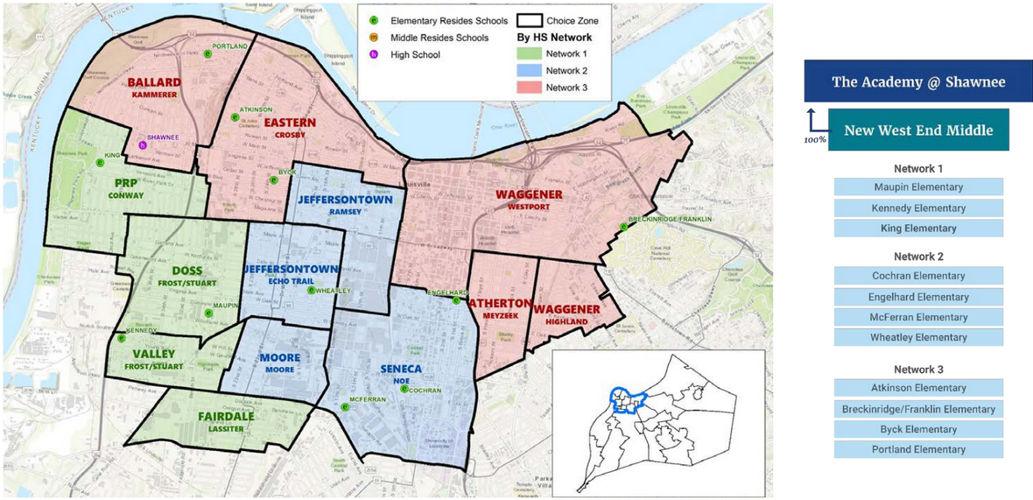
Part of the proposed JCPS student assignment plan unveiled by Superintendent Marty Pollio envisions 13 “choice zones” in and near west Louisville and giving families options between attending either a new middle school in west Louisville and the Academy @ Shawnee or their geographically assigned middle and high schools.
Most of the district’s 22 high schools and 27 middle schools qualify as Title I schools, meaning they serve many students from low-income families. All but seven of the 24 current schools covered by the choice zones — Crosby Middle, Kammerer Middle, Meyzeek Middle, Noe Middle, Atherton High, Ballard High and Eastern High — are Title I schools.
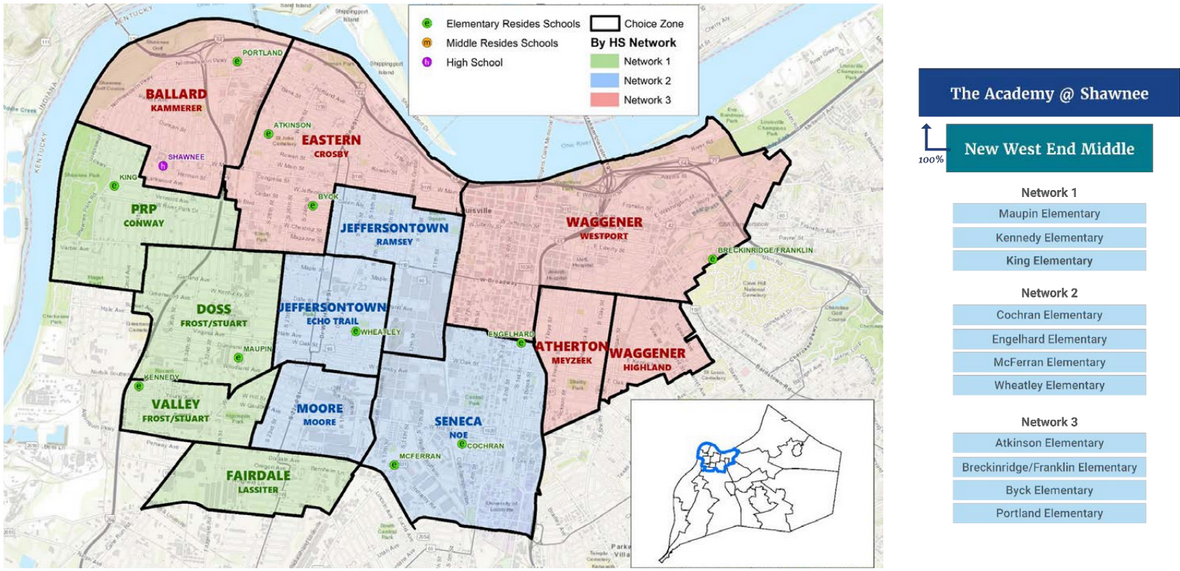
"Choice zones" proposed as part of the JCPS student assignment proposed update.
Sixty-eight percent of the more than 95,000 JCPS students qualify for free or reduced-price school meals this school year.
“Without focusing on student achievement, we by default are focusing on location as though location will automatically produce better outcomes,” Shull said. “I think that there needs to be a discussion attached to the student assignment plan concerning curriculum, concerning learning more specifically with the intent on reducing or closing the achievement gap, and I think without that component, we will see students perhaps having choice, but perhaps having choice with the possibility of being presented with two bad choices.”
Pollio said during a news conference Tuesday that he has to focus on student outcomes as superintendent and that the district serves a community with “extremely problematic” housing segregation.
He estimated that 75% of students living in west Louisville are sent to Title I schools as part of the district’s current student assignment plan. The JCPS student assignment proposal calls for the district to spend an extra $2.5 million per year for the Academy @ Shawnee, $2.5 million per year for the new west end middle school and $7 million per year split among Atkinson, Breckinridge-Franklin, Byck, Cochran, Engelhard, Kennedy, King, Maupin, McFerran, Portland and Wheatley elementary schools for things like higher teacher pay, smaller class sizes and extended learning opportunities.
The district also plans to expand magnet program offerings and prohibit magnet programs from exiting, or kicking out, students as part of its student assignment proposal.
“They're not leaving the community to go to an affluent school,” Pollio said. “They are leaving the community to go to a school like I was principal of, Doss High School, that’s 85% free and reduced lunch and majority minority. We’ve got to look at the numbers realistically and say what they are and begin to focus on student outcomes.”
The fact that many west Louisville children must leave their communities to learn is problematic for some Black families, Shull said.
“One thing I'm hearing from Black people who live in the west end is that diversity matters, but it seems to be a foregone conclusion that white people in the east end will never be asked to do anything," he said. "And that's fundamentally unfair."
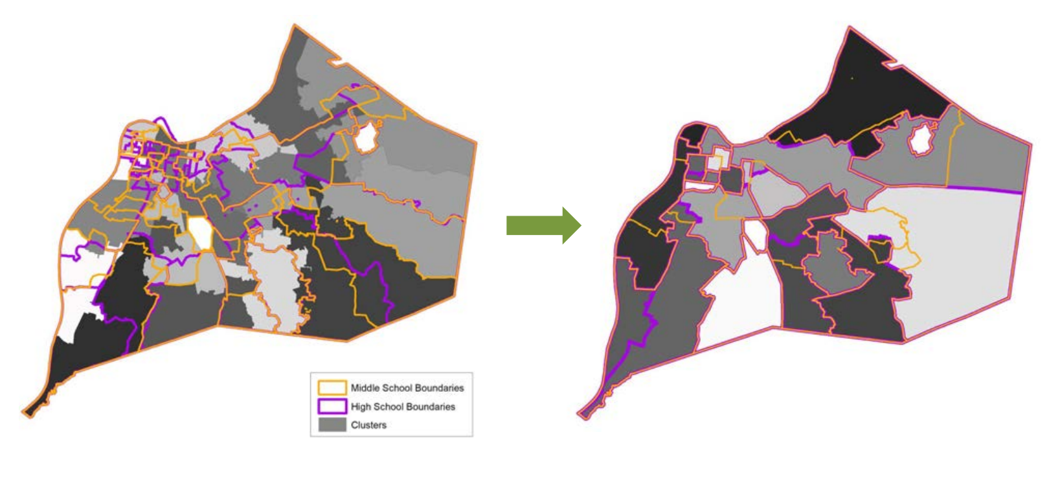
For Craig and other board members interviewed Wednesday, the proposed consolidation of K-12 school "feeder patterns" would provide clarity and continuity for families as they navigate the district’s student assignment process. Elementary school clusters and middle school enrollment boundaries would mostly align with updated high school boundaries.

The current JCPS student assignment plan (left) compared to the proposed student assignment plan (right)
Cutting the number of elementary through high school feeder patterns from 90 to 27 as proposed in the plan will “lead to significantly better experiences for students,” he said.
The biggest complaint Craig, who represents District 3, said he received while canvassing his district in 2018, particularly around Kammerer, was that “students were transported to Kammerer and then they would disappear after the eighth grade.” Participation in afterschool activities was another concern he heard often, he said, noting that he successfully advocated for an extra activity bus for Kammerer.
“If they want to attend Kammerer, they should also have the right to attend Ballard and to maintain relationships with the friends that they develop and to maintain that sense of belonging, which we now understand is one of the linchpins to student achievement,” Craig said.
Board member Chris Kolb, who represents District 2, said the “predictability and consistency” in the proposed student assignment plan are among highlights of the proposal for him.
Kolb believes streamlining feeder patterns at JCPS will improve climate and culture in schools and boost students’ comfort in their learning environments.
“They're going to be able to stay with friends, either from their neighborhoods or friends that they've met in school much more throughout their 12 years,” he said.
Kolb said he welcomed feedback on the plan, which Pollio expects to bring before the board in May. If approved, the student assignment proposal will take effect in the 2023-24 school year.
“I expect that some folks will bring up some good points that I may not have thought about, but at the moment, it all looks good to me,” Kolb said.
Board member Linda Duncan, who represents District 5, said was “cautiously optimistic” about the district’s student assignment proposal, though she worries about how the district plans to resource high-poverty schools and how quickly new schools will be built.
Reducing class sizes will be key in helping impoverished students and in recruiting and retaining teachers, she said. Putting together “a very strong compensation package” will also help draw teachers to high-poverty schools, she said.
“A teacher having 80 kids during the day versus a teacher having 150 high-poverty kids, there's no comparison,” Duncan said. “I know we won't get to 80, but if we get way closer to 80 a day instead of 150, that's going to help retain teachers.”
Board member Sarah Cole McIntosh, who represents District 7, said she understood concerns about the possibility that some schools may see higher concentrations of poverty among their students. She encouraged the community to provide feedback on the proposal.
“Unfortunately, this is largely due to historic housing patterns seen in our city for decades and JCPS alone can’t correct that,” she said in an email to WDRB News. “We need to have meaningful, long-term investment in high poverty neighborhoods by state and local authorities for that to change.”
JCPS will hold its second community forum on the student assignment plan 6 p.m. Tuesday at the Academy @ Shawnee.
Related Stories:
Copyright 2022 WDRB Media. All Rights Reserved.


