


LOUISVILLE, Ky. (WDRB) -- The Centers for Disease Control and Prevention earlier this week delivered a document to the White House outlining advice and guidance for various re-opening institutions in light of the ongoing COVID-19 threat.
The guidance was never issued, and instead the administration returned it to the CDC, rejecting it as "too prescriptive." In particular, some didn't approve of the CDC's advice for faith communities.
"Governments have a duty to instruct the public on how to stay safe during this crisis and can absolutely do so without dictating to people how they should worship God," Roger Severino, the director of the Department of Health and Human Services' Office for Civil Rights, told The New York Times.
Still, the document, published in the Times and elsewhere, gives a view of what measures the CDC believes various organizations can take to move forward, and provides ideas (without requiring them) to all manner of organizations looking to operate in a time of heightened concern about a virus whose spread is not yet under control in many parts of the country.
"This guidance is not intended to infringe on First Amendment rights as provided in the U.S. Constitution," the CDC document states at its outset. "As all Americans are now aware, gatherings present a special risk for increasing spread of COVID-19 during this Public Health Emergency. The federal government may not prescribe standards for interactions of faith communities in Houses of worship and, in accordance with the Religious Freedom Restoration Act (RFRA), no faith community should be asked to adopt any mitigation strategies that are more stringent than those asked of similarly situated entities or activities. CDC offers these suggestions that faith communities may consider and accept or reject, consistent with their own faith traditions, in the course of preparing their own plans to prevent the spread of COVID-19."
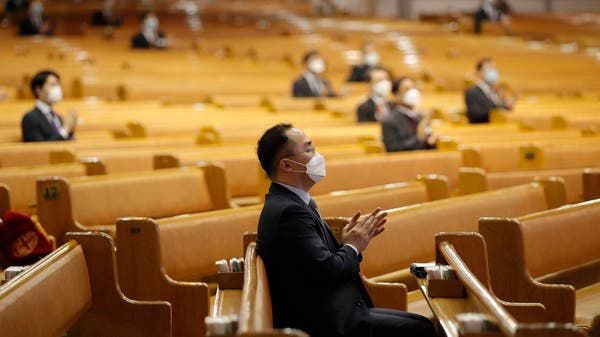
As in all matters, the CDC advises adults and children over the age of 2 to wear face coverings in any public setting where social distancing is difficult, including in church, where permitted by faith traditions.
But you can count on other changes, too. The post-service handshake with the pastor might not return for a while, nor potluck meals after services. The new sign of peace might just be a wave -- from a socially safe distance.
Even as permission to regather congregations is rolling out in many states, houses of worship are figuring out how best to proceed to keep their congregants safe.
Kentucky Gov. Andy Beshear has set May 22 as the date Kentucky churches may open to in-person services, within social distancing guidelines. In Indiana, Gov. Eric Holcomb's reopening order allows churches to hold in-person services, without limits on size of congregation, beginning today.
Southeast Christian Church, the largest congregation in Kentucky, which has a campus in Indiana, says it has not yet decided on a date for resuming in-person services, and that senior pastor Kyle Idleman will address the issue further in Sunday's online services.
When the doors do reopen in area houses of worship, here are some changes you might expect to see are below, based on the CDC guidance this week:
1). AT-RISK, AT HOME: Church membership rolls tend to skew older, and that could mean a significant number of worshippers will continue to do so virtually. In all Phases of the White House's reopening plan, those at-risk because of age or underlying medical condition are advised to stay out of large crowds and away from places they could contract the virus unless absolutely necessary.
The CDC echoed that recommendation. Older members are the backbone of many faith communities, and their absence would be felt. But their presence, for the immediate future, is being discouraged, except from a distance.
2). SPREADING OUT: Churches are being advised to seat each family as a group in worship services, with at least six feet on each side. As well, they are advised to seat people in every other row, so that the six-foot distance can be maintained in front of and behind worshippers. If necessary, churches are advised to add services to accommodate their reduced seating capacity, and to mark rows and other areas where people are not supposed to sit.
Beyond that, churches are encouraged to hold worship services in large, well-ventilated areas, or even outdoors if possible and permitted within the community's faith guidelines.
3). DON'T PASS THE PLATE. The CDC advises churches to, "Consider modifying the methods used to receive financial contributions. For example, consider a stationary collection box, the mail, or electronic methods of collecting regular financial contributions instead of shared collection trays or baskets."
Beyond that, the CDC advises that other shared items be temporarily limited. Things like bulletins, hymnals and prayer books are to be avoided, in favor of electronic texts on screens or prayers brought from home.
This is a particularly complicated subject in Christian churches when it comes to communion, which is a centerpiece of some services, but which is virtually impossible, in the way many churches have observed it in the past, to accomplish while trying to uphold safety guidelines. Some have offered communion on a drive-in basis during the crisis, other churches have refrained from it together until their entire congregations can again gather in person.
Churches in Germany, which reopened this week after six weeks of shutdown, offered communion as usual, but floor markings instructed worshippers where to wait in line as they moved forward to receive it.
Some churches have considered having worshippers pick up the pre-packaged elements themselves on their way into the sanctuary for the service. Regardless, this figures to be another element of worship that is changed, at least temporarily.
4). PREACHING TO THE CHOIR: The CDC advises faith gatherings to, "Avoid or consider suspending use of a choir or musical ensemble during religious services or other programming, if appropriate within the faith tradition. Consider having a soloist or strictly limiting the number of choir members and keep at least six feet between individuals."
In Germany, no singing is allowed in churches as they reopen. Congregational signing was a sticking point in that country, central to just about every faith's services, and yet demonstrated to be a particular area in which the virus is spread, particularly as more is learned about the aerosolization of respiratory droplets.
Of the 78 singers in Berlin's protestant cathedral, 59 contracted the coronavirus. A single choir in Mount Vernon, Wash., decided to go ahead with a rehearsal in early March and saw three-quarters of its 212 members fall ill, and two of them die.
Unlike the guidance in other countries, the CDC limited its suggestions to choral singing and other ensemble singing, but did not give advice on congregational singing.
5). CHILD CARE CHANGES: Because many churches have active Sunday School or other morning child care options during or before services, they will have the challenge of taking many of the same precautions that schools and child care providers are faced with.
Some of these measures include keeping children within the same group for the entire time of attendance, closing down all communal spaces, maintaining social distancing and spacing out seating, and staggering arrival and departure to keep large groups from forming.
What measures is your church taking? As you encounter new things with churches opening up, feel free to let us know.
Copyright 2020 WDRB Media. All Rights Reserved.


