

LOUISVILLE, Ky. (WDRB) -- More doctors could be headed to underserved areas in Kentucky, thanks in large part to a grant awarded to the University of Louisville.
The University of Louisville announced Monday that it received a $16 million grant from the Health Resources and Services Administration (HRSA) to help increase health care for Kentuckians, in both rural and urban areas of the state that are underserved.
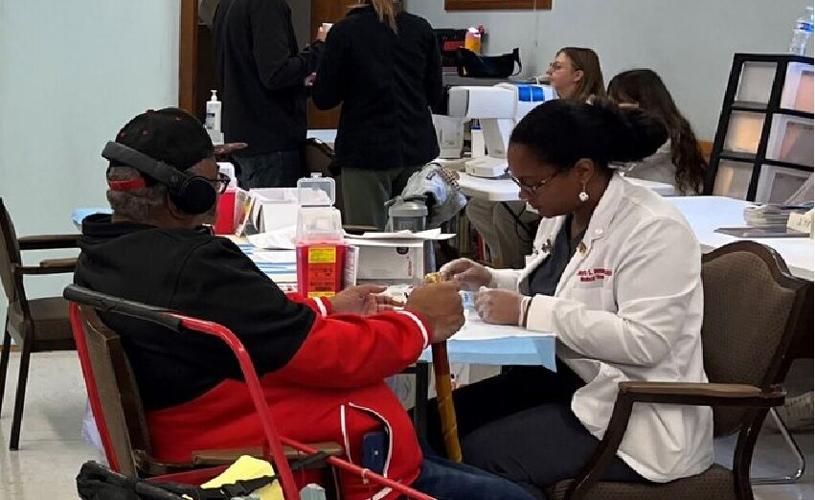
The UofL School of Medicine will use the four-year grant to help train more primary care physicians that focus on family medicine, general internal medicine, pediatrics and internal medicine.
The goal is to encourage those specialties to consider practicing in underserved communities.
"We know that students who train in these rural locations are more likely to practice there and our hope is that by strengthening these programs, we'll be able to immerse students in these communities and increase the number of primary care physicians in underserved regions across the Commonwealth," said Kelli Bullard Dunn, vice dean of community engagement and diversity for the UofL School of Medicine.

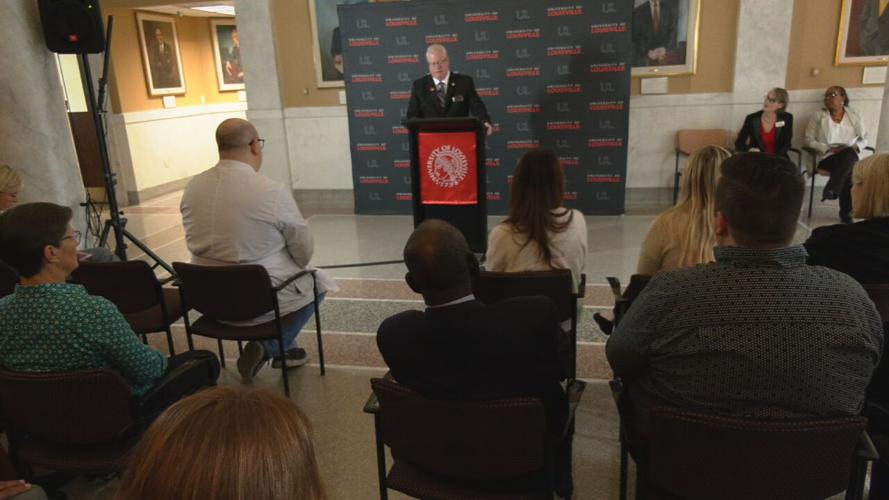
Jeffrey Bumpous, interim dean for the University of Louisville School of Medicine and vice president of medical affairs announces a $16 million grant from Health Resources and Services Administration (HRSA). WDRB Image. Oct. 9, 2023
According to UofL, Kentucky has a "severe shortage" of health care providers, with at least some portion of 113 of the state's 120 counties designated as Health Professional Shortage Areas, including parts of Jefferson County. Recent projections rank Kentucky lowest among the states in meeting the need for primary care physicians by 2025.
"We have such a need in Kentucky and all over," said Faye Jones, UofL Health Sciences Center associate vice president for health affairs and diversity initiatives.
UofL's School of Medicine already has a path for students to focus on rural areas. The Trover Rural Track offers primary care clinical training for students in conjunction with the UofL family medicine residency programs at Glasgow and Owensboro.
Medical students in the Trover program complete their final two years of medical school at Trover Campus, located in Madisonville, Kentucky, hosted by Baptist Health Deaconess Madisonville.
According to the school, of the 170 physicians who have graduated from the Trover Rural Track so far, 75% practice primary care and 43% practice in rural communities.
This grant will impact Louisville as well as areas outside the city, according to Bullard Dunn.
"Here in a big city, here in Louisville, in our urban core, we have just as many problems with access to healthcare as we do in rural communities. Sometimes they're the same. Sometimes they're different. But the need is there," she said.
The School of Medicine said it will create a new program to train medical students in an urban environment. It will be modeled on the Trover program and provide medical students opportunities to train in facilities in west Louisville and other communities.
"Another aim of this project that I think is particularly exciting is addressing the pressing need for primary care in the urban underserved environment by working right here in Louisville," Bullard Dunn said.
The project also plans to enhance a university program that prepares individuals with a bachelor's degree in a different field to enter medical school.
In addition, the grant will also help provide scholarships to support students in these programs.
"I grew up in a rural area with very little healthcare that was available there so the fact we are actually looking to increase primary care in areas, that's so important to me and my family. I think is a major, major thing for me," said Jones.
It's not only primary care where health experts said there is a need.
Down the road at Sullivan University, there's a push to encourage more people to go into pharmacy programs.
"As you've probably noticed, if you go into a chain retail pharmacy, you often have shorter opening hours, you have long lines. That is because there is a need both for pharmacists and for pharmacy technicians," said Misty Stutz, dean of Sullivan's College of Pharmacy and Health Sciences.
Stutz said there is a nation-wide shortage of new students enrolling in pharmacy programs and that decline is being seen at universities like Sullivan.
"We're down over half of what we were in 2018," she said.
Stutz said workplace conditions at pharmacies started changing around 2013, with fewer people on shifts, making it more challenging for someone to do the same amount of work with less help. She said the pandemic in 2020 also added a new workload to pharmacies, including administering vaccines.
Stutz said the role of the pharmacist is to be the "medication expert" and serve a critical role in helping the public.
"The thing we worry about the most is the risk for medication errors because that's really where the pharmacist makes the most contribution," Stutz said.
She said to help encourages students to go into the field, Sullivan has scholarships available.
"Pharmacy is a great field," she said. "Especially if you're a science and math lover. It is a lucrative field. It still has a median salary of about $130,000."
For a direct link to the University of Louisville School of Medicine, click here.
For a direct link to Sullivan University's College of Pharmacy and Health Sciences, click here.
Copyright 2023 WDRB Media. All Rights Reserved.