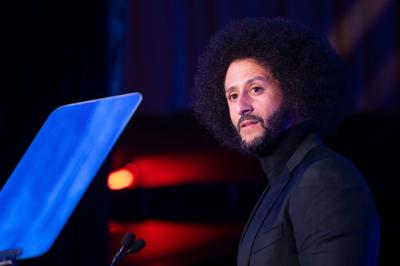

LOUISVILLE, Ky. (WDRB) — Colin Kaepernick, whose decision to kneel during the national anthem made him one of the most controversial athletes in American sports, will receive the Muhammad Ali Humanitarian of the Year Award in Louisville.
The choice will be controversial. It may be especially so because of the name attached to the award.
But controversy doesn't make Kaepernick an uncomfortable fit with Muhammad Ali's legacy.
In one important respect, it may make him a more appropriate one.
The Muhammad Ali Center announced Tuesday that Kaepernick, the former San Francisco 49ers quarterback who became an activist for racial justice, will be honored at its 13th annual Muhammad Ali Humanitarian Awards on Nov. 7.
"Colin was chosen for his courage to stand against racial injustice and his unwavering commitment to empowering underserved communities," Lonnie Ali, co-founder and president and CEO of the Muhammad Ali Center, said in the announcement. "Like Muhammad, Colin has used his platform to advocate for equality, human dignity, and social change, even when doing so came at significant personal and professional cost."
Kaepernick, in accepting the honor, drew the same connection.
"Receiving the Muhammad Ali Center's Humanitarian of the Year Award is an incredible honor," Kaepernick said. "Muhammad Ali lived with an uncommon courage to stand firmly in his convictions, even when doing so came at a great personal cost. He understood that our platforms are not simply ours to benefit from, but ours to use in service of others."
Kaepernick has lived with strong reactions for a decade.
In August 2016, he began protesting during the national anthem before 49ers games, first by sitting and later by kneeling, saying he wanted to call attention to racial injustice and police brutality.
The protest spread to other players, other teams and eventually other sports. It also became a national political flashpoint, with critics arguing that kneeling during the anthem was disrespectful to the flag, the country and members of the military.
Kaepernick said that was not his purpose. After speaking with former NFL player and Green Beret Nate Boyer, he shifted from sitting during the anthem to kneeling as a way of continuing his protest while showing greater respect for military members.
He never played another NFL game after the 2016 season.
Muhammad Ali knew something about the consequences of an athlete becoming a lightning rod.
Ali was stripped of his heavyweight championship and lost some of the prime years of his boxing career after refusing induction into the U.S. Army during the Vietnam War. He was vilified by many Americans. His positions on race, religion and war made him a deeply divisive figure, including in his hometown.
Today, much of the anger that surrounded Ali has faded from the popular memory of him. His courage and conviction are celebrated far more readily than they were when exercising them came at a cost.
Kaepernick's legacy has not reached that comfortable distance.
The argument about him is still going on. And perhaps that is part of what makes this award fitting.
Kaepernick's activism also has extended well beyond the gesture that made him famous.
He founded Know Your Rights Camp, an organization focused on education and empowerment for Black and Brown youth. He also pledged more than $1 million of his own money to charitable organizations, founded Kaepernick Publishing and has written several children's books.
Most recently, he founded Lumi, an education platform that uses storytelling as a tool for literacy and student expression.
"Through Know Your Rights Camp and his broader philanthropic efforts, Colin has turned his convictions into meaningful action by educating, empowering, and supporting young people and communities," Lonnie Ali said. "His courage, sacrifice, and sustained dedication to service embody the humanitarian spirit and enduring legacy of Muhammad Ali."
Kaepernick played six seasons with the 49ers and led San Francisco to Super Bowl XLVII and consecutive NFC Championship games. His 181 rushing yards in a 2013 playoff victory remain an NFL single-game record for a quarterback.
But football long ago became secondary to his place in the American conversation.
His protest inspired other athletes and drew criticism from fans, politicians and public officials. In 2017, after going unsigned, Kaepernick filed a grievance accusing NFL owners of colluding to keep him out of the league. The sides reached a confidential settlement in 2019.
The Ali Center's choice comes almost exactly 10 years after Kaepernick's protest began.
There is an irony in the timing, though perhaps also a lesson. Time has a way of sanding the sharp edges from public memory. Ali's convictions, once condemned by large portions of the country, eventually became inseparable from the admiration afforded him.
Kaepernick's legacy remains far less settled. The Muhammad Ali Center isn't waiting for history to settle it. It is honoring him now.
"To be recognized in his name is simultaneously humbling and a responsibility," Kaepernick said. "I remain committed to bring about justice, uplift our communities, and develop a world where all people can live with freedom, dignity, and self-determination."
Kaepernick joins previous Humanitarian of the Year recipients including Shaquille O'Neal, Christina Aguilera, Michael J. Fox, Common, Patricia Arquette and Geena Davis.
Louisville philanthropists Steve and Amy Trager also will be honored with the Kentucky Humanitarian Award. Six young international humanitarians will receive awards corresponding to Ali's six core principles of Confidence, Conviction, Dedication, Giving, Respect and Spirituality.
Sometimes an athlete decides there is something more important than being cheered.
Muhammad Ali knew what could happen next.
Colin Kaepernick does, too.
Copyright 2026 WDRB Media. All Rights Reserved.


