


LOUISVILLE, Ky. (WDRB) — There was a time when if you wanted to find Oliver Lewis, you had to know where to look.
You could find his photo hanging inside the Aristides Lounge at Churchill Downs.
You could find him in old newspaper archives.
You could find him in the work of historians and genealogists.
You could find him in African Cemetery No. 2 in Lexington, where volunteers spent years cutting through overgrowth and searching records to preserve the stories of Black horsemen buried there.
But mostly, you had to know where to look. That seemed strange.
Oliver Lewis won the first Kentucky Derby.
At age 19, he rode Aristides to victory before a crowd of roughly 10,000 spectators in 1875, becoming the first winning jockey in the history of America's most famous horse race. His trainer, Ansel Williamson, was a Black horseman born into enslavement whose reputation was so strong that he carried documentation certifying his expertise with horses. Thirteen of the 15 jockeys in that first Derby were Black. The early Kentucky Derby was not merely inclusive of African Americans.
They were the sport.
Then they weren't.

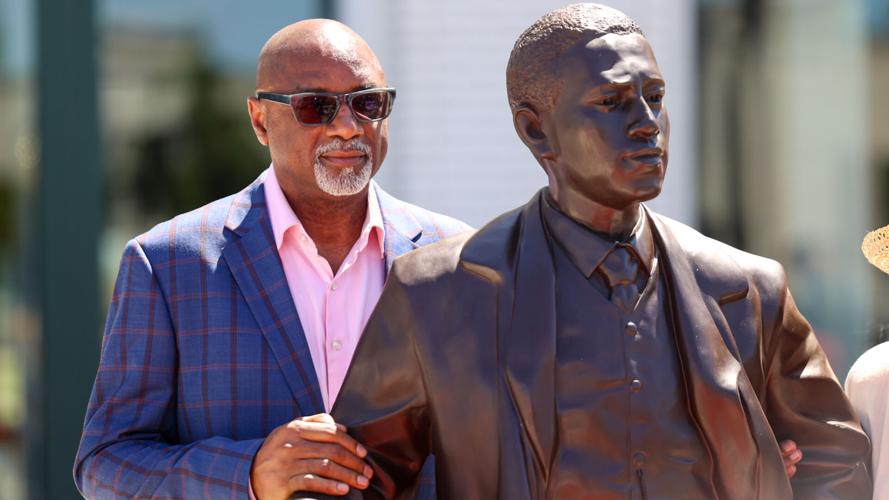
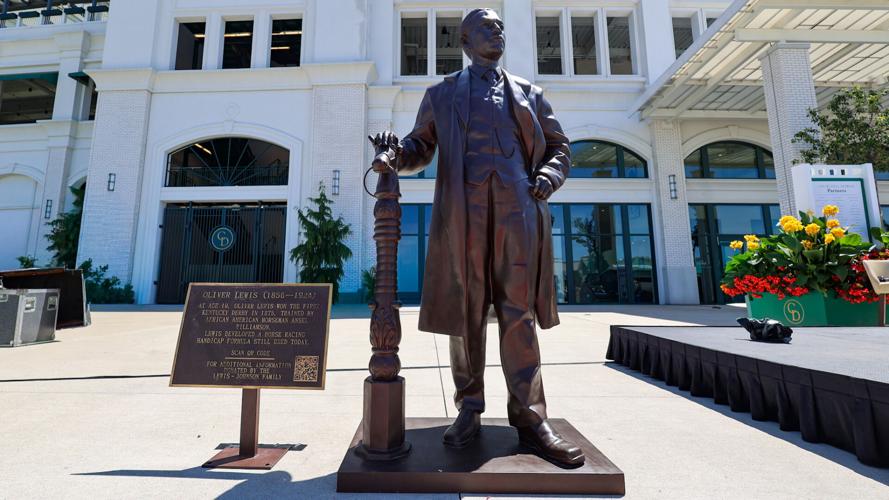
A statue of Oliver Lewis, the jockey who won the first Kentucky Derby aboard Aristides, after a June 24 unveiling in front of the First Turn Club at Churchill Downs.
By the early 1900s, Black jockeys and trainers who had dominated the sport's formative years had been systematically pushed aside. Opportunities vanished. Mounts vanished. Careers vanished. By 1921, Black jockeys had vanished from the Kentucky Derby itself.
The people were erased. The history followed.
Lewis never rode in another Derby. Nobody seems entirely sure why. He worked around racing for a time as a bookmaker and handicapper. Later he moved to Cincinnati and wound up laying asphalt for city streets. When he died in 1924, he was brought back to Lexington and buried in African Cemetery No. 2.
If his grave was marked, those markings disappeared.
Meanwhile, Churchill Downs became Churchill Downs.
The Derby became the Derby.
The race grew into an American institution.
The horse got a statue. The jockey became a story that had to be rediscovered.
Which is why Wednesday felt important.
Near the First Turn Club entrance, descendants of Lewis unveiled a bronze statue donated by the family — cast in China, delayed by the war, finally arrived — made from the only known photograph of him.
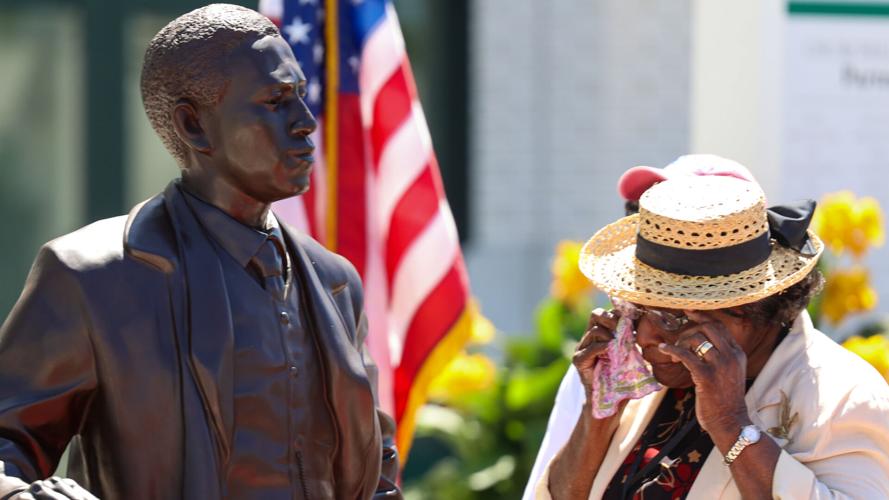
Some family members cried. You could understand why.
The journey to Wednesday was a long one.
Rodney Van Johnson, Lewis' great-great-grandson, told the story.
Years ago, his mother, Ruth Johnson Watts, became interested in the family's genealogy. This was before ancestry websites and searchable databases. She did it the hard way, gathering records, documents and family histories.
Eventually she handed her children a packet.
This is who you are.
"I took that packet," Van Johnson said Wednesday, "and I just tossed it."
His mother kept going.
"I'm glad she didn't get rid of it," he said. He knew she wouldn’t.
At about the same time, another search was underway.
In Lexington, historian Anne Butler was trying to find Oliver Lewis.
Not the famous Oliver Lewis. The actual one.
There were three Oliver Lewises in Lexington born around roughly the same time. Butler sorted through obituaries, death certificates and historical records until she finally found a notice reporting that Lewis had died in Cincinnati and would be returned to Lexington for burial in the family plot at African Cemetery No. 2.
Then she got in her car and drove to Cincinnati.

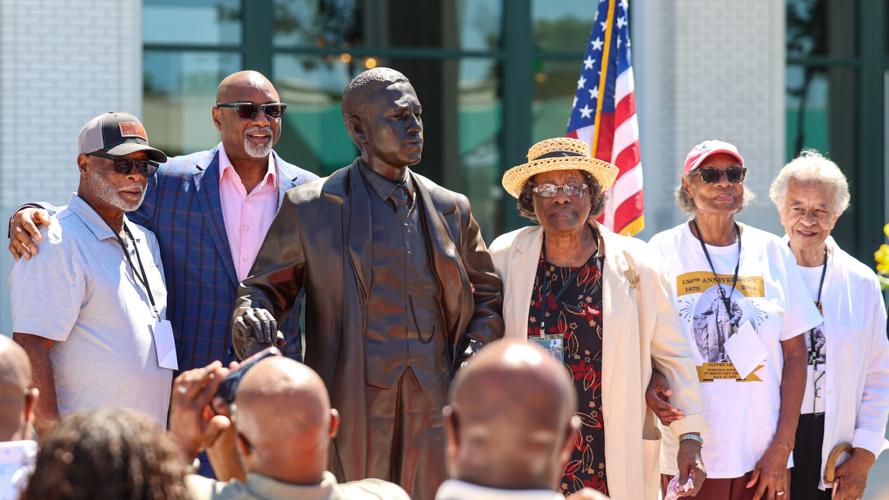
Descendants of Oliver Lewis, and others who helped make the unveiling of a statue of the first winner of the Kentucky Derby possible at Churchill Downs, posed with the statue on June 24, 2026.
The house had been sold.
The family was gone.
So Butler started asking questions around the neighborhood until she found where they had moved. She knocked on Ruth Johnson Watts' door. Watts invited her inside, assuming Butler might be a relative.
The two women talked. And Butler sat there waiting for the right moment. Because she knew something she suspected the family didn't.
Finally she told her.
Your ancestor won the first Kentucky Derby.
That moment led, eventually, to Wednesday.
After Butler's death, Yvonne Giles continued the work.
When Lewis' 150th Derby anniversary approached and some publications began circulating the wrong photograph of him, Giles had T-shirts printed with the correct image from the Keeneland Library archives.

Ruth Johnson-Watts, great-granddaughter of Oliver Lewis, sheds a tear upon seeing a statue of the Kentucky Derby winning jockey, unveiled at Churchill Downs on June 24, 2026.
She wore one nearly every day.
Nobody was going to forget what Oliver Lewis looked like.
Not if she could help it.
That's really the story of Wednesday.
History did not preserve Oliver Lewis.
People did. His family did. Anne Butler did. Yvonne Giles did. The volunteers at African Cemetery No. 2 did.
People cared enough to remember. Churchill Downs eventually joined them.
One of the day's speakers, poet Hannah Drake, put it beautifully.
"History remembered the first Kentucky Derby, but it forgot the man," she said. "History remembered Aristides, the horse who crossed the finish line first, but it forgot the man."
For a long time, that was true.
The horse stood outside. The jockey watched from a photograph inside.
Now they both stand at Churchill Downs. As they should.
Anyone who doubts how completely a people can be erased from an institution they helped build need only look at the early Kentucky Derby. Black jockeys won 15 of the first 28 runnings. Black trainers conditioned six of the first 17 winners. Then they were driven from the sport's highest levels and spent the next century trying to find their way back.
What happened was not complicated.
It was shameful.
But the track that was built in part by Black horsemen, then pushed them aside, then spent a century becoming something larger than that history proved Wednesday it is big enough to stand in front of a statue and tell the truth about where it came from.
That's what Wednesday was.
For generations, you had to know where to look for Oliver Lewis.
Now you don't.
Copyright 2026 WDRB Media. All Rights Reserved.


