
We had a heat wave last week, now this week there is a heat wave in Europe. This comes after last year was the hottest summer on record in England. CNN said, "The average temperature in England from June to August 2018 was 17.2 degrees Celsius (63 degrees Fahrenheit), beating the previous record set in 1976 by 0.2 degrees." On Thursday the UK Met Office tweeted this saying they had potentially recorded the highest temperature ever in the UK.
❗Breaking News❗
— Met Office (@metoffice) July 26, 2019
A new provisional recording of 38.7 °C at Cambridge Botanic Garden has been received from yesterday
It will be quality controlled & if validated would be the highest temperature officially recorded in the UK
More here: https://t.co/1SJxix4VWb #UKHottestDay pic.twitter.com/7kfI17nOgx
38.7ºC is 101.66ºF, and Cambridge is at roughly the same latitude as Saskatoon in Saskatchewan, Canada. The map in the tweet below shows eastern England experienced the higher heat for longer, especially the southeast.
Have you been enjoying the heat? Or are you pleased to see the fresher weather?
— Met Office (@metoffice) July 27, 2019
This map shows the areas that experienced a #heatwave this week and for how long 🌡️🌡️🌡️
Find out more about heatwaves here 👇https://t.co/Mwxf207Ej1 pic.twitter.com/BUPQyZ2oRp
But it wasn't just confined to England. The majority of France was under alerts related to intense heat Thursday, including Paris. The tweet below from BBC Weather also shows that Norway tied its highest temperature record, too!
#NORWAY appears to have equalled its all-time temperature record today with a provisional 35.6C reported at Laksfors #heatwave 🌡️🥵
— BBC Weather (@bbcweather) July 27, 2019
Matt pic.twitter.com/uHydnKlC1U
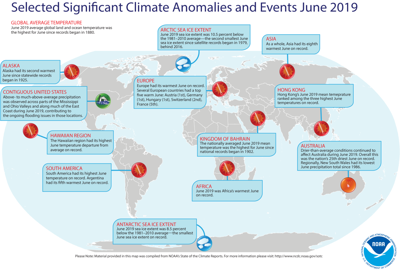
The National Oceanic and Atmospheric Administration issued a report earlier this month saying, "the average global temperature in June was 1.71 degrees F above the 20th-century average of 59.9 degrees, making it the hottest June in the 140-year record, according scientists to NOAA’s National Centers for Environmental Information. Nine of the 10 hottest Junes have occurred since 2010. Last month also was the 43rd consecutive June and 414th consecutive month with above-average global temperatures." They added that, "average Antarctic sea-ice coverage was 8.5% below the 1981-2010 average – the smallest on record for June." The image below is part of the report from NOAA.


