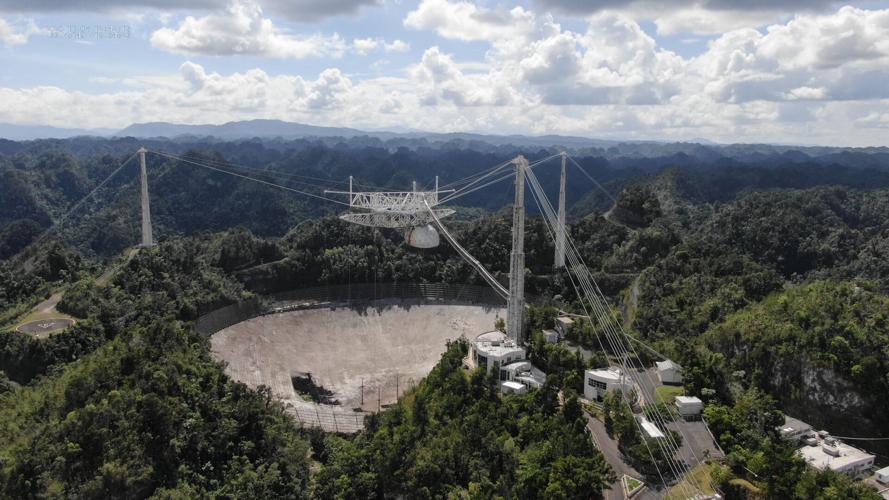
Until recently the radio telescope at Arecibo Observatory in Puerto Rico was the largest on Earth. Now it has been destroyed, but not on purpose. Overnight between November 30 and December 1, another part of the telescope collapsed. This is actually the third time in the last 3-4 months a piece of this extensive array has failed and resulted in damage to the telescope.
The instrument platform of the 305m telescope at Arecibo Observatory in Puerto Rico fell overnight. No injuries were reported. NSF is working with stakeholders to assess the situation. Our top priority is maintaining safety. NSF will release more details when they are confirmed. pic.twitter.com/Xjbb9hPUgD
— National Science Foundation (@NSF) December 1, 2020
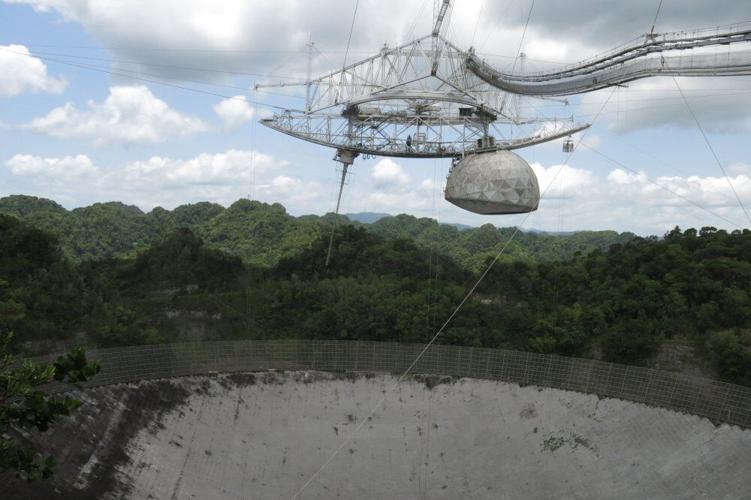
This telescope was build in the 1960s when the U.S. government was trying to create anti-ballistic missile defenses. This telescope may be unlike anything you've seen before. There is a radio dish at the bottom which is 1000 feet in diameter and an instrument platform suspended 450 feet above that dish. That platform weighs 900 tons and hangs in the air by cables connected to three towers. If you consider yourself a movie buff, these images may look familiar to you. Arecibo made appearances in GoldenEye (the Bond movie) and Contact, the 1997 sci-fi movie directed by Robert Zemeckis.

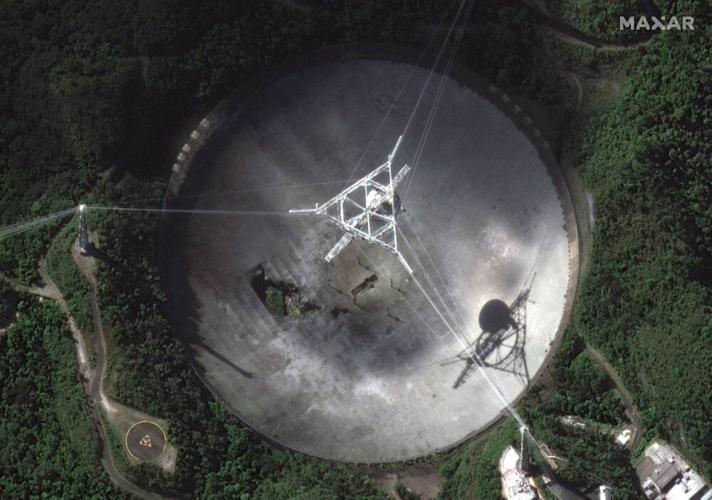
This satellite image provided by 2020 Maxar Technologies shows the damaged radio telescope at the Arecibo Observatory in Puerto Rico, Thursday, Nov. 17, 2020. The National Science Foundation announced Thursday, Nov. 17 that it will close the huge telescope in a blow to scientists worldwide who depend on it to search for planets, asteroids and extraterrestrial life, saying it’s too dangerous to keep operating the single-dish radio telescope because the entire structure could collapse. (Satellite image ©2020 Maxar Technologies via AP)
This telescope has been used to study myriad topics from tracking asteroids to understanding gravity. Up to 90,000 people visited the observatory annually to see it, to study or to conduct research.

FILE - This July 13, 2016 file photo shows one of the largest single-dish radio telescopes at the Arecibo Observatory in Arecibo, Puerto Rico. Giant, aging cables that support the radio telescopes are slowly unraveling in this U.S. territory, threatening scientific projects that researchers say can’t be done elsewhere on the planet. (AP Photo/Danica Coto, File)
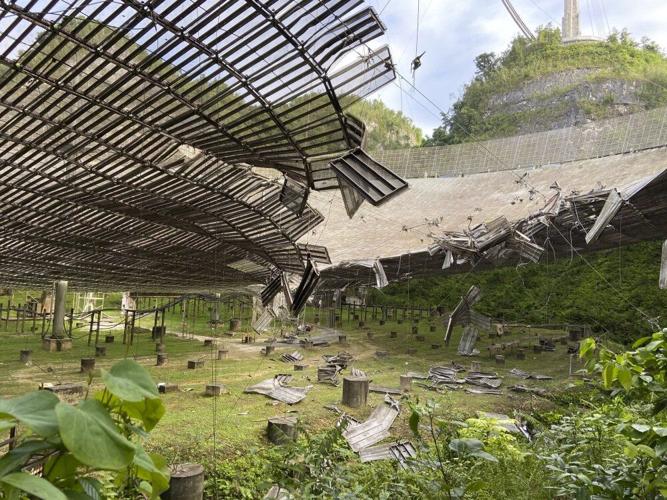
According to the National Science Foundation, in August of this year a cable from one of those towers came out of its socket which resulted in a 100 foot gash in the dish and possibly damage to the instruments suspended above. While the telescope was closed and engineers were working to figure out how to repair the damage, another cable from that same tower failed in early November 2020. The cable in August was an auxiliary cable, but the one in November was a main cable causing much more significant structural concern. After examining this main cable, engineers realized it broke at only 60% of the stress it should have been able to withstand. That raised further concern that other cables might be compromised too, their integrity weakened.

FILE - In this Tuesday, Aug. 11, 2020 file photo, provided by the Arecibo Observatory, shows the damage done by a broken cable that supported a metal platform, creating a 100-foot (30-meter) gash to the radio telescope's reflector dish in Arecibo, Puerto Rico. Giant, aging cables that support the radio telescopes are slowly unraveling in this U.S. territory, threatening scientific projects that researchers say can’t be done elsewhere on the planet. (Arecibo Observatory via AP)
At that point all the other cables and sockets were examined and more issues were found, so the engineers recommended demolishing the whole thing saying it would be unsafe to try to repair it because of the high likelihood another cable would break or a socket fail to hold it's connection. The NSF got several additional opinions, including the Army Corps of Engineers, the majority of which said the only option would be a controlled demolition. In mid-November the National Science Foundation agreed the best course of action would be to demolish the telescope because repairs could not be made safely. Just last week more breakage was found (using drones) in wires connecting to the same tower that already caused problems. Then this morning it was discovered that the platform had fallen.
Additional details regarding the collapse at the Arecibo Observatory’s 305-meter telescope are available now at NSF's site: https://t.co/dCYLolC22LEngineers are on-site. Top priorities are maintaining safety at the site and assessing damage. pic.twitter.com/9mqnBx3dcU
— National Science Foundation (@NSF) December 1, 2020
Now the National Science Foundation and the University of Central Florida will need to decide what to do with the damaged telescope and how to clean up the mess.