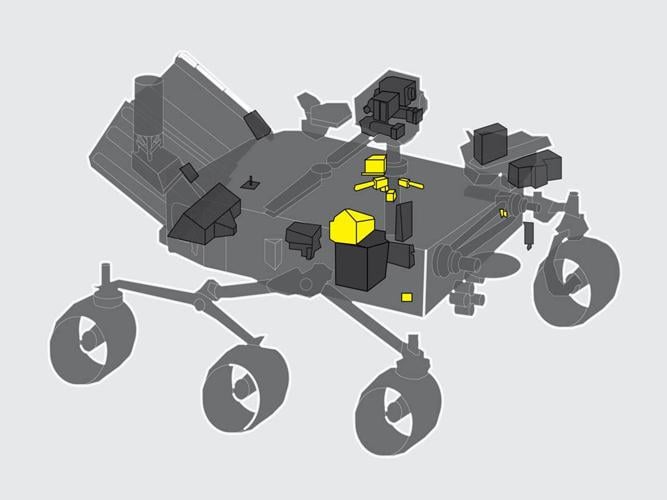

When you wonder what the weather is going to be like in the next few days, you turn on the WDRB Weather report. But have you ever wondered what the weather is like right no on Mars? Well wonder no more! When the Perseverance rover landed on the red planet earlier this year, it was carrying the MEDA - Mars Environmental Dynamics Analyzer. It's highlighted in yellow on an image of the rover below.

Credits: NASA/JPL-Caltech
According to NASA, MEDA can record ,"wind (both speed and direction), pressure, relative humidity, air temperature, ground temperature, and radiation (from both the Sun and space)" in addition to dust levels. NASA adds that MEDA wakes itself up once every hour, takes its measurements, and puts itself back to sleep. All of that is done regardless of what the Perseverance rover is doing at the time. "Boasting higher overall durability and additional temperature readings, MEDA can record the temperature at three atmospheric heights: 2.76 feet (0.84 meters), 4.76 feet (1.45 meters), and 98.43 feet (30 meters), in addition to the surface temperature." Like on Earth it's important to understand how temperature changes the higher up you go in the atmosphere. There are sensors on the mast and body of the rover itself and an infrared sensor that gets the top measurement.
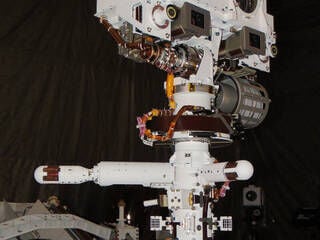
Credits: NASA/JPL-Caltech
Here's the really cool part: if you click here, you can see the most recent weather update from Mars. Keep in mind MEDA is not the only weather sensor on Mars. The Curiosity rover at the Gale crater and the Insight lander at Elysium Planitia are also studying temperature and wind from other locations. Click here to see the latest weather report from the Insight lander.
We have been able to learn a lot about the climate, atmosphere, and large-scale weather patterns on Mars by using telescopes to study the planet. Having weather sensors at three different locations will give scientists a much better grasp on what the weather is like at the surface. Knowing surface wind and dust conditions and radiation levels at different locations on the planet will help determine if and where it would be best for humans to land in future exploration missions.


