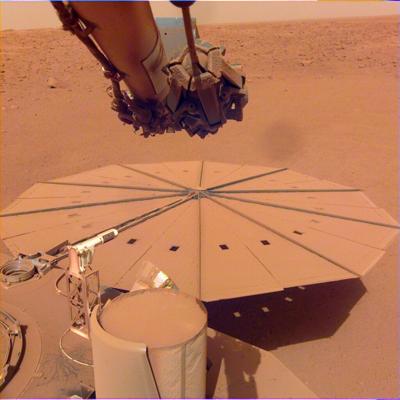

NASA's InSight lander on Mars is headed for retirement. As power levels drop, NASA is laying out the plan for how pieces of equipment will be turned off and eventually the craft will simply run out of power.
The problem is the Martian dust. Dust is now covering InSight's two solar panels that are roughly seven feet wide, and InSight gets its energy from the sun. If the solar panels can't collect that energy, InSight will keep losing power. For some perspective, here's an analogy NASA shared in their statement, "At the beginning of the mission, the solar panels generated 5,000 watt-hours each Martian day, or sol. That is enough to power an electric oven for an hour and 40 minutes. But now, they’re only producing about 500 watt-hours per sol. That’s enough to power the same electric oven for just 10 minutes."

Image Credit: NASA/JPL-Caltech
You might be wondering why NASA can't just clean off the solar panels. They can to an extent and have already done that. InSight has an instrument deployment arm that has been able to brush away a bit of the dust before, but there's only so much the arm can do when it was not created to function in that way. The season is changing in Elysium Planitia, where InSight is located, and it's not for the better. That area is headed into a more dusty season which will reduce the sunlight, add more dust to the solar panels and further reduce the energy operating the lander. At this point InSight needs a strong wind event to come through and blow the dust away, but NASA doesn't seem to think that's very likely.
“We’ve been hoping for a dust cleaning like we saw happen several times to the Spirit and Opportunity rovers,” said Bruce Banerdt, InSight’s principal investigator at NASA’s Jet Propulsion Laboratory in Southern California, which leads the mission. “That’s still possible, but energy is low enough that our focus is making the most of the science we can still collect." NASA went on to add in their statement, "If just 25% of InSight’s panels were swept clean by the wind, the lander would gain about 1,000 watt-hours per sol – enough to continue collecting science." As it stands the energy is being directed to the seismometer, and the seismometer is being operated at strategic times of day. Specifically it will be working a lot at night when winds are lower so it can better detect faint Marsquakes.
InSight's original missions to "uncover how a rocky body forms and evolves to become a planet by investigating the interior structure and composition of Mars" and to "determine the rate of Martian tectonic activity and meteorite impacts" was supposed to last one Martian year (nearly two Earth years). It achieved those missions, has recorded over 1300 Marsquakes, and kept operating, but it also kept accumulating dust. At this point science operations are expected to stop later this summer, but InSight can keep sending back photos and brief updates to Earth. By December NASA expects InSight will not have enough power to continue to function at all, at which point the mission will end.


