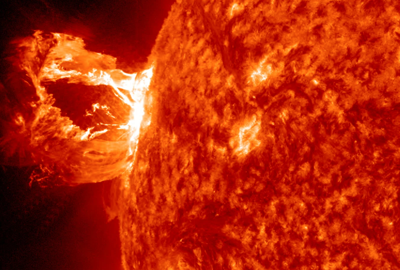
Perihelion is happening today! The word comes from Greek and means near the Sun. The Sun won't appear noticeably larger in the sky – only about 3% larger. Of course, you should never look at the Sun without proper eye protection. Remember, sunglasses are not sufficient for viewing the Sun.
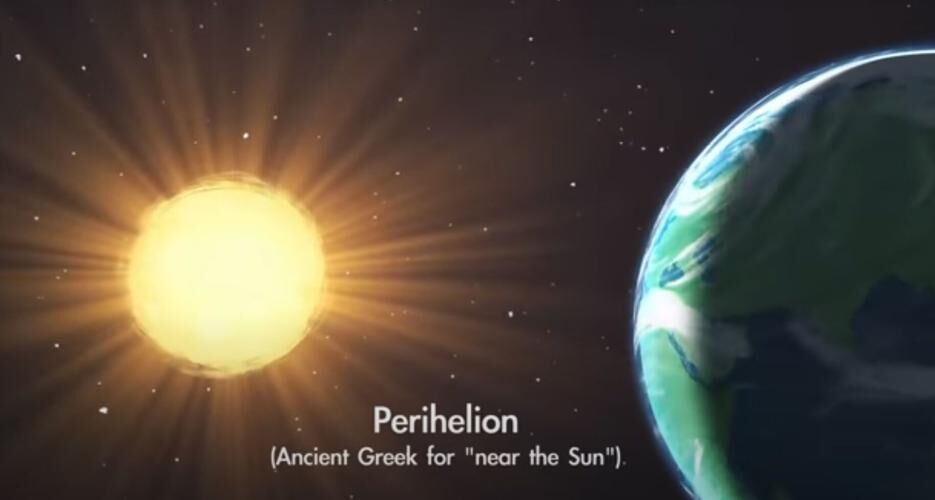
This usually leads to the question - "why are we in our coldest season when we are closest to the Sun?" Bottom line: we're still in the same orbit, so our position relative to the Sun in that orbit doesn't direct our seasons. The tilt of Earth's axis is what governs seasons.
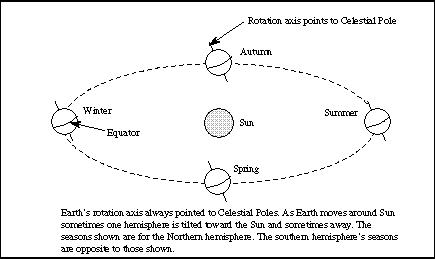
When our side of the planet is tilted toward the Sun, we have summer; when it's tilted away, we have winter. Seasons are all due to the tilt of the earth, not the distance of the Earth from the Sun. During northern hemisphere winter, the north pole is tilted away from the Sun. Days are short and that makes it cold.
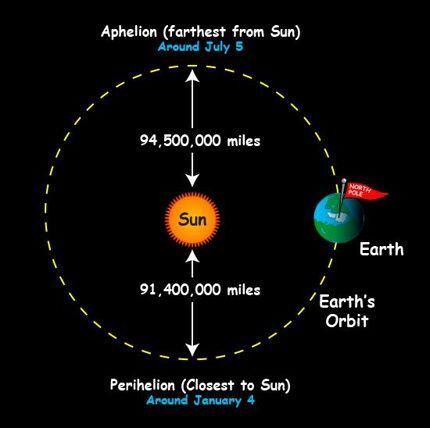
Image Credit: NASA
At perihelion the Earth is a little more than 91 Million miles from the Sun. When the Earth is farthest from the Sun, we're more than 95 Million miles apart. That's called aphelion; between the closest and farthest points, we fluctuate more than 3 Million miles. That means Earth's orbit around the Sun is not a perfect circle but actually an ellipse.
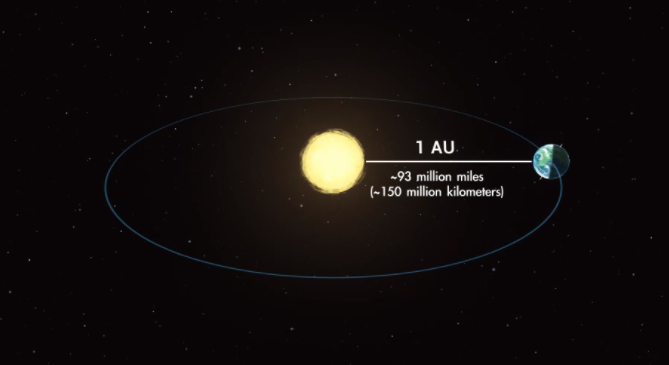
You may have learned in school that Earth orbits a certain distance from the Sun and that its orbit is nearly circular. The average distance from Earth to the Sun is called an astronomical unit, but since our orbit is not a perfect circle, it means sometimes we're a bit closer to the Sun, and sometimes farther away. Between perihelion and six months later when the Earth is at its farthest from the Sun (aphelion) there is about a 6.7% difference in the intensity of the sunlight reaching the Earth.


