
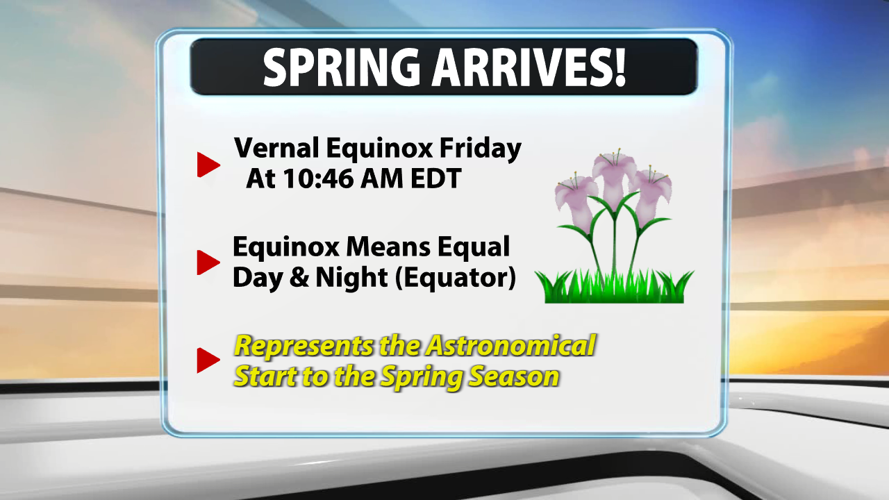


The Vernal Equinox has arrived with Friday marking the first day of spring. It can be confusing to say that because there are a couple different times this comes up. Today is, astronomically, the first day of spring because the vernal equinox happens at 10:46 AM. March 1 was climatologically the first day of spring because that's how we keep all our seasonal weather records consistent.
Equinox means "equal night" in Latin because it seems like we get an even 12 hours of sunlight and darkness on the equinox, but that's not true everywhere on the globe. In Louisville, our day of roughly 12 hours of sunlight and 12 hours of dark actually happened a few days ago, March 17th, when we had 12 hours, 1 minute, and 9 seconds of daylight.

Now we're adding daylight with each day that passes, so on the day of the equinox Louisville will actually see 12 hours, 8 minutes, 38 seconds of daylight. What is true at every location on the equinox is that the sun rises at due east and sets at due west.
The equinox is caused by tilt of earth's axis (roughly 23.5º). On the day of the equinox, the tilt of the earth combined with its orbit around the sun lines the Earth's axis up vertically, neither toward nor away from the sun.
On the day of the equinox, the geometric center of the Sun's disk crosses the equator, and this point is above the horizon for 12 hours everywhere on the Earth. However, the Sun is not simply a geometric point. Sunrise is defined as the instant when the leading edge of the Sun's disk becomes visible on the horizon, whereas sunset is the instant when the trailing edge of the disk disappears below the horizon. At these times, the center of the disk is already below the horizon.
Another reason why the day is longer than 12 hours on the vernal equinox is because Earth's atmosphere refracts, or bends, light. This refraction causes the sun's upper edge to be visible several minutes before sunrise. This also happens at sunset, you can see the sun for a few minutes after it has dipped below the horizon. This means that everyday on Earth is longer because of this refraction, not just on the equinox.


