One of the most common questions we are being asked right now is some variation of "when will we warm up for good?" We will talk about that today! First, some context. In the weather world, we track seasonal records by months. September, October, November is autumn; December, January, February is winter; March, April, May is spring; and June, July, August is summer. But is that still the correct way to separate seasons?
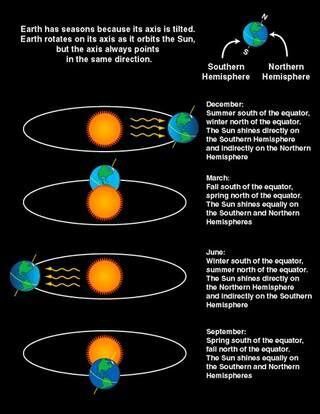
Second, some clarification. Seasons on the Earth are dictated by the tilt of the earth. The North Pole and South Pole are not pointed directly north and south; the Earth is tilted roughly 23.5º. Because of that tilt, different parts of the Earth directly face the sun for about a quarter of the year and create our seasons. The image above from NASA illustrates that point. Here's where the science becomes truly fascinating. You probably learned that 23.5º number in school, but that's not constant. In fact that was the number I (Hannah) learned in school, but new studies suggest the tilt is now 23.4º and decreasing. That doesn't mean the world is ending, but it does prove the theories of Milutin Milankovitch. Greek astronomer Hipparchus was actually the first person to suggest the Earth's axial tilt changes, but Milankovitch fine-tuned that work. He showed that every 26,000-40,000 years the tilt changes between 22.1º and 24.5º.
Timeanddate.com estimates the tilt of the Earth is decreasing about 0.00001° every 30 days right now. By my math that means it would take more than 8000 years for the tilt to change one full degree.
There are actually three cycles called the Milankovitch cycles, all named for Milutin Milankovitch who studied them. The other two describe slight changes in the eccentricity of our orbit around the sun and axial precession. These cycles play a big role in our climate and seasonal variability. If the tilt changes and we are tilted farther away or closer to the sun during summer, that will change how much insolation (incoming solar radiation) we receive which will impact our heat potential. If the eccentricity of our orbit changes to bring us closer to our farther from the sun during our closest and farthest points that will also impact how much insolation we receive.
What does this mean for you: the movement of the Earth is shifting on a very small scale in the midst of a normal cycle. That is likely causing the seasons to change a little bit, but that doesn't mean winter will last until June.