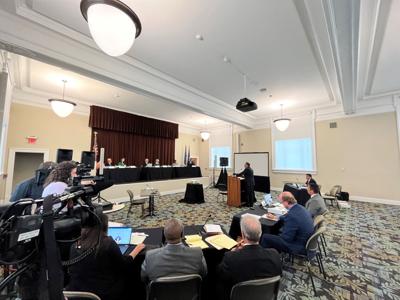


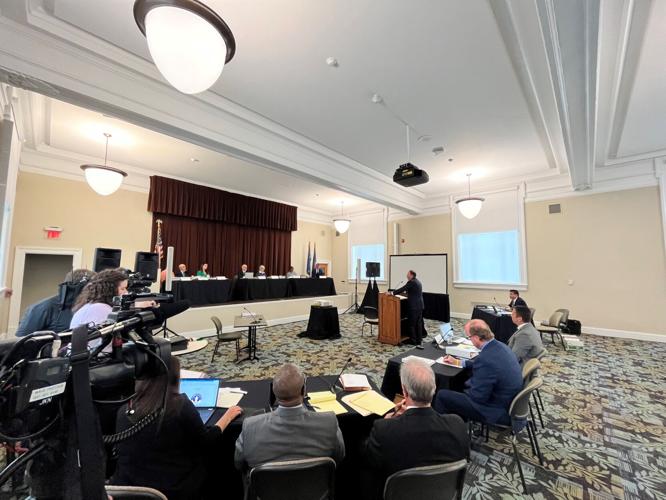
LOUISVILLE, Ky. (WDRB) — The city's ethics board began hearing arguments Monday in the trial of Metro Council member Anthony Piagentini over his role in a federal grant he backed for his future employer.
Piagentini was hired by the Louisville Healthcare CEO Council after he had co-sponsored an ordinance giving one of the group's top projects $40 million in American Rescue Plan money, Louisville Public Media reported earlier this year. The Metro Council approved the funding last December.
That prompted a complaint filed in March by Kevin E. Fields Sr., the CEO of Louisville Central Community Centers, which also had vied for the funds. The Louisville Metro Ethics Commission has scheduled four days for the hearing at the Louisville Free Public Library downtown.
Piagentini, a Republican who represents parts of eastern Jefferson County, faces charges that include failing to disclose a financial or personal interest in a matter before the Metro Council and using his official position to get "unwarranted privileges or advantages."
The ethics commission has the power to decide if Piagentini committed ethics violations; if it does, the Metro Council then would determine whether he would face disciplinary action.
"We are here to hold Anthony Piagentini accountable," Fields' attorney Kent Wicker said in his opening statement. "We give our elected leaders enormous power to make our laws and spend our money. What we ask in return is that they act solely in our interest – not in theirs."
Wicker argued that Piagentini didn't follow the city's ethics rules and didn't recuse himself from the measure until after he had helped shepherd the plan through the Metro Council budget committee in November 2022.
By that time, Wicker claimed, Piagentini had been trying to get a job with the healthcare group for more than a year. Wicker said Piagentini received a nondisclosure agreement from the CEO council on the day of the budget committee vote.
The consulting job in government affairs pays Piagentini $20,000 per month, or $240,000 annually, Wicker said.
Piagentini remained as a sponsor of the ordinance until the Metro Council vote on December 1, 2022. After the call for voting to begin, Piagentini interrupted and asked to be removed as a sponsor because of a "potential conflict of interest."
He didn't elaborate and was the only council member who didn't vote.
In his opening statement Monday, Piagentini attorney J. Brooken Smith urged the ethics commission to find "clear and convincing evidence" that the council member violated the city's ethics code.
"Make no mistake: Councilman Piagentini vehemently denies these charges," Smith told the commission.
Smith acknowledged that the timing of Piagentini taking the job with the healthcare council was "not ideal." But he said that doesn't prove a connection between the offer and the grant moving through the Metro Council.
And he said Piagentini had been a vocal supporter of the CEO council well before he was approached about a job there.
The healthcare council includes the leaders of 16 hospitals, medical systems and other providers in Louisville, including Norton Healthcare, Baptist Health, Humana and the University of Louisville. The grant was for one of the council's initiatives called the Healthcare Workforce Innovation Coalition.
The coalition includes the CEO council and Amped, Louisville Urban League, Metro United Way and the University of Louisville. The Greater Louisville Inc. chamber of commerce, KentuckianaWorks workforce development agency and KIPDA, the Louisville region's metro planning agency, also are members, but didn't receive funding.
The coalition's proposal involves making the city "a national epicenter of healthcare aging innovation" through increasing and diversifying healthcare jobs.
The Metro Council ultimately had the final say over how to spend the federal funds meant to aid in the economic recovery from the COVID-19 pandemic. But former Mayor Greg Fischer's administration helped to review projects interested in the money.
Margaret Handmaker, a former Kentucky Secretary of Revenue, led that effort for the Fischer administration. She testified Monday that the healthcare council had been part of a grant application that ranked 29th out of 30 submitted.
Handmaker said the proposal was ranked low because the CEO group was competing against more established organizations with workforce development expertise. Wicker called the later American Rescue Plan application a "repackaging" of the earlier proposal.
Grace Simrall, who served as Chief of Civil Innovation and Technology under Fischer, also was involved in reviewing potential applicants for the ARP funds. She said the CEO council's application "showed a lack of experience" for taxpayer funded grants.
In particular, she testified to the ethics commission, she had concerns that the project couldn't meet certain spending requirements laid out in the federal rules.
In April 2022, she testified, Fischer administration officials shared their ranking of the CEO council's plan with Metro Council Democratic caucus chair Markus Winkler -- who is now the council president -- and Piagentini. Those two members were in charge of a group overseeing the council's spending on workforce projects.
Simrall said in a later phone conversation Winkler "shared some frustrations" about the lack of "transformational projects" under consideration.
Smith noted that the council had its own priorities in how it directed funding, including minimizing spending on smaller projects. He argued that the council had broad discretion over how the money would be spent.
Among those testifying Monday was former Metro Council member Bill Hollander, a Democrat who didn't seek reelection last year after eight years on the council.
Hollander, who chaired the council's budget committee, said he wasn't involved closely in the Winkler-Piagentini work group that was considering the workforce projects. He said he wasn't aware of the CEO group's proposal that was ranked low by city officials.
At a meeting of Hollander's budget committee on November 3, 2022, Piagentini touted the CEO group's proposal as "by far" the best submitted, according to video of the meeting played before the ethics commission.
Piagentini again spoke in favor of the plan at the budget committee meeting two weeks later on November 17, when the measure he co-sponsored passed and moved on to the full council.
At that full council meeting on December 1, Piagentini announced he was abstaining from the vote due to a potential conflict of interest. Hollander said Monday that Piagentini's failure to disclose exactly why he recused himself ran afoul of council rules.
Asked by Wicker, Fields' attorney, what the council's reaction would have been had members known of Piagentini's connection to the CEO group, Hollander said: "I think we would have called a timeout and said, 'What is this interest?'"
Hollander said he was "very surprised" to learn of Piagentini's employment with the CEO group in January from reading a Christmas card. Hollander told the ethics commission that Piagentini's connection should have been disclosed as soon as it was known.
Among those scheduled to testify are Winkler and Tammy York Day, president and CEO of the Louisville Healthcare CEO Council.
Piagentini issued a newsletter to his constituents Monday morning saying he can't comment on the case but said he has cooperated "in almost every possible way."
Copyright 2023 WDRB Media. All rights reserved.