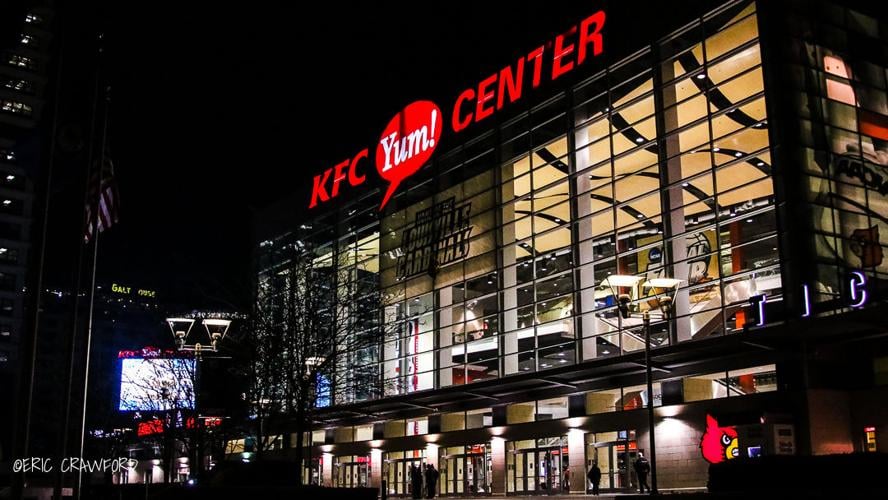


LOUISVILLE, Ky. (WDRB) -- State lawmakers are advancing a bill that would allow development incentives in a prime part of downtown Louisville that's now off limits because of a deal struck for the KFC Yum! Center nearly two decades ago.
The measure opens up areas inside the arena's tax increment financing (TIF) district to smaller projects seeking the same types of state tax rebates that help the Yum! Center pay off its construction debt.
Rep. Jason Nemes, R-Middletown, sponsor of House Bill 775, testified the TIF district changes were sought by Louisville's Democratic mayor, Craig Greenberg, and will aid housing, tourism and retail.
"We're trying to make sure we make the core of Louisville strong," Nemes said during a meeting of the House Economic Development & Workforce Investment Committee.

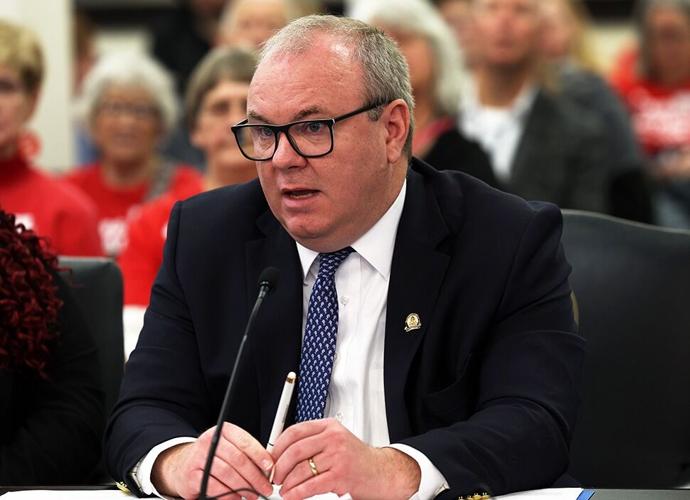
House Majority Whip Jason Nemes, R-Middletown, presents House Bill 206, an act relating to wrongful convictions, during the House Judiciary Committee meeting Wednesday, Feb. 12, 2025 in Frankfort. (Photo courtesy of LRC)
The committee approved the bill last week, advancing it to the House floor. On Thursday, House leaders sent the measure back to committee.
"It is fine," Nemes told WDRB in a text message. "We are sending it back to improve it."
Greenberg said in an interview Wednesday that the changes to the TIF district address a roadblock to big developments downtown.
"One of the challenges that we have to encourage significant investment in downtown is, that the way the arena TIF is currently in place, it is difficult to provide incentives to large projects like the new proposal for the new $250-plus million development just east of Louisville Slugger Field," he said.
The plan announced late last year calls for turning surface parking lots into 500,000 square feet of hotel, office and retail space overlooking the baseball stadium on East Main Street near the Kennedy Interchange.

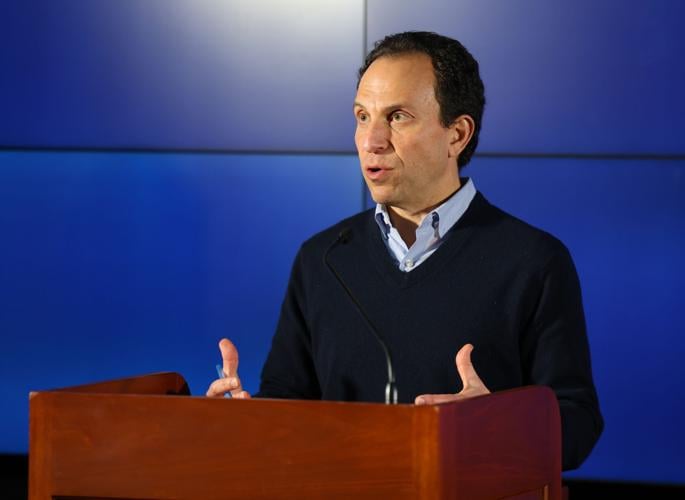
Mayor Craig Greenberg speaks at a press conference in Louisville, Ky. on Jan. 7, 2025.
Louisville Bats' owner Diamond Baseball Holdings and sports and entertainment district developer Machete Group are the project's developers. Project representatives did not immediately respond to questions Thursday.
Greenberg said he hopes the development is the first to apply for TIF incentives if HB 775 is passed into law.
"New developments right now are incredibly difficult," he said. "You have high construction costs. Interest rates don't appear to be going down. That makes new building difficult."
A common — and controversial — public incentive
At times, tax increment financing has been a contentious economic development tool in Louisville. Critics of the subsidy frequently cite the Yum! Center TIF's early woes as a reason to question rosy projections.
Then-Kentucky Auditor Mike Harmon released a blistering report in 2017 that concluded that estimates used to sell bonds for the Yum! Center were based on flawed data that included using a 16-year analysis for sales tax and a 10-year review for property taxes.
"The faulty analysis of the overly high growth rate contributed to the unrealistic expectations of the TIF performance," the auditor said.
TIF proposals for the One Park development planned near Lexington Road and Grinstead Drive also have faced scrutiny, as has a massive subsidy zone for Louisville's west end – the largest in Kentucky.
Tax increment financing measures the amount of annual taxes collected in a defined area — typically a vacant tract of land slated for a new hotel or other development project.
When tax collections exceed that baseline amount each year, a portion of the new revenue goes to developers instead of city or state government coffers. The developers' amount is the "increment."
Under that theory, taxes generated solely by a project are used to help finance it. But not with Louisville's downtown arena.
When civic leaders were working on the arena deal in the mid-2000s, they secured a unique arrangement from Kentucky state government that pulled tax revenues from across downtown to help pay for construction.

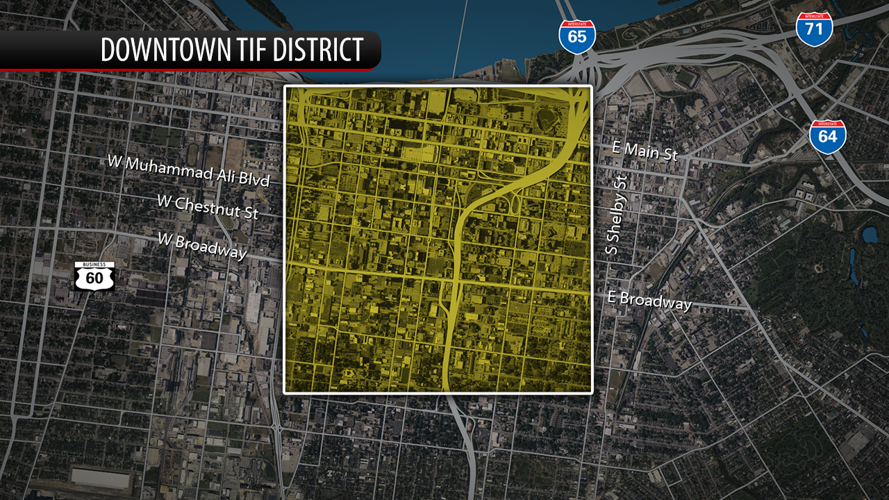
The boundaries of the tax increment financing (TIF) district established for the KFC Yum! Center
The TIF district was first established as six square miles, then later reduced to its current two-square-mile footprint. A portion of sales and state property taxes from that area helps pay off the project's debt.
The Yum! Center's debt obligations largely come from fixed sources such as annual payments from the University of Louisville, whose basketball teams are the building's main tenant, and a budget allocation from Louisville Metro government.
But the TIF revenues are the biggest contributor. They generated roughly $17.9 million during 2023, according to Louisville Arena Authority data for the most recent full year available.
The bill aims to protect the Yum! Center subsidy by funneling some tax revenue from new projects to the arena and giving the arena authority and local and state government officials veto power over any new incentives.
Arena authority chair Leslie Geoghegan said it's intended that any new state TIF districts carved out of the arena district would be for underutilized property that now creates little tax revenue.
"It will be on a project-by-project basis, because we can't just let our TIF just evaporate," she said. "But we also want to be good partners with the city and the state, because we want to see the city flourish."
The legislation ensures that the arena authority — a nonprofit corporation whose board is appointed by Kentucky's governor and Louisville's mayor — stands to receive no less than 10% of TIF revenues from new projects in the arena zone.
Geoghegan noted that the arena TIF district relies on state tax revenue and continues to allow local incentives. "The city can create a local TIF," she said. "So they can do that, regardless of whether we carve out or not."
The arena TIF district helped get the Yum! Center built, but its unique size and approach has frustrated some downtown projects that wanted incentives.
In 2019, state records show, Angel's Envy producer Louisville Distilling Company applied for state tourism incentives for its downtown distillery, but officials ruled the project ineligible because it was inside the arena TIF district.
"It's definitely been an impediment and a frustration," said Rebecca Fleischaker, executive director of the Louisville Downtown Partnership.
She wasn't able to say how many projects, if any, haven't been built as a result of the prohibition on new TIF districts near the Yum! Center.
"This flexibility that the state is allowing to take place is just extremely important to future investment," Fleischaker said.
Top Stories:
- Kentucky lawmakers consider lowering concealed carry age from 21 to 18 years old
- Bardstown residents complain of latest corruption case after sheriff, chief deputy were indicted
- Louisville police officer seriously injured after crash with stolen pickup truck near Algonquin Parkway
Copyright 2025 WDRB Media. All Rights Reserved.


