


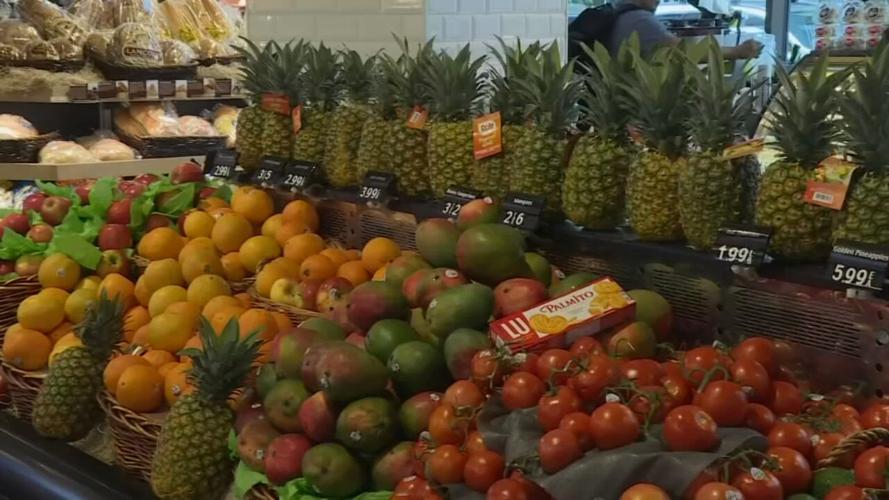
LOUISVILLE, Ky. (WDRB) -- One in every five kids in Kentucky do not know where their next meal will come from, new data from the U.S. Department of Agriculture shows.
Food insecurity, according to the USDA, "is a household-level economic and social condition of limited or uncertain access to adequate food."
Data released by Kentucky Youth Advocates revealed that, in 2022, 21% of Kentucky children lived in food insecure households. Currently, 36 counties show a rate of 25% or higher, the report showed.
That's an increase from 2020, which showed 16% of Kentucky kids lived in food insecure households.
"At a time when lots of us are counting blessings, it's important that we remember those boys and girls who may not have that level of blessing," said Terry Brooks, the executive director for Kentucky Youth Advocates. "You're not going to microwave a solution to hunger, it's much more of a crockpot."
Youth food insecurity in surrounding counties:
- Statewide: 20.7%
- Jefferson County: 22.1%
- Hardin County: 19.6%
- Bullitt County: 15.9%
- Oldham County: 7.3%
Food insecurity amongst youth in each of the above counties increased from 2020 to 2022. Brooks said Kentucky schools have become an oasis in helping address food insecurity. Several districts, including Jefferson County Public Schools, provide breakfast and lunch to students daily as well as feed students over breaks and summer vacation.
Brooks said a full-proof solution will require lawmakers and local organizations to help address other challenges kids face, including poverty and homelessness.
"If today is a typical day in Kentucky, over 100,000 kids woke up living in deep poverty," he said.
Despite the increase in number of kids living in food insecure households, Brooks hopes during the season of giving many will find it in their heart to help cook up a solution.
"I think we got some things going that will create some good results in the next couple years," he said.
The Kentucky Youth Advocates data book measures children on 16 areas such as child health, education, economic security and family and community throughout all 120 counties in the commonwealth. This year, the 34th edition of the Data Book, the data is accessible through a new interactive County Data Dashboard.
"While the Data Book still offers that statewide look at how children and families are faring, the online County Data Dashboard presents data at the county and school district-level in a way that allows users to compare to baseline data, to neighboring counties, and to how the state fares overall,” Brooks said in a news release earlier this month.
In addition to the standard measures, the Data Book measures the impacts of Adverse Childhood Experiences (ACE) and Positive Childhood Experiences (PCE) in regards to economic security, education, health, and family and community.
"Nearly one in four Kentucky kids have experienced at least two ACEs – within the abuse, neglect, or household dysfunction categories – and we know those traumatic events can increase the risk for developing health issues and engaging in risky decision-making into adulthood," Brooks said.
Overall, Kentucky saw improvement in 11 of the 16 categories being evaluated, but is still coming up short in other areas.
For child poverty, one in five children, or 21%, in Kentucky still live in poverty, and of that, 38% are Black children and 28% Latinx children compared to only 18% white children.
In 2022, one in five, or 21%, of Kentucky children lived in food insecure households, and currently, 36 counties show a rate of 25% or higher.
Related Stories:
Copyright 2024 WDRB Media. All Rights Reserved.


