
LOUISVILLE, Ky. (WDRB) -- On the surface, the University of Kentucky football team looks like it generally does one-quarter of the way through the season.
It has dispatched three weak opponents and covered the spread against two of them, thereby meeting expectations. Built into those expectations is that it won't open the season particularly sharply. It will ease into Southeastern Conference play, mindful of the major challenges to come.
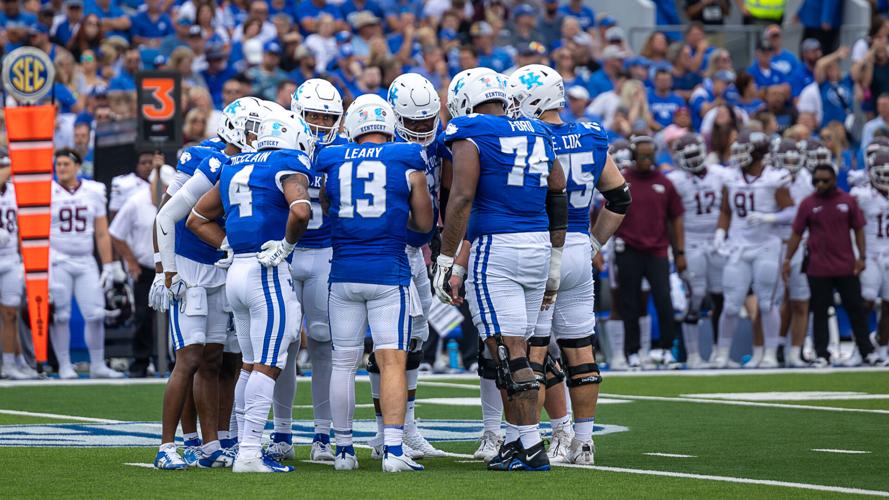
The more I watch Kentucky and the rest of the SEC, the more I wonder if this Wildcats team has a chance to do something special. It has an experienced quarterback in N.C. State transfer Devin Leary. It has a good running back in Vanderbilt transfer Ray Davis and solid receivers in Tayvion Robinson, Dane Key and return phenom Barion Brown.
Leading the offense is a gifted coordinator in Liam Coen, and, on defense, Mark Stoops and Brad White always field a tough and effective group.
The problem in evaluating the Wildcats through three games is that none of those elements has been tested or required to run at anything resembling full capacity.
So in looking for ways to evaluate this team through the statistics it has compiled, we have to be mindful that the stat profile has been built against one of the worst three-game opening schedules faced by any Power 5 team. There are a few small signs of potential good news for the Wildcats, as well as some red flags that will bear watching.
Let's take a look.
THE SCHEDULE: PRETTY BAD
There's no other way to put it. Kentucky's schedule strength ranks No. 191 in Sagarin's computer index. Only one Power 5 team (Maryland, No. 203) has played a worse schedule to open the season.
Kentucky's FBS opponents, Akron and Ball State, have been particularly inept offensively, both in the bottom 12 of FBS in scoring.
Moreover, the Wildcats are the only SEC team without a win over a top-100 team.
Now, a schedule like this can work both ways. It can leave a team healthier as it enters the second quarter of its season. Or it can fail to prepare a team that needs more serious tests with some golden SEC opportunities ahead of it. Which one of those winds up being the case will only be determined by the upcoming games.
DEFENSE: KENTUCKY'S CALLING CARD
Mark Stoops has built hard-nosed defenses at Kentucky. Of the school's 27 draft picks since 2012, 16 have been defensive players. And Kentucky's impact exports to the NFL in that time have primarily been defensive players, guys like Danny Trevathan, Za'Darius Smith and Josh Allen.
Defensively so far this season, Kentucky is in a familiar place, ranking No. 12 nationally in scoring defense and No. 27 in total defense. That would suggest a defense that is humming right along. In fact, Kentucky's has not.
Beneath those numbers are some others that bear watching. Despite playing less-than-stellar competition, Kentucky is No. 68 nationally against the pass, giving up 210.7 yards per game. And its third-down defense has been some of the worst in the nation, giving up first-down conversions 47.7% of the time, ranking No. 115 in the nation.
Eastern Kentucky, an FCS opponent, put together nine-plus play drives of 73 and 75 yards against the Wildcats in the second half of a game that was still in striking distance.
Whether this is a sign of defensive efficiency or just sloppiness born of not playing top-level competition remains to be seen. There's some sign it could be the latter. Kentucky has missed an uncharacteristic 34 tackles through its first three games, and its tackling grades out at just 91st in the nation, according to Pro Football Focus.
Kentucky has real talent on the defensive front, and some inexperience in the secondary. Given all that, and the competition, the Wildcats' second quarter of the season should be more instructive than the first of its overall defensive strength.
OFFENSE: LEANING TO THE LEFT
We'll get to some breakdowns of Leary, Davis and Kentucky's receivers in a bit, but one quick observation, that may or may not wind up being a trend.
Davis has done most of his running (14 carries out of 38) around the left and right ends (14 carries, 93 yards, 55 of those on a TD run at the end of the Ball State win). But his most effective running has been off the left guard and left tackle (seven carries, 78 yards). He's also had some success through the A-gap on the right, (five carries, 40 yards).
Passing, Leary has feasted on the middle and left. On deep throws of 20 yards or more, he's 7-12 for 146 yards and three touchdowns to the left. He's 2-7 for 35 yards, zero touchdowns and an interception to the right.
It's not so much that the offense leans left, perhaps, than that it hasn't been as productive to the right.
LEARY: HANDLING THE PRESSURE
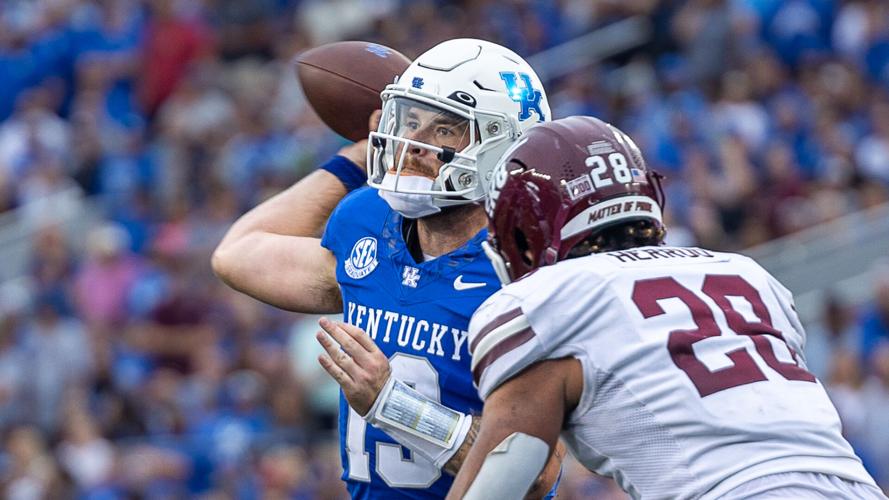
Leary has been consistent through a range of passes and pressures. His NFL quarterback rating varies little. He's at 103.6 when kept clean and 99.7 under pressure. He actually has a higher rating (111.7) when blitzed than when not blitzed (100.8).
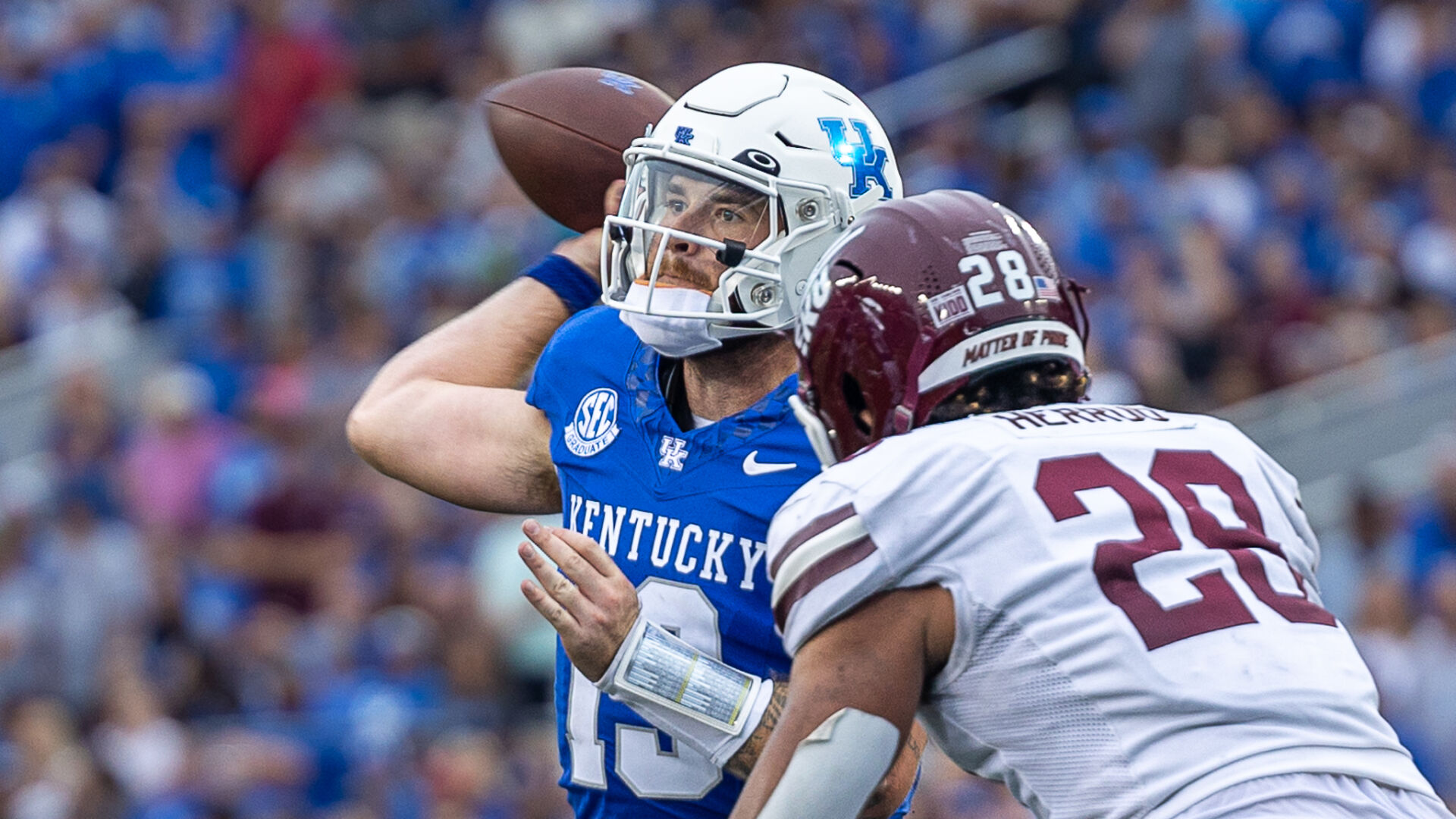
Kentucky quarterback Devin Leary turns loose of a pass in a win over EKU.
Those are good signs for a quarterback who is still easing into a new system.
He thrives in the medium range of 10-19 yards, where his rating is 120.8. Nearly half of his completions have been in the middle of the field either behind the line or in the short range of 10 yards or less. But his effective throws have come to the middle or left at midrange or deep.
His college passer rating puts him at No. 30 in the country, but his completion percentage of 61.1 could use a bit of improvement. It ranks 74th.
RECEIVERS: STILL CATCHING ON
It's worth noting, Leary has done what he has done this season without stellar receiver play from two of his top three targets.
Robinson has been nearly perfect, earning a receiver grade of 84.7 from Pro Football Focus. He has 14 receptions on 16 targets and hasn't dropped a ball. He's 3-for-3 on deep passes of 20 yards or more and 3-for-3 on intermediate passes.
Key, however, has just nine catches on 20 targets, with a pair of drops. His receiver grade from PFF is just 61.3. Barion Brown has 11 catches on 21 targets with a drop. His receiver grade is 59.2. Together the pair is 0-for-7 on targets of 20 yards or more, though they have been better (10 of 19) in the intermediate range.
It bears repeating – a lot of this may just be timing between quarterbacks and receivers. It takes a while to develop. The hope is that these early games have given Kentucky's skill players that space.
However, all of these numbers coming against defenses that bear no resemblance to SEC defenses mean that the pass game bears more examination.
RAY DAVIS: TWO-WAY THREAT
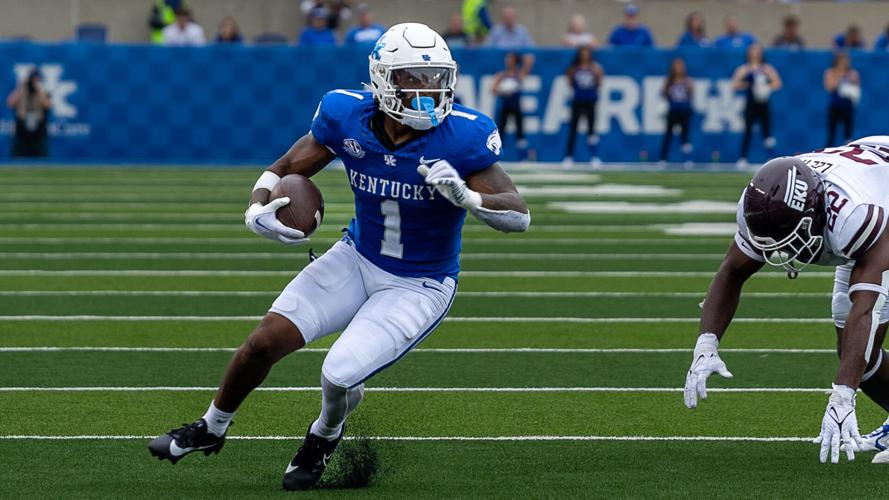
The Vanderbilt transfer has been useful not just as the team's top running back but in catching the ball out of the backfield. In the inside screen game he's caught five of six targets for 101 yards and a touchdown.
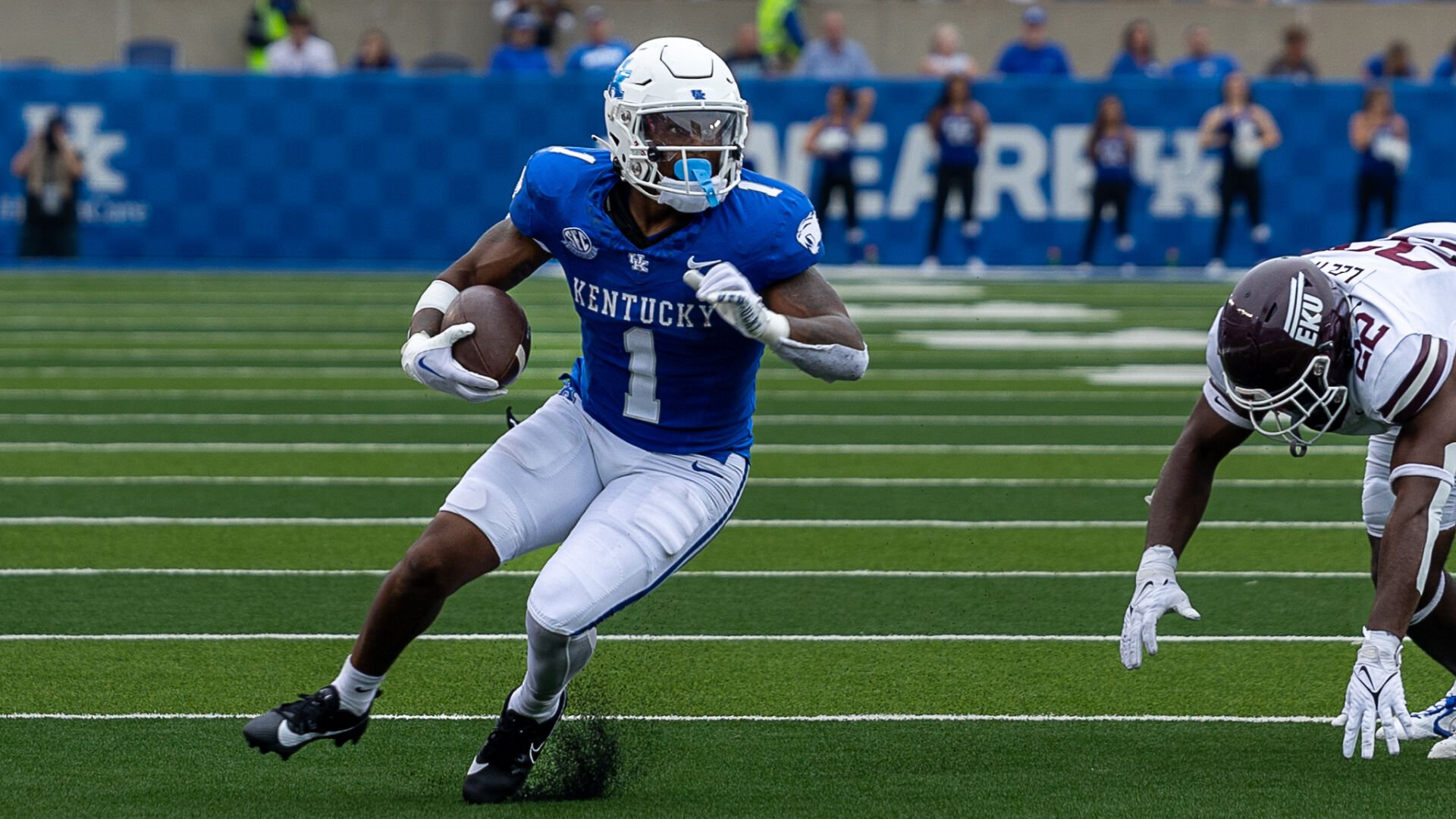
Kentucky's Ray Davis with the ball in space in a win over EKU.
As a runner, he grades out at 85.3 from PFF and has carried 32 times — just over half the team's runs — for 233 yards and three touchdowns, an average of 7.3 yards per carry. Some would argue he should get the ball more, but given the competition, his number of touches have probably been right. There has been no need to overwork a top-level back.
Davis has piled up 114 yards after contact (an average of 3.56 yards after contact).
RUN BLOCKING: A WORK IN PROGRESS
One problem with Kentucky's running game has been an offensive line that still hasn't lived up to its historic billing. Kenneth Horsey, its top lineman, has been out with injury. And that's been a factor.
Kentucky's run blocking gets a grade of 64.6 from PFF, good for 54th nationally. But against the defenses Kentucky has been facing, that's not particularly encouraging.
A key indicator: On first down, Kentucky is averaging just 2.6 yards per carry (35 carries, 92 yards). A year ago it averaged 4.2 yards per first-down run, and in 2021, Liam Coen's previous year as offensive coordinator, it averaged 5.4 yards per first down carry.
"We're taking steps," Coen said of his line play. "From a pass pro perspective, we're throwing the ball more times than I'd probably like to, because of some of our inefficiencies on first down. Right now we're 50 percent efficient on first down. It's not where we want to be. And that's putting us behind the chains and behind the sticks and ultimately, like on 2nd and 20 the other night, I threw a dagger cut to Dane on 2nd and 20 because I trust those plays. Now it didn't happen, but we had a good look and a clean pocket and I trusted those guys to push the ball down the field. We're not throwing the quick game as much or handing the ball off. So from a pass pro perspective, we've improved. Now it's just about how can we get better in the run game? Blocking movement, seeing things, being on the same page, and communication."
A PLODDING PACE
Kentucky has run 166 offensive snaps this season through 3 games. Among teams that have 3 games in, only two teams in the country (Miami of Ohio and Eastern Michigan) have run fewer plays.
Given the weapons Kentucky has on offense, it would seem that more plays would create more opportunities for big plays, but thus far, it hasn't worked out that way.
Again, there's something to be said for not playing wide-open against overmatched opponents. Certainly, keeping things close to the vest, keeping your team healthy and advancing into conference play in good shape, while conservative, is a good strategy.
But a team like Vanderbilt, for instance, is running 10 more offensive plays per game than Kentucky has run. That's a pretty big difference. It will be interesting to see if Kentucky picks up its pace in conference play.
CONCLUSION
There's still a lot to learn about the Wildcats. The intriguing thing about this team is the opportunity ahead of it. The SEC is manageable, Georgia notwithstanding. A Kentucky team operating to its full potential would be an interesting proposition. Clearly, however, it hasn't been asked to operate at anything close to that in the first quarter of the season.
It could be that the gradual buildup of competition is the perfect runway for this Kentucky team. There's no way to know ahead of time. But over Kentucky's next three games (at Vanderbilt, at home against Florida, at No. 1 Georgia) we should find out a great deal more.
Copyright 2023 WDRB Media. All Rights Reserved.


