
LOUISVILLE, Ky. (WDRB) — A legal fight over a fifth year of college eligibility escalated sharply Thursday, with attorneys for dozens of athletes asking a Jefferson County judge to block new Southeastern Conference restrictions and potentially hold the NCAA in contempt over the SEC's actions.
Attorneys in the case that last week resulted in 13 athletes receiving temporary protection from NCAA eligibility rules filed a series of motions Thursday asking Jefferson Circuit Judge Brian Edwards to expand his order to 27 additional athletes, including new Louisville basketball player Seth Trimble.
But the more significant development may involve Kentucky basketball transfer Mark Mitchell and the SEC.
The plaintiffs contend that new SEC rules restricting the eligibility of athletes who missed regular NCAA transfer windows or signed professional contracts amount to an attempt to circumvent Edwards' Aug. 21 temporary restraining order.
They are asking Edwards to declare that his order applies not only to the NCAA but also to organizations "acting in concert or participation" with it, a description they say includes the SEC.
The filings also include a proposed order asking Edwards to require the NCAA to explain why it should not be held in contempt because of actions taken by the SEC.
"The NCAA shall show cause why it should not be held in contempt of Court for the violation of this Court's Order by the SEC, a person acting in concert and/or participation with the NCAA," the proposed order says.
Edwards has not granted any of the new requests. What attorneys submitted Thursday includes both motions and proposed orders. A hearing is scheduled for Monday at 10:45 a.m.
The case began as a challenge to NCAA rules limiting athletes who graduated from high school in 2022 to four seasons of competition while athletes in later classes will be permitted five seasons under rules adopted this summer.
Edwards issued a temporary restraining order Aug. 21 protecting the original plaintiffs from NCAA enforcement.
The new filings seek to dramatically expand both the number of athletes covered and the practical reach of that protection.
The plaintiffs want Edwards to add 27 athletes to his order, reopen the NCAA transfer portal to those athletes for one week and prohibit the NCAA or anyone acting in concert with it from using missed transfer windows to prevent them from competing during the 2026-27 season.
They also seek protection for athletes who signed professional contracts after being told they had exhausted their college eligibility.
Mitchell at center of SEC dispute
Mitchell, who played last season at Missouri and has transferred to Kentucky, illustrates the new dispute.
Mitchell did not enter the NCAA transfer portal during its regular spring window because, under the eligibility rules then in effect, he had exhausted his four seasons of competition.
Edwards' Aug. 21 order gave Mitchell temporary protection from NCAA rules that otherwise would prevent him from playing another season.
But the SEC subsequently announced a requirement that athletes transferring between conference schools must have entered the portal during their sport's regular transfer window.
That creates the unusual circumstance in which Mitchell may be eligible to play under Edwards' order but still unable to play at Kentucky under SEC rules.
The plaintiffs contrast Mitchell's situation with former Missouri player Jevon Porter, who entered the portal in April despite having exhausted his eligibility and later received court protection allowing him another season.
"Mark Mitchell, who did not enter the portal because he reasonably believed he would not have eligibility," received protection from Edwards, the filing says, "yet the SEC claims he cannot transfer within the conference."
The SEC this week also approved substantial penalties for schools that violate its eligibility policies, including a half-season suspension for a head coach, loss of conference voting privileges and a fine equal to 50 percent of the affected sport's annual budget.
The plaintiffs argue those penalties effectively prevent SEC schools from using athletes whose eligibility has been restored by courts.
Plaintiffs say SEC and NCAA acted together
To bring the SEC's actions within Edwards' order, the athletes point to a declaration filed earlier in the case by SEC commissioner Greg Sankey and commissioners from other major conferences in support of the NCAA.
That declaration said conference representatives were "heavily involved" in developing the NCAA's new eligibility model.
The plaintiffs contend that cooperation establishes that the SEC has been acting "in concert or participation" with the NCAA on eligibility issues.
Whether Edwards agrees could become one of the central questions at Monday's hearing.
Kentucky civil rules allow injunctions in some circumstances to bind people or entities acting in concert with parties subject to the order. The SEC itself is not a defendant in the case, but the plaintiffs argue its actions can nevertheless be covered by Edwards' order because of its cooperation with the NCAA.
Trimble among 27 seeking protection
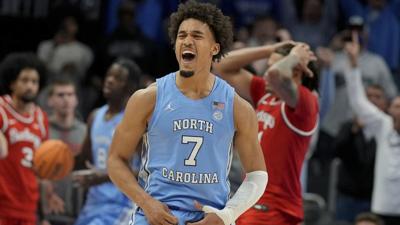
Trimble, who transferred from North Carolina to Louisville earlier this month, is among the additional athletes seeking protection.
Unlike Mitchell, Trimble entered the NCAA transfer portal during the spring window, meaning the portal restriction at issue in Mitchell's case does not appear to present the same obstacle for him. His immediate fight, in other words, is narrower — not whether he can transfer, but whether Edwards will extend fifth-year eligibility protection to him at all.
The amended complaint says Trimble intends to play at Louisville if granted another season and that Louisville has a roster spot available for him.
The proposed order filed Thursday nevertheless asks Edwards to reopen the portal for all 27 newly added athletes for one week.
Other newly added plaintiffs span several sports and schools. The second amended complaint brings the case to 37 named athletes and says the new filing adds plaintiffs and allegations concerning conduct since the original lawsuit, but does not change the underlying legal claims.
Among the other new plaintiffs are Western Kentucky football players Jaylen Wester, Rylen Su’a-Filo and Mackavelli Malotumau; former Louisville basketball player Emmanuel Okorafor; Louisville native and former Sacred Heart basketball standout Josie Gilvin; Kentucky swimmer Levi Sandidge; Kentucky tennis player Zoe Hammond; and Louisville rower Macy Whisenand. The group spans football, basketball and several Olympic sports.
The plaintiffs continue to argue that the NCAA unlawfully excluded members of the high school Class of 2022 when it adopted a five-season eligibility model that will benefit later classes.
But Thursday's filings take the case beyond the question of whether those athletes should receive another season.
The question now is whether NCAA transfer rules, professional-contract rules or conference regulations can prevent athletes from using eligibility that a court has restored.
And in Mitchell's case, that puts Edwards' Jefferson County courtroom on a potential collision course not only with the NCAA, but with the SEC.
Copyright 2026 WDRB Media. All Rights Reserved.


