
LOUISVILLE, Ky. (WDRB) -- Carla Robinson describes herself as an engaged parent of three who attend Jefferson County Public Schools, so given her frustrations with the district’s rollout of its distance learning program this week, she can’t fathom the struggles that less fortunate families have endured in the transition.
Her two daughters, second- and fifth-grade students at Maupin Elementary, and son, a preschooler at Brandeis Elementary, need reading interventions that haven’t yet been provided. The only interactions they’ve had with teachers have come by phone even though they have the resources to connect in the digital space, and she worries about how prepared her fifth-grade daughter will be when she advances to middle school.
The Chromebook Robinson requested from JCPS hadn’t come as of Wednesday, the second day of the district’s remote learning program, and although Robinson has a tablet her daughter can use to access assignments and lessons, she prefers the familiarity of the Chromebooks her class uses regularly for instruction.
“It’s a whole lot easier for her than her using my tablet where we have to go into Google, try to get it to pull up,” Robinson said. “She has to click all of these different things that she may not have seen before.”
Robinson’s exasperations with the district’s rollout of non-traditional instruction aren’t foreign to some JCPS parents who now find themselves doubling as their children’s teachers at home during the COVID-19 pandemic that has stopped in-person instruction schools across Kentucky through at least May 1, but they are for others who say the district’s move to distance learning has been relatively smooth since it began on Tuesday.
With an annual budget of $1.8 billion for the 2019-20 school year, Robinson expected more from the district to improve equity for its nearly 99,000 students.
"I feel as though the schools that have the biggest achievement gaps, the schools such as Maupin that the kids have always kind of struggled academically, I don't feel like there was a plan to make sure that they have some rigor in their setup to ensure that those kids were not left behind and that those kids did not fall further behind due to the virus," Robinson said.
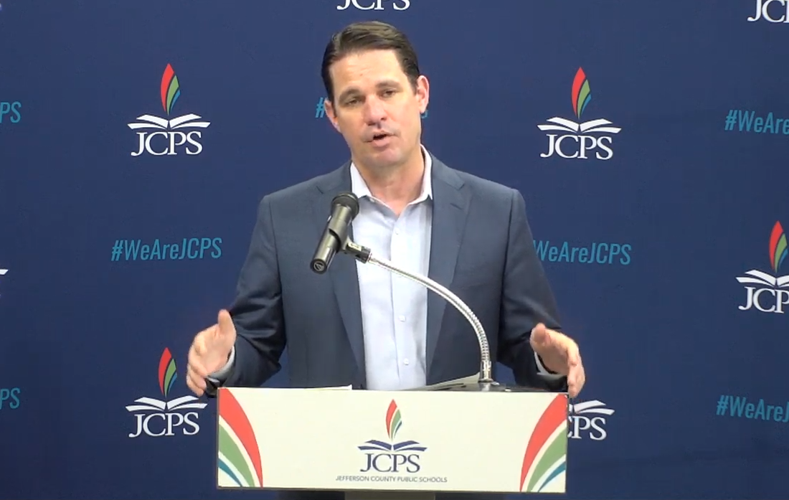
During a Friday news conference, Pollio said he was pleased with the first week of nontraditional instruction at JCPS. Some 25,000 individual Google Meet sessions were held Tuesday, the first day of distance learning for JCPS, and by Wednesday, 80,000 district users had logged in to Google Classroom, and there were more than 23,000 active classes on the site.
“We think our platform rivals any platform,” he said.
Pollio has often said he hoped the district’s remote learning program would be considered a national model for other districts to emulate. Still, he said there’s always a concern that some schools are implementing distance instruction better than others in JCPS.
“With 155 schools, I think there will always be variance in how something is implemented, but we are confident looking at the plans that every school has put together an effective plan,” Pollio said. “Our goal with that is always to help those that are doing something very well, to teach and support those that may need a little additional support as well.”

Many teachers, too, now find themselves helping their own children through schoolwork at home while also trying to help their students with assignments.
The start of nontraditional instruction wasn’t entirely steady at first for Emilie Blanton, an English teacher at Southern High School whose children are in first and fifth grade at Blake Elementary.
But she says after a couple of days of working from home, she and her kids have found a groove with their distance learning plans. Her children are expected to work on assignments while she holds virtual office hours for her students, who total about 120.
Everyone – students, parents and teachers – needs some grace as JCPS and other school districts throughout Kentucky and the U.S. find their footing with remote instruction, Blanton said.
JCPS has done well navigating uncharted waters so far despite some complaints she’s seen on social media, she said, adding that teachers are “really trying our best” and have been frequently reminded to “do not harm” if students struggle with distance learning in what can be a traumatic time for many given COVID-19’s impact.
“I understand it didn’t go perfect for some people the first day, but it’s not like we’re going to look at it and be like, ‘Well, your family didn’t get it the first day, so we’re just going to fail your kid,’” Blanton said. “We’re not going to do that. We’re obviously going to work with families as best we can.”
For her classes, Blanton has tried to limit her lessons to about two hours of schoolwork per week. So far, she’s asked her students to pick assignments for a “passion project,” explain why they chose their topics and send her their best “dad jokes.”
She’s also been reading poetry every day on her personal Facebook page and posted the videos on her Google Classroom for her classes to watch. She also uploaded a video explaining how she expects her students to turn in their work.
Bobbijo Kingery agrees with Blanton and says the district needs leeway to work out the kinks in its distance learning plan.
“I think the first week is going to be rough until parents get the hang of the routine,” she said.
Kingery’s daughter, an eighth grader at Stuart Academy, must check in with her teachers four times a day, either via videoconference, email or text to let them know how she’s doing on her assignments. Much of her work involves material she’s already learned in class, and one of her teachers is having her class come up with their own play after reading Shakespeare.
Kingery said they’ve been practicing online through videoconferencing.
“One good thing that I like is that they’re not trying to teach them anything new that would hinder them moving forward,” she said.
Still, Kingery wonders whether she’s doing enough at home to get her daughter ready for high school.
“I hope I’m teaching my child enough from home that when she goes into high school next year that I’ve done my part, and I think that’s what a lot of parents are afraid of,” she said. “I talked to another parent today who said the same sort of thing.”
Robinson said that’s one of her “biggest fears” as her fifth-grade daughter prepares for middle school. She also worries about other students at key transition points in their academic careers.
“What is the proactivity that’s happening right now with schools that are saying, ‘We can get a bunch of sixth grades who aren’t ready. We can get a bunch of ninth graders who aren’t ready, and what are we putting in place to make sure that we identify those kids as soon as possible and that we make sure that they receive everything that they need?’” Robinson said.
Pollio said there are no plans to relax the district's graduation requirements at this time.
"We believe we are having interactions with our seniors that are necessary to get them to where they need to be," he said.
Simply getting children to learn at home can be a struggle for some parents, particularly those whose kids have special needs.
Cindy Cushman says she’s had a difficult time getting her son, a senior at Iroquois High, to focus on schoolwork, even with strategies shared by his teachers.
“It just crashed and burned the first day,” she said.
After working on assignments for about 10 minutes Tuesday, he got frustrated and left the room.
“At that point it was like no learning is going to happen today,” she said.
Cushman, who is preparing for Easter services interim pastor at Corydon Presbyterian Church in southern Indiana and learning to minister to a congregation from a safe distance in the days of COVID-19, believes her son would do better with the structure that he’s given at Iroquois rather than trying to learn from home.
She also worries that students who already struggle in school will fall further behind academically.
“Achievement gaps are going to widen with this,” she said. “I don’t see how they can’t. It’s not anybody’s fault. I’m not blaming the district, but they’re going to have to figure out how to deal with that when everybody comes back.”
Pollio said Friday there will be “multiple opportunities” for students to catch up academically if they don’t participate in nontraditional instruction.
Even those who are certified to teach have faced some difficulty when trying to teach their children.
For Blanton, helping her fifth-grade son through math concepts she’s not familiar with has been challenging at times.
“I’m not a math teacher, and there were times when I was like, ‘I know the answer. I don’t know how to tell you how to find the answer,’” she said. “… Overall it wasn’t anything huge and drastic.”
She’s been asked by several of her friends, some in different states, for advice on teaching their kids from home as districts across the country cease in-person instruction, some for the rest of the 2019-20 school year.
Her biggest piece of advice, she said, is to break down assignments into manageable steps.
After seeing some of the assignments other districts have asked students to complete from home, she’s more confident that JCPS has struck the right balance between rigor and flexibility.
“That’s actually where I’ve gotten really frustrated with some of the other districts,” Blanton said. “I’ll be like, ‘I don’t know why anybody would assign this,’ and then I’m like, ‘They probably were told to by an administrator because this is wildly inappropriate for a homeschooling atmosphere.’”
Access to resources like the internet is also a concern for parents.
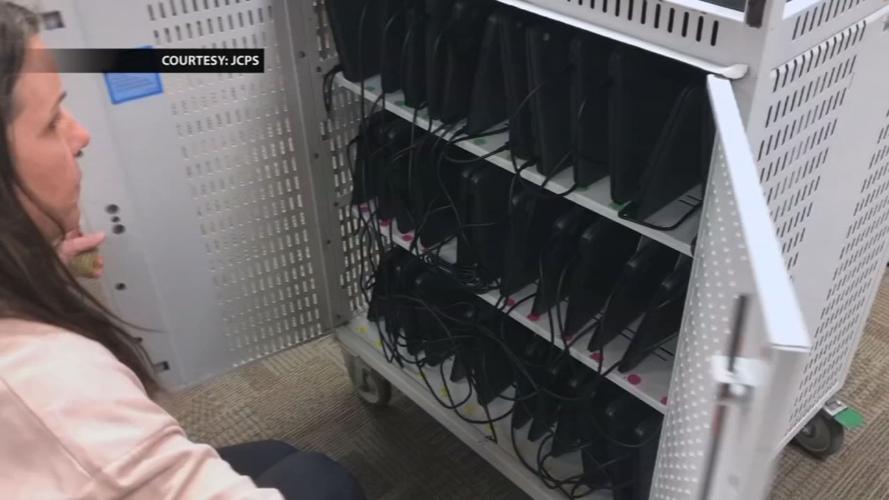
Pollio said JCPS expects all 20,000 households who’ve requested Chromebooks from the district to get them by early next week. By the end of the week, the districts hopes to begin sending internet hotspots with unlimited data from T-Mobile to families of students with special education needs, he said.
“These are big gamechangers for us,” he said.

Charter has offered free Spectrum wireless internet to homes with students and teachers.
But there’s a caveat: They can’t have any outstanding bills owed to Charter.
Spokesman Michael Pedelty said Charter is not providing the number of homes serviced in particular areas, though he said demand across the country “has been strong.”
“If you are a former customer, your outstanding balances must be current,” he said in an email to WDRB News.
Robinson said she hoped nonprofits and other groups would step up to help families pay off their debts to Charter so they can get the most out of the district’s nontraditional instruction program.
“We have way too many smart people that are in the city and within JCPS,” Robinson said. “Why are we always behind?”
Copyright 2020 WDRB Media. All Rights Reserved.


