

LOUISVILLE, Ky. (WDRB) -- An introductory digression: I wish I could tell you that every time I sit down behind the desk to have a conversation with Rick Bozich, the resulting discussion is the product of hours of thought and research and meditation on insights.
That's not usually the case. It's why I have a lot of respect for many of the commentators you see on national sports shows, who can clearly make a concise point and have it stick with you. Not everybody can.
When the great Tony Kornheiser started Pardon the Interruption, he stopped writing columns. He realized, rightly, that to do TV well is a full-time vocation in itself (not to mention doing a radio show or podcast, which also is a full-time vocation). He writes the intros to PTI (on a yellow legal pad), compiles the topics in consultation with Mike Wilbon and the show producers and still is fantastically insightful when it comes to the actual on-air discussions.
It's a lot harder than it looks. Usually, by the time I write topics (with the input and often leadership of Bozich) and piece together photographs for video elements for our twice-weekly "Overtime" webcast on WDRB+, preparing to actually discuss those topics is a strictly wing-it proposition.
Which brings us to the subject of today's column. On Monday, Rick and I were talking about "what success looks like" for a Louisville basketball team heading into three games where they are given a win probability of less than 10%.
Rick said, "Don't get blown out. ... I guess the best I could hope is that they steal one of the three, somehow."
I said, "It's tough when you're defining success by anything other than winning games. I do think they need to be competitive."
But the discussion probably deserved a bit more of a foundation than we were able to give it in a three-minute segment because it gets at the heart of a couple of things I think we confuse in our sports discussions these days: standards and expectations.
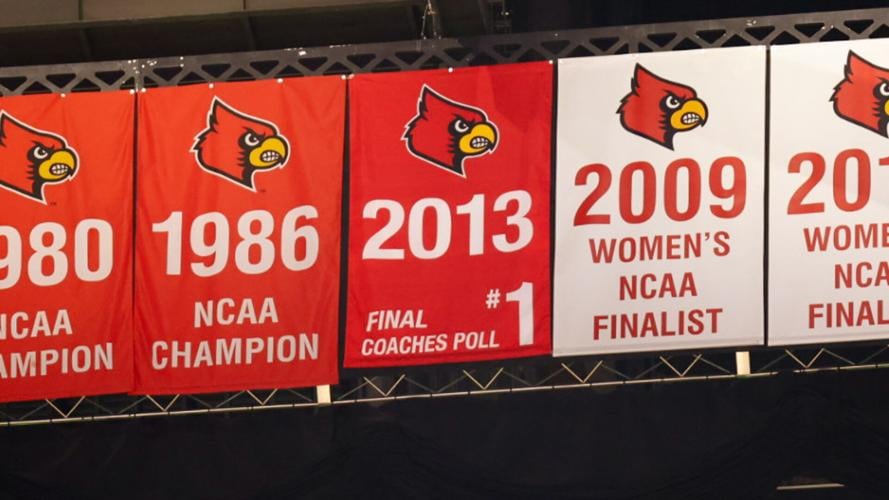
Let's start with standards. Louisville basketball has a standard. It's one of the reasons the past years have been so maddening for fans, because they have those standards firmly in mind. Recently, the Associated Press put out its rankings of the most-ranked programs in its college basketball poll's history.
Louisville ranked No. 6. Louisville's standard is to be a top-10 program in the nation. Its coaches are judged on Final Fours. Its teams are judged on NCAA Tournament performance. And the yardstick is a standard of achievement at the highest level in the college game.
That's the standard. No different from if you had, say, a five-star restaurant which had a standard of having the very best in food and service. If a chef departs and goes somewhere else, you don't throw out the standard just because the leadership changes. The next meal you have at that restaurant is going to be judged how? Against every other meal you've had there and against the standard of the best.
That's how standards work. The restaurant sets the standard. The customer judges the restaurant against that standard. The standard doesn't take time off. Chefs may come and go, staffs may change. The standard remains. Standards are set by creating goals, and processes to reach them.
But let's say the new chef just isn't as gifted. Or the old chef took a bunch of the kitchen staff, or otherwise left dysfunction that took some time to work through.

A StarryAI illustration of "The Thinker, in a Louisville basketball uniform" edited via the Prisma app.
This is where expectations come into play. The customer comes in and gets a bad bowl of soup. He doesn't care about what issues they're having in the kitchen. He came to a restaurant that upholds the highest standards, and it didn't meet them.
If that happens enough, business will fall off. The expectations of customers for the place will decline.
The standard hasn't changed. But the ability of the restaurant to meet them has, and it pays the price in lowered public expectations.
That's your interplay. We saw it when Denny Crum was struggling at the end of his tenure. We saw it when Chris Mack failed to make the NCAA Tournament. One time.
Louisville is a five-star basketball program. Still. And fans (and media) can't really see what's going on in the kitchen. We just all know that, right now, the soup isn't good enough.
The standard of Louisville basketball is that it is on a par, or really close to being on a par, with Duke and North Carolina. It is better than Wake Forest.
But the expectation right now, for anyone who has been paying attention, is nowhere near that high.
And that's a problem. When expectations don't align with standards, you have issues. And that's something that, in my business, I have to pay closer attention to.
It's one thing to cover the soup game. It's another to be paying for the unsatisfactory soup. Does that make any sense?
The job of the reviewer isn't to say, "Well, they're on the way to fixing the soup so we need to show some patience" or to say, "Well, these people in the kitchen are really nice and they came into a tough situation so you need to just choke this soup down the best you can." Or, even, "I've always written that this was a great restaurant so I have to defend my past opinions instead of the reality in the bowl in front of me."
No, we have to say what it is. The standard of Louisville basketball is that it will stand in and compete with these teams, even if they are highly ranked.
The expectation of that, however, at the moment, is that it is probably not able to do that.
Now, basketball is a whole lot different from soup. We're dealing with human dynamics, not static ingredients. But many of the principles, of standards and holding to them, are the same.
A couple more quick things about standards. First, they often are as much about process as outcome. And a lot of us aren't really privy to the process. We can only see the outcome. And when the outcome doesn't meet the standard, all we can assume is that the processes must not meet it either. That may not always be the case. Is it the case with Louisville basketball right now? I have no idea.
Second, from a personal standpoint, much of the literature (and you can google it) would tell you that standards are something we should set for ourselves, expectations are what we should have of others. One key to a happy life, then, is keeping our standards high and our expectations low.
If that were completely true, Louisville basketball fans would be some of the happiest people on earth. So, I don't know what to tell you about that.
I know this is all too simplistic. Maybe it's why comparing life to basketball isn't always a solid practice.
But it does bear repeating once in a while. In the media, a lot of what we deal with are expectations and performance against them. It's a daily grind, and a somewhat shortsighted task.
That doesn't mean, however, that we should ignore the standard, no matter how far away it seems from the present reality.
Related Stories:
- OVERTIME | With tough schedule stretch ahead, how does success look for Louisville?
- BOZICH | Stats say Louisville improved; record says not enough
- BOZICH | N.C. State ends Louisville's winning streak at one, 89-83
- CRAWFORD | Facing rock bottom, what can Payne and Louisville do to dig out?
Copyright 2024 WDRB Media. All Rights Reserved.


