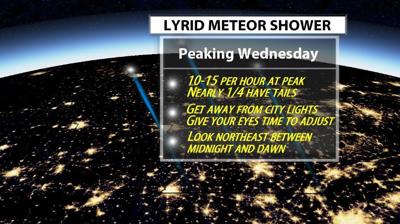

Activity from the Lyrid meteor shower is starting to pick up! It looks like the technical "peak" in activity will be Wednesday night/Thursday morning, but activity usually starts to pick up around April 16. At the peak of activity, this shower only produces about 10-15 meteors per hour, so though you may be able to see a shootings star now, they will be few and far between. You need to get away from all lights (including light from the city) and give your eyes about 20-30 minutes to adjust to the darkness. Look toward the northeast between midnight and dawn for the best chance to see a show.

There's always a chance the Lyrids will provide you a better show than expected. Lyrids in particular are known for random outbursts of more meteors. If you do see one, watch for a train or tail. Nearly a quarter of all Lyrids meteors have a trail that glows behind them.
Meteor showers happen when Earth crosses through the path of a comet. The comet has left behind dust and debris that hits Earth's atmosphere and burns up as it falls. That's what we see as "shooting stars." Comet Thatcher is specifically responsible for the Lyrid meteors, but as EarthSky shares, we don't actually have a picture of Comet Thatcher. "Its orbit around the sun is roughly 415 years. Comet Thatcher last visited the inner solar system in 1861, before the photographic process became widespread." If you do the math, we won't see Comet Thatcher until the year 2276! If you see a shooting star this week, let us know!


