




LOUISVILLE, Ky. (WDRB) -- School districts across Kentucky are considering how to comply with a state law that deals in part with gender identity, sex education and student pronouns.
The Jefferson County Board of Education's Policy Committee met Monday night to talk about how Jefferson County Public Schools will follow Senate Bill 150. The committee had a lengthy discussion over two draft versions of policies and how to move forward.
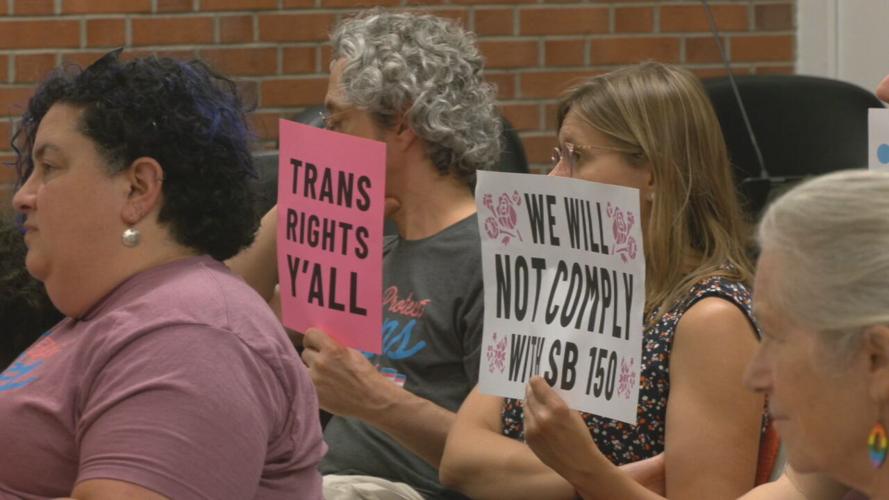
Before the meeting, a group of people held a protest outside Van Hoose Education Center in opposition of SB 150. Among the crowd, Justice Chenault, an incoming fourth grade student who identifies as nonbinary.
Board Member Chris Kolb, and chair of the policy committee, speaking about the messages he’s received from community about SB 150, and the the two policy draft versions the committee will discuss. pic.twitter.com/Xj9Np8ZaLb
— Katrina Nickell WDRB (@knickelltv) July 10, 2023
"That is just not going to make me feel not as safe at school," Chenault said, adding that the legislation could keep teachers from using their preferred pronouns. "I assume my teacher will use my correct pronouns, but I believe some of my next teachers will maybe not respect them."
The policy committee looked at two draft versions of policies to consider. The first version includes a statement of concern, written by the district, saying SB 150 targets transgender students. It also follows guidance from the Kentucky Department of Education, which said based off of lawmakers' use of the word "or," districts can choose what part of the legislation to enforce.
The second version states that SB 150 violates federal laws, including Title 9. The JCBOE's attorney, Kevin Brown, recommended the first version as legal challenges are expected.
"I do believe that our version number (one) will serve us well during this time when we are still trying to figure out what the law is or hopefully will be," said Brown.
While several committee members favored the second version, the group decided to let the board decide between the two.
"Once Kevin (Brown) has given us his legal opinion, and we go against it, we're really putting ourselves, the district's putting ourselves, in a bad position, I think," committee member Warren Shelton said.
But waiting and unable to take a full stance leaves students like Chenault anxious.
"I hope they will say we will not comply," they said.
The committee said it can revise the policy as needed.
The board is expected to discuss the matter at its meeting later this month. A policy has to be in place by Aug. 15.
In a statement, the Family Foundation of Kentucky said school districts "must fully comply" with the legislation.
"School districts and officials who refuse to abide by the opinion willingly violate the law, ignore Kentucky's courts, and subject themselves to legal consequences," the statement continued."
SB 150 also bans gender-affirming care for transgender youth, bans schools from requiring staff to use a student's preferred pronouns, limit the teaching of certain sex-related topics and requires school policies on bathrooms, locker rooms and showers.
In late June, a federal judge temporarily blocked part of the new state law prohibiting the use of puberty blockers and hormones on minors. Seven transgender children and their parents sued to block the law, arguing it violates their constitutional rights and interferes with parental rights to seek established medical treatment for their children.
Last week, Kentucky Attorney General Daniel Cameron filed an emergency motion asking a federal appeals court to lift the injunction. In his motion, Cameron argued that parents have a “fundamental right to make decisions concerning the medical care of their children” but it is only a “general right to make decisions among legally available medical treatments.”
Additionally, Cameron called the Kentucky Department of Education's interpretation of the law "flawed," and that school districts need to implement the law as intended.
The KDE issued guidance in June, saying lawmakers' use of the word "or" instead of "and" in some of the law's language meant districts could choose what to enforce. Cameron issued a 13-page opinion saying that guidance is wrong. He said districts don't have an option, and must enforce all parts of the law.
But Education Commissioner Jason Glass said in a statement that matters of opinion regarding law are not for Cameron to decide, but the courts, adding that lawmakers may also provide clarity in the next session if they want to correct anything.
Related Stories:
- Kentucky AG challenges federal judge's blocking of state law banning transgender youth treatment
- Kentucky AG calls KDE's interpretation of Senate Bill 150 'flawed,' says schools must enforce law
- Federal judge blocks part of Senate Bill 150 due to lawsuit filed by transgender children, their parents
- State guidance on Kentucky gender and sex ed bill sparks new debate
- Group calls on JCPS to disregard Kentucky bill they call an attack on transgender students' rights
- Lawsuit targets Kentucky ban on gender-affirming care for youth
- Students rally for LGBTQ support, improved services at University of Louisville
- JCPS figuring out how to implement Senate Bill 150 into classrooms starting next school year
- Confusion surrounds new Kentucky law restricting sexual education material, pronoun usage
- Trans-activists want charges dropped after disrupting Kentucky House chamber during vote
- ACLU of Kentucky plans lawsuit over new law banning gender transition for those under 18
- Kentucky lawmakers override Beshear veto of sweeping transgender bill
- Kentucky bills regulating school content, preferred pronouns to lead to classroom changes
- Kentucky governor vetoes GOP transgender measure
- 19 arrested as hundreds protest Kentucky lawmakers' vote to override governor's veto of transgender bill
- Ky. Senate passes bill banning gender-affirming care for transgender youth
Copyright 2023 WDRB Media. All Rights Reserved.