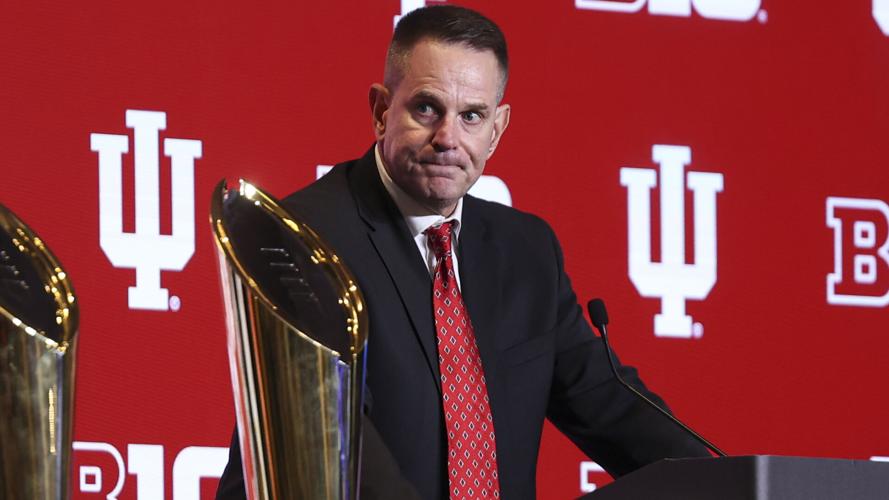

BLOOMINGTON, Ind. (WDRB) — Curt Cignetti spent last season chasing a national championship.
This season, he's chasing something considerably more dangerous. Complacency.
Or, as Cignetti put it this summer, he's "stalking" it.
Indiana football has run out of mountains nobody believes it can climb.
The Hoosiers went 16-0. They beat six top-10 teams. They won the Big Ten. They won the national championship. They turned "Google me" from an introductory boast into an unnecessary instruction.
Everybody knows Curt Cignetti now.
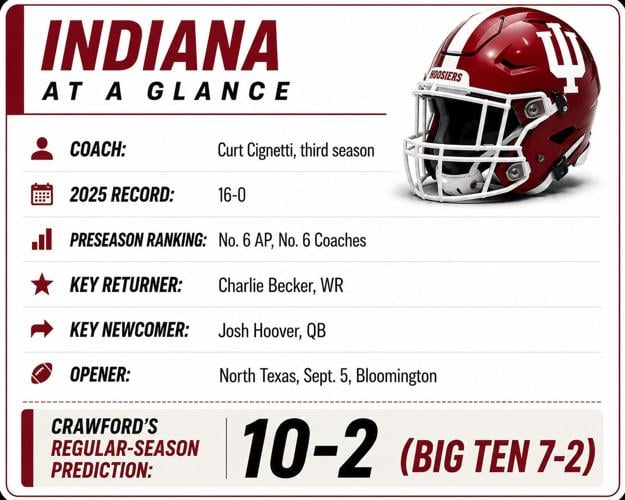
The defending champions begin this season ranked No. 6 in the Associated Press poll, which suggests a healthy amount of skepticism about everything they lost.
But even that ranking comes with an interesting footnote. Indiana received eight first-place votes, third-most in the country and more than three of the five teams ranked ahead of it.

Apparently some people believe the Hoosiers are going to be pretty good again.
So what do you do for an encore after perhaps the most improbable national championship in college football history?
Cignetti's answer is remarkably unsentimental. You start over.
"When you get to the top, you don't want to leave the top," Cignetti told Fox Sports recently. "But the only way to stay on top is to start at zero again."
His analogy is building a house. Dig the hole. Pour the foundation. Build it again.
Which sounds terribly unfair. Indiana already built the house. It was spectacular. There was a national championship trophy in the living room. Now Cignetti wants everybody back outside with a shovel.
What this team is
Different. And, Cignetti hopes, exactly the same.
Fernando Mendoza is gone. So are two 1,000-yard running backs, receivers Omar Cooper and Elijah Sarratt, tight end Riley Nowakowski and All-American linebacker Aiden Fisher.
You don't lose that much from a national championship team and pretend nothing has changed.
But Cignetti isn't trying to reproduce the personnel from last season. He's trying to reproduce the football.
"We don't turn it over, we play smart, all three phases play off each other, we stop the run, we run the ball," he said.
The faces change, Cignetti said. The formula doesn't.
And there are enough remains of a national championship scattered throughout this roster to make that plausible.
Three starters return from an offensive line that was a finalist for the Joe Moore Award, led by first-team All-Big Ten tackle Carter Smith. Center Drew Evans and guard Bray Lynch are back, and Wisconsin transfer Joe Brunner brings two years of starting experience.
The two 1,000-yard backs are gone, but the cupboard isn't bare. Boston College transfer Turbo Richard rushed for 749 yards and nine touchdowns last season. Khobie Martin averaged 6.5 yards per carry while rushing for 506. Lee Beebe averaged 7.7 before an injury ended his season after three games and rushed for 885 yards at UAB the year before.
Charlie Becker returns after catching 34 passes for 679 yards, and Cignetti supplemented the receiving corps with Michigan State transfer Nick Marsh, Michigan transfer Tyler Morris and Tulane transfer Shazz Preston.
The defensive front lost both starting ends but returns Tyrique Tucker and Mario Landino inside after they combined for 11 sacks. Leading tackler Rolijah Hardy is back at linebacker after making 102 stops. Isaiah Jones, who made 78 tackles as a backup last season, steps into a larger role after the departure of All-American Fisher.
And the secondary could be the strength of the defense. Cornerback Jamari Sharpe and safety Amare Ferrell return, with Penn State transfer A.J. Harris and Wisconsin safety Preston Zachman joining them.
There is plenty of talent here. There is experience. There is financial investment. There is coaching.
What Cignetti has to recreate is the thing that doesn't show up on a depth chart.
Consistency.
Last year's team, he said, separated itself by its day-to-day consistency. It stacked meetings. It stacked practices. It went into every game with the proper mindset and respect for the challenge.
That's why Cignetti is stalking complacency.
The championship trophy is proof of what Indiana did.
It doesn't do anything for Indiana now.
Why it could work
Curt Cignetti. Next question.
At some point, continuing to search for reasons Cignetti's success can't last becomes more stubborn than skeptical. He's 27-2 in two seasons at Indiana. He just went 16-0.
His team beat six top-10 opponents last season, including teams ranked No. 1, No. 2 twice and No. 3.

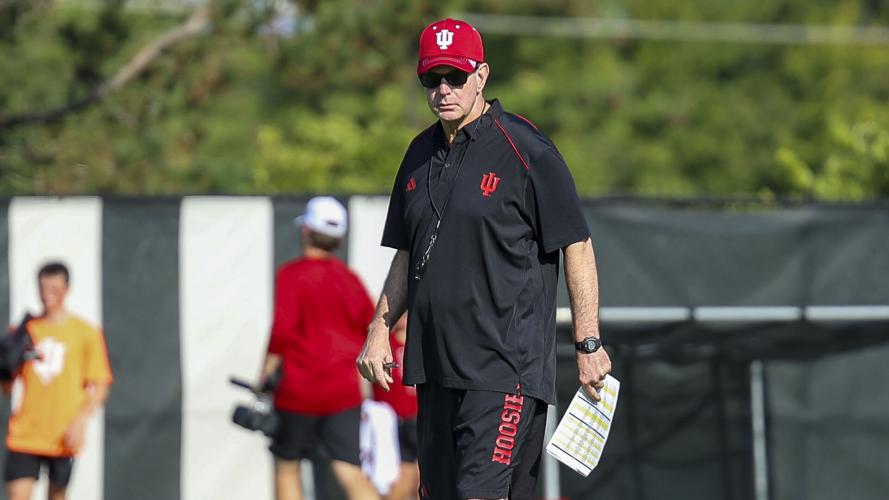
Indiana coach Curt Cignetti at the first practice of 2026 fall camp. He says he's "stalking complacency" in his defending national championship program.
He has retained one of the best staffs in college football. Indiana has given him the financial resources to compete for players. And Cignetti has a long track record of taking transfers, putting them into his system and getting more out of them.
Perhaps most importantly, Indiana now has something Cignetti didn't inherit when he arrived.
Institutional memory.
There are players in the locker room who know what a championship practice looks like. They know what the meetings look like. They know what Cignetti means when he talks about standards because they've seen those standards produce a trophy.
That's important when you're incorporating 17 transfers.
Cignetti talks about getting everybody to "think alike." The veterans can help with the translation. And the program isn't changing its personality to accommodate its success.
Cignetti said his Monday morning meeting is essentially the same one he conducted eight years ago. Practices are similar. The messages are similar.
"We have a way of doing things," he said.
It's difficult to argue with the results.
What could go wrong
Josh Hoover could give the football away, and that's harsher than it's intended to sound.
Hoover is a good quarterback — he completed nearly 66% of his passes for 3,472 yards and 29 touchdowns last season at TCU, and Cignetti calls him a natural passer who processes quickly and throws accurately. He also threw 13 interceptions, and that number gets your attention at Indiana.
Perhaps nothing defined last year's championship team more than its refusal to beat itself. The Hoosiers played smart, ran the ball, played defense and won situational football. They didn't turn it over. Cignetti listed that first this summer when explaining what his successful teams have in common.
"We don't turn it over."
That's the standard Hoover inherits. He doesn't have to be Fernando Mendoza. He doesn't have to win the Heisman Trophy. He doesn't even have to produce Mendoza's numbers. But he probably has to play the position with something approaching Mendoza's discipline.
Cignetti has made clear Indiana isn't planning to put the ball in Hoover's hands and tell him to outscore everybody; the Hoosiers intend to give him a running game, a defense and special teams. The quarterback's first job is not to break the machine.
Indiana can survive fewer yards from Hoover than it got from Mendoza. It can survive fewer spectacular plays.
It probably can't survive a bunch of interceptions against the best teams on this schedule.
And eventually Hoover will have to do more than avoid the losing play. He'll have to make the winning one, the way Mendoza so often did in the final three or four minutes last season. Hoover hasn't had the chance to show that at Indiana yet. Soon enough, he will.
And that brings us to the other thing that could go wrong.
The schedule waits until Game 7 to ask a championship-level question.
Indiana opens with North Texas, Howard, Western Kentucky, Northwestern, Rutgers and Nebraska. The Hoosiers should be 6-0.
Then Ohio State comes to Bloomington. A week later, Indiana goes to Michigan. After Minnesota, USC comes to Bloomington. Then Indiana goes to Washington before finishing with Purdue.
There are four games in that second half — Ohio State, Michigan, USC and Washington — in which turnovers and quarterback play could be the difference between another playoff run and something considerably less.
The first six weeks should allow Indiana to establish what it is.
The next six will tell us how good it is.
What would a good season look like?
Get back to the College Football Playoff. That's the new standard. Not another 16-0 season. Not necessarily another national championship.
Those are absurd expectations for anybody, even if Indiana has forever lost the ability to call them impossible.
But last season changed the definition of success in Bloomington.
Ten wins should be attainable. Indiana should be in the Big Ten race. And when the College Football Playoff committee starts sorting contenders in November, the Hoosiers should be part of the conversation.
Indiana doesn't have to defend its national championship to defend what last season meant. One championship can be a magical season. Sustained contention is a program.
For six weeks, Indiana should look like the defending national champion.
It should run the ball. It should stop the run. It should play smart. It should protect the football. The faces have changed. The football shouldn't.
Then Ohio State comes to Bloomington. Then the Hoosiers travel to Michigan.
That's when we'll find out whether Cignetti has built another championship contender or merely a very good football team.
Eric's Pick: 10-2 (7-2 Big Ten)
I'm picking Indiana to lose twice and return to the College Football Playoff.
Three years ago, the remarkable part of that sentence would've been the College Football Playoff. Now it might be the two losses. That's how quickly Cignetti has changed the expectations in Bloomington.
I have enough questions about Hoover and enough respect for that second half of the schedule that I'm not predicting another undefeated season. But I have even more respect for what Cignetti has built.
The sequel doesn't have to be as good as the original to prove the original wasn't a fluke. Ten wins and another playoff appearance would do that just fine.
Now Cignetti has a different job: making a team that's already reached the top believe it's back at zero.
Indiana already built the house. Cignetti is still passing out shovels.
Copyright 2026 WDRB Media. All Rights Reserved.


