

LOUISVILLE, Ky. (WDRB) -- Now that we've talked a little bit about how exciting the upcoming eclipse will be, it's time to acknowledge the elephant in the room.
What happens if the weather is bad on Eclipse day?
WDRB Meteorologist Hannah Strong has the logistics for you.
Typical weather in the Ohio Valley area in early April is anything but typical.
Throughout the years, we've seen everything from severe thunderstorms to snow.
But, some good news! Based on climatological normals, the temperature in our area is projecting to be in the 60s on April 8. Not bad!
In the past years, the temperature has been as warm as 85 degrees and as cold as 24 degrees on that day.
Another thing to think about is rainfall. Remember - April showers bring May flowers!
Over the years we've been tracking rainfall, April 8 has been dry 55% of the time.
There have been a few years with more than an inch of rain, but the average rainfall for April 8 is a little more than a tenth of an inch if we do see rain.
We even saw snow one year, but thankfully, the odds are in our favor for no snow.
Our biggest issue is likely to be the clouds.
On average, about 60-70% of the sky is covered by clouds on an April afternoon in our region.
If the weather is showing to be bad, WDRB has a plan to make sure you still see the eclipse.
The WDRB Weather crew feels it is important to get this rare celestial event on air no matter what.
"We're not taking NASA's feed," WDRB Meteorologist Marc Weinberg said. "If I have to go to Texas so we can show this live on air, then I will go to Texas to show this live on air."
So, no matter where you are watching from, you will be able to see totality from where we are!
Total eclipse:
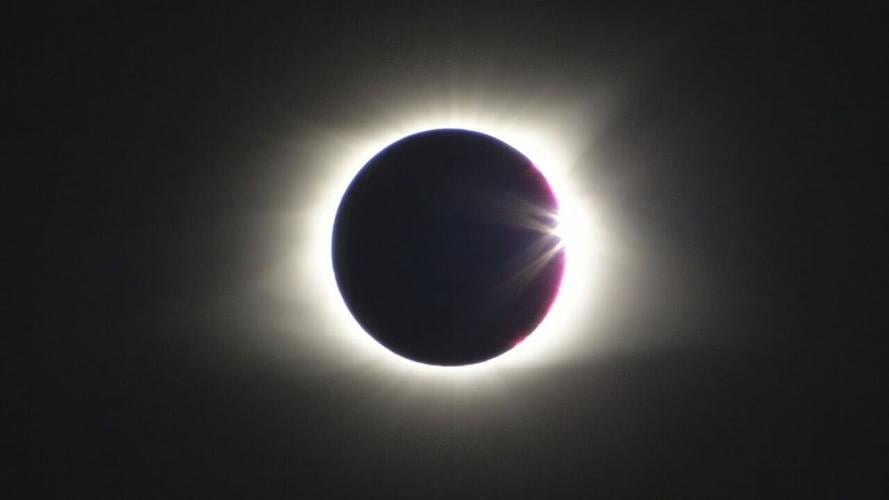
The eclipse will start in the Pacific on April 8 and first reach land over Mexico around 11:07 a.m. local time, NASA predicts. Then, it’ll cross over into Texas and move across parts of the Midwest and Northeast in the afternoon.
For much of the Louisville and southern Indiana area, the eclipse will start around 1:45 p.m. and will be at its max just after 3 p.m. The city of Seymour is ground zero to view totality. The city launched a website — SeymourEclipse.com — to help visitors and residents know where to go for the best glimpse as possible.
That line of totality runs from southwest to northeast, following a line including these cities:
- Dallas, Texas
- Little Rock, Arkansas
- Paducah, Kentucky
- Evansville, Indiana
- Cleveland, Ohio
- Erie, Pennsylvania
- Buffalo, New York
- Burlington, Vermont
A total eclipse will be visible within a 115-mile wide swath — the path of totality. Outside that path, you can still see a partial solar eclipse, where the moon takes a bite out of the sun and turns it into a crescent shape.
To learn more about the eclipse in Indiana, click here.
Eclipse coverage on WDRB:
You’ll be able to find all our Eclipse coverage on wdrb.com and some of that coverage involves you!
Do you have questions about the eclipse, how to watch safely, or how kids can participate? Send them to us! We will have a panel of experts answer your questions in one of our upcoming segments. You can send those to me on Facebook or X or you can email Hannah Strong: hstrong@wdrb.com
Related stories:
- Can't find eclipse glasses? Here's how to make a DIY Eclipse viewer to safely watch the event
- Eclipse countdown | What's the difference between totality and partiality?
- Eclipse countdown | Louisville area prepares for total solar eclipse in our area on April 8
- University of Louisville offering class preparing students for 2024's total solar eclipse
- Southern Indiana city expecting 3 times its population to converge for 2024 solar eclipse
- Indiana DNR preparing for total solar eclipse in April 2024
Copyright 2024 WDRB Media. All Rights Reserved.


